
NEW GLOUCESTER – Anna and John Hunnewell have spent thousands of dollars replacing corroded well-water systems at their home on Bald Hill Road in New Gloucester.
When the wellhead stops pumping, which has happened several times in the past dozen years – even on Christmas Eve, it’s usually due to the salt- and benzene-laced water that churns through the groundwater and up into their well. John Hunnewell knows the drill. He heads outside to the well cap, hauls out the 400-feet of line, and replaces it with a new pump that can cost several hundred dollars.
The couple’s well, along with 47 other private and commercial wells in the Upper Village of New Gloucester along Route 100, became contaminated in the 1980s when gasoline leaked from underground tanks at a service station in the village. The gasoline additive, benzene, made the water undrinkable.
Salt has also invaded the residents’ wells. The Maine Department of Transportation has operated a sand/salt shed in the village since the mid-1900s. Covered now, the salt was uncovered for many years and leeched into the groundwater. As a result By John Balentine
jbalentine@keepmecurrent.com
Anna and John Hunnewell have spent thousands of dollars replacing corroded well-water systems at their home on Bald Hill Road in New Gloucester.
When the wellhead stops pumping, which has happened several times in the past dozen years – even on Christmas Eve, it’s usually due to the salt- and benzene-laced water that churns through the groundwater and up into their well. John Hunnewell knows the drill. He heads outside to the well cap, hauls out the 400-feet of line, and replaces it with a new pump that can cost several hundred dollars.
The couple’s well, along with 47 other private and commercial wells in the Upper Village of New Gloucester along Route 100, became contaminated in the 1980s when gasoline leaked from underground tanks at a service station in the village. The gasoline additive, benzene, made the water undrinkable.
Salt has also invaded the residents’ wells. The Maine Department of Transportation has operated a sand/salt shed in the village since the mid-1900s. Covered now, the salt was uncovered for many years and leeched into the groundwater. As a result of the contamination, wells in the Upper Village have become unusable, and residents such as the Hunnewells have been unable to sell their homes, since no one wants to go through the headache of lugging water, changing broken well pumps and bathing in contaminated water.
“We’ve gone through washing machines, hot water heaters, six well pumps. It’s crazy,” John Hunnewell said. “Even with the filtration systems, because the contamination is in the outside wells so it’s still getting the corrosion. And you take them out of the well and they’re just corroded. The salt just eats it.”
All that is going to change, however, much to residents’ relief. Last Friday, despite 95-degree heat and high humidity, about 50 officials from all layers of government – local, county, state and federal – joined with a handful of residents to celebrate a groundbreaking ceremony of a new well, pump station/treatment plant and storage tank to be built beside the New Gloucester Fairgrounds, at a potable source of groundwater.
The steady source will feed a 10,000-foot-long network of water mains in Upper Village that will supply the 48 contaminated households as well as others along the line. According to Town Manager Sumner Field, the well buildings will be built concurrently with the mains starting this week. Crews overseen by Apex Construction, based in Massachusetts, will work through the end of fall and come back in spring with any remaining work. The system will likely be operational within a year.
Officials at the groundbreaking were at once celebrating the milestone of finally beginning to address the widely known contamination issue. But some were also apologetic it took the layers of government so long to come to the aid of the affected residents.
“I have waited for this day so long,” said Steve Libby, 20-year veteran of the Board of Selectmen and staunch proponent of the water system. “What a great day to live in New Gloucester. I want to start with an apology, an apology to the residents of the contaminated area. I’m sorry it has taken so long to get to this day. Your patience and long-suffering silence is a fine example in this age of it’s-all-about-me. Having said that, you deserved better. The road to get here, the path to find a solution, has not been a smooth highway. We had so many roadblocks, so many dead ends and so many hurdles to overcome.”
Libby directed much of the praise to Town Planner Paul First, whom he credited for keeping the town focused in recent years to finding a solution to one of the “roadblocks,” which was trying to find funding for the massive and costly project. The town eventually received sizeable grants from the federal U.S. Rural Development, Department of Environmental Protection and Cumberland County Community Development Block Grants. All told, New Gloucester taxpayers will pay about $900,000, depending on interest rates at bond issuance, of the estimated $2.4 million project.
Several government officials spoke at the groundbreaking. Virginia Manuel, state director for U.S. Rural Development, said: “I’m extremely pleased to know that the impact of this vital water project will make life easier for the residents in New Gloucester’s Upper Village, providing them something they haven’t had for about half a century now – clean, safe, reliable drinking water right from the tap. So congratulations to all of you who made this happen.”
Patricia Aho, commissioner of the Maine Department of Environmental Protection, said for 27 years, the department has been involved with the town to find a clean water solution for Upper Village residents.
“Today we celebrate collaboration, teamwork, and patience between a community, the state, and federal partners,” she said. “DEP values the opportunity to support this water system because we know an enhanced and improved environment supports a sustainable economy.”
State Rep. Ellie Espling, R-New Gloucester, who convinced the governor to sign legislation allowing the town to create a water district in order to qualify for state and federal funding for the project, said how the “long and arduous process” of dealing with governmental red tape yielded the “joyous occasion” of the groundbreaking.
“And for me personally, I have developed a deep concern for how fragile our natural resources are and have taken to heart the need to protect our groundwater from future contamination and the welfare of all our citizens,” she added.
While they were happy to take part in the groundbreaking ceremony, which ended with water from the tent canopy splashing down on audience members in an ironic twist that event organizer Steve Johnson of the New Gloucester Water District described as “a sign,” the Hunnewells will be more excited when their house is finally hooked into the new system.
“People who don’t have bad water don’t realize how big of a thing this is,” Anna Hunnewell said. “They don’t get it because they haven’t been weeks at a time without water. We’ve gone weeks where our system was down. So, the sooner the better. It’s a great thing; so exciting.”
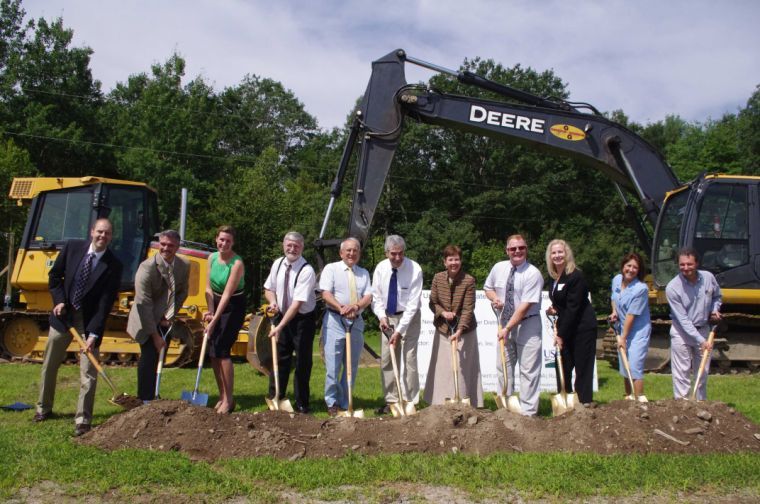 Local, county, state and federal officials gathered at the New Gloucester Fairgrounds last Friday to celebrate a groundbreaking of a new pumphouse and distribution network that will provide municipal water for Upper Village residents in New Gloucester.
Comments are no longer available on this story