
GORHAM – With drizzle stalling the hay harvest, Albert Erlon Mosher, 85, took time on Tuesday morning to tell the story of the farm his ancestors carved from a wilderness in Gorham.
His forebear, Daniel Mosher, was one of Gorham’s first settlers in 1738 and ownership of the family’s present day land traces back 243 years. At the gateway to Gorham, the sprawling farm stretches along routes 25 and 237.
The 160 acres at Mosher’s Long View Farm has provided for generations of the Mosher family. His forebears bought, the farmland in 1770 and its still active, producing hay along with sweet corn marketed to the public at its roadside stand at Mosher’s Corner.
“We all liked the land,” said Mosher, a former town councilor, explaining the farm’s longevity under his family’s ownership. “We appreciate the good things of farming.”
On Sunday, July 28, the Cumberland County Farm Bureau will recognize Mosher with its initial Heritage Farm Award, recognizing a farm that has been in a family for a long time, in a meeting at the farm.
“(The) Mosher Farm was one I thought of that traced back to one of Gorham’s first,” Ben Hartwell, president of Cumberland County Farm Bureau, said on Tuesday.
The honor follows the third annual Gorham Founders Festival on Friday and Saturday, July 26 and 27. Mosher and other descendants of Gorham founders will be honored with a special reception at the festival.
Sitting in his dining room on Tuesday, Mosher recounted his farm’s history. Books chronicling the family’s history and other records were spread on a long table.
Farming success over the decades and centuries represented hard toil in the fields, milking cows by hand and cutting wood for heat.
“You didn’t leave home for a weekend very often,” Mosher said with a smile.
The historic farm is one of a select few such operating Maine farms that has remained in the same family for two centuries or more, but the number is unclear. Smiling Hill Farm in Westbrook would be one. John Piotti, executive director of Maine Farmland Trust, said his organization has worked with two – one in Edmunds and another in Sanford.
“I suspect there are others, maybe a dozen or more statewide,” Piotti said.
Mosher’s farm in Gorham has long been a recognized landmark. Brenda Caldwell, a Gorham Historical Society archivist, said many times directions are given citing the farm’s location at Mosher’s Corner. “It’s very visible,” Caldwell said.
Daniel Mosher’s son, James Mosher, bought the present farm’s property, and his sons, Benjamin and Daniel, built the home in 1810, where Albert Erlon Mosher lives today.
The home contains 14 rooms and 10 fireplaces. An arsonist in 2004 destroyed the 110-foot-long barn with a modern-day wing that housed cattle and a milk house.
Mosher, a widower, has three children – Mark and his wife Rosalie live in Gorham; Tim in Seattle; and Elizabeth Hilton in Norridgewock – and eight grandchildren.
Mosher told how his ancestors carted produce, butter and meat to market in Portland. The house has a plastered room in the basement where butter was churned and cheese manufactured.
“They were quite self-sufficient,” he said.
His great-grandfather, Mark Mosher, sold wood to S.D. Warren, the paper mill in Westbrook.
Well before days of baled hay, farm teams hauled wagonloads of loose hay to Portland, where it was sold to horse stables in the city. Mosher’s father, the late Albert Erlon Mosher, born in 1893 and later a legislator, carried on the hay delivery business.
Mosher’s father established a dairy herd in 1926 and had a retail milk route in Westbrook and Portland. A wooden sign inside the entrance to the Mosher house advertised milk at 10 cents a quart, and Mosher said that was the delivered price.
Mosher recalled rising early each morning as a teenager to milk cows before going to school.
Gorham was once a large milk-producing town in the past century, with so-called milk trains on two separate railroad lines passing through Gorham daily.
“It was a real farm community,” Mosher said about Gorham.
Many Gorham farmers in those times would ship cans of milk by rail to dairies. Mosher recalled an incident when pranksters in Gorham greased the train tracks, causing difficulty for it to proceed uphill.
“Gorham was one of the busiest (railroad) stations in the state,” Mosher said.
The Mosher family delivered milk to homes until 1943. It switched its operation from retail to wholesale milk, selling milk to Oakhurst Dairy. Mosher built the herd up to 140 animals, but liquidated the cattle in 1987.
Mosher said his knees were “giving out,” and a doctor said if he kept up the demanding work of milking and caring for the cows, “I’d be crippled.”
The farm long had been well known for its cattle. He said his forebears herded their heifers overland to a summer pasture in Cornish before they had enough land cleared at home.
In earliest days, oxen had provided power for farm work. But on Tuesday, Mosher, the sixth generation at the farm, hooked a hay mower to a big tractor to be ready when the weather cleared.
Tractors replaced workhorses at the farm. He recalled as a youth riding along on his father’s horse-drawn sleds that removed snow from downtown Westbrook. Workers shoveled snow onto the sleds. He remembered Claude Daigle, who later operated a big potato farm in White Rock, as one of the shovelers.
Mosher still has all six tractors he ever owned, including a 1942 Oliver, the first at the farm.
“I put myself through college combining (oats and rye) with it,” Mosher said, who graduated Gorham High School in 1946 and University of Maine in 1950.
As a youth during World War II, Mosher spent summer haying days atop a “hayrack” while field hands pitched up forkfuls of hay for him to place on the load. One summer, he built 129 such loads of loose hay to be hauled and stored in the huge barn.
The farm once produced corn for canning factories in Gorham and grew corn for cattle fodder when it had the dairy herd. Mosher and his wife, Lorraine, who died in 2010, then started selling corn roadside.
“She loved selling corn,” Mosher said. “It was her project, she was a good manager.”
He said his son, Mark Mosher, 59, a master mechanic who is developing and building electric cars, handles raising the corn crop these days, while his son, Sam Mosher, will sell corn at the farm stand to earn college money. In September, Sam Mosher, representing the eighth generation to work at the farm, will be a sophomore at Rochester Institute of Technology.
As for a future generation taking reins at the farm, Albert Erlon Mosher said his son, Mark, is interested.
“He’s probably the logical one,” Mosher said. “He’s very capable.”
Mark Mosher said several factors, like estate issues and taxes, could affect the future of the farm. He said his wife, who teaches at Great Falls School, is interested in cut flowers and he wouldn’t rule out expanding the corn acreage. He also said his sister’s family is interested in marketing the farm’s produce at the farm stand.
“It’s an excellent place for a market,” he said. If the farm stayed in his family for another 200 years, “I would love that.”
 Albert Erlon Mosher, 85, is the sixth generation of his family that has owned Long View Farm in Gorham for 243 years. He’s descended from Daniel Mosher, who settled in town in 1738. Mosher will receive the first Heritage Farm Award on July 28.
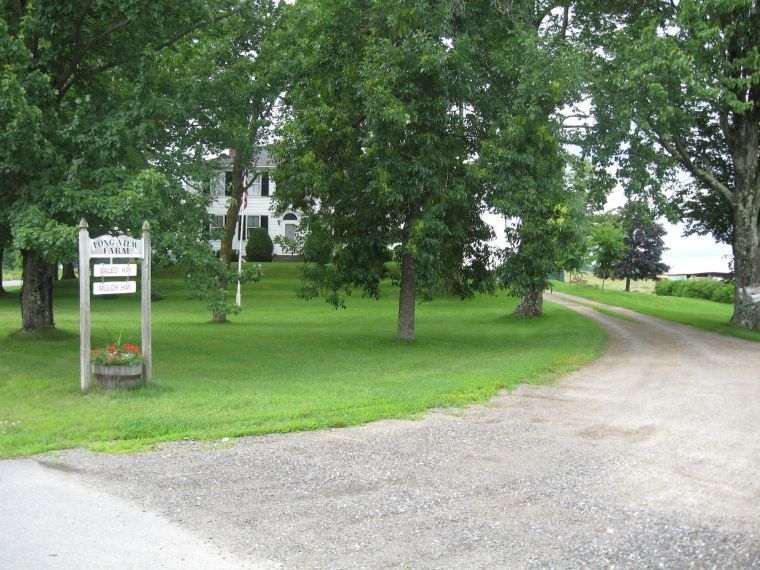 The historic Long View Farm is a landmark at the intersection of Main Street (Route 25) and Mosher Road (Route 237) in Gorham. The farm has been in the Mosher family since 1770.
Comments are no longer available on this story