
SCARBOROUGH – Despite completion just six weeks away of a $3 million project to remake Dunstan Corner in Scarborough, the area still has an image problem.
Or, more correctly, according to community planning think tank Sustain Southern Maine, it has an “imageability problem.”
Imageability, says Bangor-based planner Evan Richert, the lead consultant for Sustain Southern Maine, is “the quality of a place that makes it distinct, recognizable, and memorable.” It’s a place valued by residents, neighborhood-scale businesses, and the real estate market because it has distinct boundaries, focal points and landmarks, and pathways that people travel, particularly on foot.”
To hear some people in town talk, that doesn’t sound like anyplace in Scarborough. Town Manager Tom Hall has often said his is a town without a center. However, that wasn’t always true.
“There was a time when people didn’t bother going down Route 1 to Oak Hill from Dunstan,” he said at a May 21 public forum. “They didn’t have to, they had everything they needed right there.”
Getting back to that point – where Dunstan Corner servers the people who live in its immediate vicinity, not just the those passing through on their way to Old Orchard Beach – was the topic of the May 21 forum led by Richert and his crew from Sustain Southern Maine.
The work to reimagine Dunstan began in October 2010, when the Greater Portland Council of Governments won a $1.6 million Sustainable Communities Planning Grant from the U.S. Department of Housing and Urban Development. Under the motto “By choice not by chance,” the group has been busy since leading Sustain Southern Maine, a partnership it created of 41 municipalities, schools, nonprofits and planning agencies from Brunswick to Kittery.
In order to learn how to “absorb significant shares of most kinds of growth” through the next 25 years, Sustain Southern Maine eventually chose 10 pilot projects, including Dunstan Corner, to be what Richert calls “learning laboratories.”
“What you are seeing today is not a mini master plan for Dunstan,” Richert told a dozen Dunstan property owners and other interested residents at the May 21 meeting. “We would not be that presumptuous. But this may be a once-in-a-generation type of opportunity.”
Based on a meeting with property owners on April 9, Sustain Southern Maine drew up broad specifications for Dunstan’s future, visualized on two poster boards by Charette Design of Portland.
The three major steps include establishing a “gateway” intersection at Route 1 and the new entrance of Payne Road; creating a new “Main Street” just behind Route 1, where 31,000 cars pass daily, with a number of new commercial buildings to create “a village center feel;” and establishing as a “built-in residential base as the engine of growth” a number of new homes and apartments surrounding and mixed into the commercial sector.
The 100-acre study area has 36 lots, more than half of which are vacant or have commercial uses “only partially built.” The area from the Saco line to Haigis Parkway is home to 4,500 people, about 20 percent of Scarborough’s total population.
Although Sustain Southern Maine’s efforts in South Portland focused on absorbing 10 percent of the city’s projected growth in the next 25 years, primarily through a host of possible zoning changes and tax incentives, its efforts in Scarborough center on recreating the Dunstan village.
However, even when working within Scarborough’s zoning rules, Richert said, Dunstan Corner has the capacity, including lots already approved for the Dunstan Crossing subdivision, for at least 400-500 new homes, including multi-story apartment buildings. That, he said, does happen to be about 10 percent of the town’s projected growth over the next quarter-century.
In another contrast with Sustain Southern Maine forums in South Portland, where attendees urged planners to think of residential growth first, Dunstan boosters said the key is to establish coffee shops or other gathering places where people can “get to know each other.”
And, although Town Planner Dan Bacon said Hannaford has repeatedly blocked efforts to bring a competitor to the area, residents said a small grocery store is the best, first step in establishing a walkable neighborhood, or at least one dense enough to be served by public transportation.
“I meet people at the grocery store, but I have to drive there,” said resident Bob Curtis.
The biggest bone of discontent at the forum, however, was whether vacant commercial buildings now in the area can be rehabilitated, or if they should be torn down for something new. Bacon, meanwhile, suggested that like Haigis Parkway, the trick will be getting some developer to push the first domino, when many might see a safer bet on development dollars in Oak Hill, or along upper Payne Road, between Cabela’s and the Maine Mall.
Either way, said Richert, the future will be for locals to decide. Sustain Southern Maine may present a final poster of its findings and recommendations based on the May 21 forum, but otherwise its work is done.
“We’ve taken the opportunity to play around with your neighborhood for a day, to try and figure what might be done,” said Richert, “and now we leave it to you untouched, exactly as we found it.
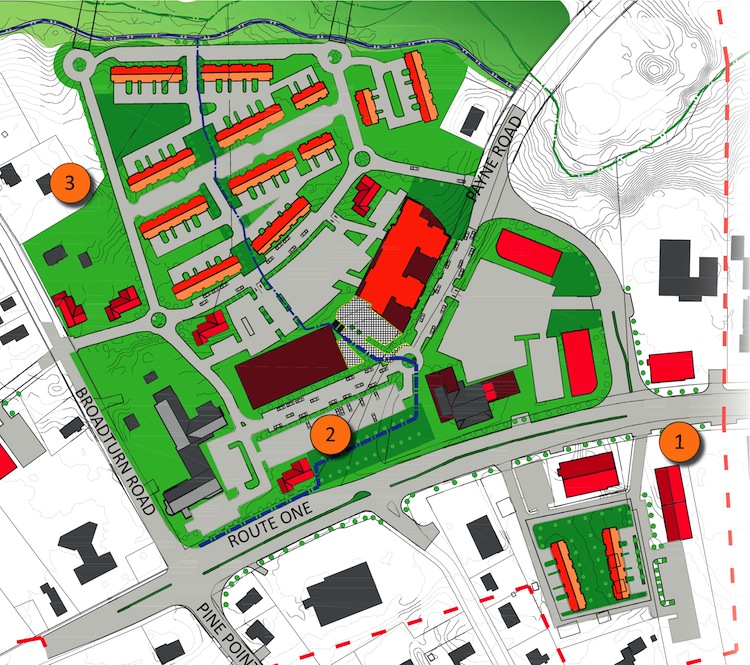 SCARBOROUGH – A Sustain Southern Maine proposal for the next quarter-century of development in Scarborough’s Dunstan Corner neighborhood, prepared by Charette Design of Portland, shows existing buildings in gray, along with (1) a “gateway” intersection at Route 1 and the new entrance of Payne Road, (2) a new “Main Street” just behind Route 1, with open frontage and proposed new commercial buildings, and (3) a “built-in residential base as the engine of growth” with new homes and apartments.
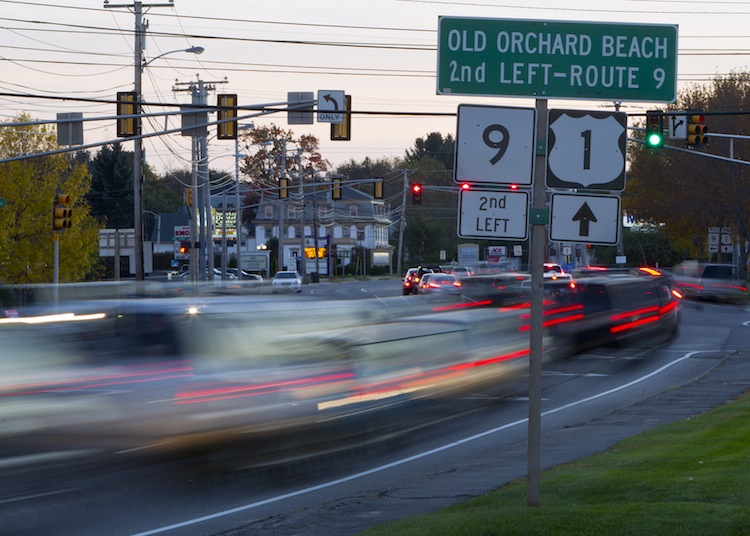 The future of Dunstan Corner was the subject of a forum last week in Scarborough. Community planning think tank Sustain Southern Maine is leading an effort to get resident input on how to make the area a true neighborhood.
Comments are no longer available on this story