
WINDHAM – The contaminated Keddy Mill complex in South Windham has become eligible for placement on the National Priorities List, also known as the Superfund list, opening the possibility that federal funds will be used to clean up the site.
The former paper mill on the Presumpscot River contains contamination from PCB, or polychlorinated biphenyl, a toxic substance once used in mechanical parts that was banned by Congress in 1979. The federal Superfund program addresses properties where remediation of toxic soil or water can cost millions, and where previous owners cannot be expected to cover the entire cleanup cost.
Placement on the priorities list is a three-step process to determine whether federal funds can be used for site cleanup. Keddy Mill has cleared the first hurdle by scoring well enough on an initial test determining eligibility for further consideration by the federal government.
The former mill, located at the corner of Main and Depot streets in South Windham, served as a paper mill and steel mill during its 100-plus year history. The large concrete building, which town officials say is starting to disintegrate rapidly, has sat unused for about the past two decades.
The Maine Department of Environmental Protection has been studying the site intensively in recent years. The department determined the scale of the cleanup exceeded the ability of the state-administered Brownfields program to pay. Due to lack of funding, the Maine DEP asked the U.S. Environmental Protection Agency to investigate the site for possible inclusion on its list of Superfund sites. The sprawling property achieved a score between 50 and 54 on a scale of 100 based on preliminary soil samples by the federal agency. A score of at least 28 is needed to be considered for the Superfund list.
Several rounds of testing have found significant PCB contamination in and around the dilapidated structure, which was fenced off in 2011 after investigators discovered the high PCB concentrations in the soil.
Now that the site has achieved initial consideration for the priorities list, the second step in the process requires Gov. Paul LePage to submit a letter of concurrence to the EPA agreeing to the cleanup funds. The letter is required since the state would be responsible for 10 percent of the cost of cleanup, which is expected to cost in the millions of dollars. The letter is due Aug. 1. Once the letter is in hand, the federal government – which awards Superfund projects twice a year, in October and April – could approve listing Keddy Mill as a Superfund site as early as October.
It could take years, however, before cleanup is fully achieved, said Meghan Cassidy, chief of Superfund technical and enforcement support for the U.S. Environmental Protection Agency’s New England Region, who addressed the Windham Town Council Tuesday night. She said there are many Superfund sites throughout the country and a limited amount of cleanup money appropriated annually by Congress.
If Keddy Mill is granted Superfund status, a full investigation of the grounds and nearby river would then take place, Cassidy said. The ultimate goal of the remediation – which could take 15 or more years, Cassidy added – is to remove an environmental threat and get the property back into residential or commercial use. But no development can occur until full remediation, which could include the adjacent riverbed, is achieved, she said.
“This site obviously has some reuse potential,” Cassidy told councilors. “Not only does this site pose some potential risks to human health and the environment, it clearly cannot be used in any capacity until the cleanup is done. And cleaning a site up for beneficial reuse is a very important goal of this program as well.”
Cassidy assured town officials that the town has no financial responsibility related to the cleanup. If the site earns Superfund status, Cassidy said, the EPA would begin a thorough investigation into previous owners to determine culpability and liability. The investigation would also look into vendors that may have delivered harmful products, such as the grease containing PCB used to lube electrical transformers in the mill. The likelihood of finding previous owners that both caused the toxic conditions and are still in business and able to contribute the cost of remediation is slight, she added.
“The original [Superfund] statute was built on the idea that ‘Polluter pays,’” Cassidy said. “If we know who the responsible parties are, they should be paying for the cleanup. Where there is no responsible party, the Superfund federal dollars are used to clean up abandoned sites.”
In Keddy Mill’s case, a preliminary title search has already been done by state officials.
“I think the expectation is there is nobody who is going to fully fund this cleanup,” Cassidy said. “I mean, this is going to be a very expensive cleanup.”
Windham’s town manager, Tony Plante, said the property’s owner, Portland-based real estate development firm Lumas, Inc., failed to pay property taxes on the Keddy Mill as of last August and the town has placed a lien on the property. Cassidy said Windham is not considered an owner of the property simply because it has placed a lien. Lumas, Plante added, is maintaining a fence around the property.
In October 2011, Lumas obtained the property at no cost from the previous owner, a New York City investment firm that planned to install condominiums on the property before discovering toxic waste during construction. A Lumas official said the firm used to own the Keddy Mill from 2000-2004 but didn’t use the property during that time.
Asked in 2011 why the Portland-based firm would purchase a heavily contaminated site that state and federal environmental officials expect will take years and millions of dollars to rectify, the Lumas spokesman said the company was already in the chain of title and wanted to be directly involved in negotiations with the government.
If federal dollars are brought to bear, Lumas could benefit by regaining use of the property after cleanup is complete. Cassidy addressed the possibility that profits could be made by Lumas at the taxpayers’ expense. She said the EPA would negotiate repayment of its investment prior to cleanup.
“If an owner doesn’t pay for the cleanup, they’re not going to get a windfall profit on it. That’s all part of the negotiations with the government,” Cassidy said. “We would recoup whatever the property is worth. If we clean up the property, and now it’s all nice and ready to go, we do have to prevent windfall profits.”
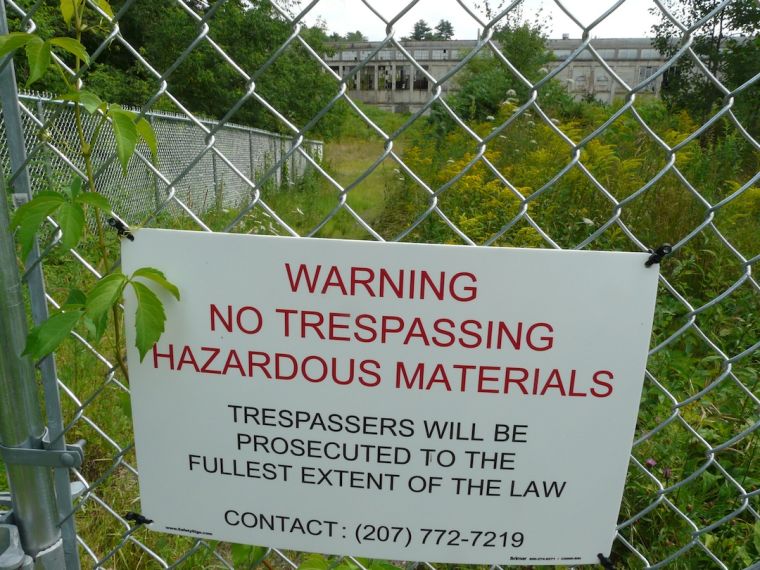 A fence was erected in 2011 to prevent trespassing on the former Keddy Mill in South Windham. The soil around the mill and concrete structure is contaminated with PCB. The site has met initial requirements for possible listing as a federal Superfund site. Superfund status could be achieved by October, meaning federal dollars could be used to address the pollution. File photo
Comments are no longer available on this story