
FREEPORT – For Ned Allen, Freeport Historical Society collections director, history not only provides a window into the past, but also provides a hint at our future. The 55-year- old Allen has spent a lifetime studying the hows, whys and what-ifs of history. When an individual donates an item, Allen will catalog the gift and enter it into the database of the society. He is also instrumental in preparing, researching and assembly exhibits.
At its headquarters at the Harrington House on Main Street, the historical society is featuring an exhibit entitled “Buttons, Rum and Rakes: Freeport’s Mercantile Past.” Allen recently took a few minutes to discuss his role as an archivist, the perils of working on the Sabbath, and a curious can of corn that came across his desk a few years back.
Q: What is the role of a historical society and why are they important?
A: Our mission is to preserve historical documents and artifacts relating to Freeport and to make them accessible to the general public. It’s not the objects themselves, but the stories they tell and the history they embody. I like to think of it as preserving communal memory. It’s important to understand where you come from. I use the analogy to your own personal life when you look back at yourself as a child, teenager and young man. You’ve grown through those processes and a historical society can provide that same perspective for a community at large.
Q: What is the most interesting or curious donation you’ve handled?
A: Since I’ve been here, the most interesting item was a jar of corn that was canned in 1890. It was in a glass canning jar made by a woman in August of that year. I’m not sure if it was edible or not, I’d have to be at the point of serious starvation to sample that.
Q: What are functions of the society that people can take advantage of?
A: Research and genealogy are very popular. Scholars are interested in our maritime history documents so there is a demand for that.
Q: Who were the early settlers and founders of Freeport?
A: Freeport was incorporated in 1789 and inhabited by farmers and also fisherman, as activity was centered primarily on the coast. Freeport was a part of “ancient” North Yarmouth, a six-town collection of land which once included Freeport, part of Harpswell, Pownal, Cumberland, Yarmouth, and of course North Yarmouth.
Q: Looking at the history of Freeport, what is something that surprises you or may go overlooked today?
A: What fascinates me is the robust shipbuilding business that existed up until the third quarter of the 19th century. People think of the downtown area as the heart of Freeport, but the coastal area was a major hub of activity for shipping. Of course, it made sense because it you were going to get anywhere it was by water, at least until the train arrived in roughly 1849. After that, the center moved further inland.
Q: What role did the railroad play in the development of Freeport?
A: It really solidified land-based transportation to the downtown as the most efficient means to travel and also transport goods. It also paved the way for quite a bit of industry in Freeport, shoemaking in particular.
Q: Your current exhibit features a look at E.B. Mallet?
A: He was originally from Pownal, inherited a large fortune and in the 1800s decided to put a large chunk of the fortune into developing Freeport. He built the infrastructure, started the shoe factory, and developed the quarries. He was instrumental in creating the village,
Q: Any history of Freeport would not be complete without a mention of L.L. Bean. How much of a role did Bean really play in the growth of Freeport?
A: Without question Freeport would not be what it is today without L.L. Bean. Bean celebrated its 100th anniversary, which was actually an anniversary for its signature walking shoe. You can find advertisements before 1912 from L.L. and his brother for the store. It was the 1980s when Bean’s started to take off in terms of worldwide. The town smartly realized that there was going to spectacular growth for the village, like it or not. Clearly that would not have happened if L.L. Bean had not of been here.
Q: What can the past of Freeport tell us about the future?
A: That’s a tough question, but I think Freeport is able to adapt maybe a little more effectively than other towns. A lot of towns seem to have a heyday and can’t move on.
Q: For the weekend historian, what are a few points of interest you would recommend visiting?
A: I would visit the Pettingill Farm and the old Harraseekett boatyard in South Freeport. The Pote House is another interesting choice as it has a great backstory. The house was moved from Yarmouth to Freeport after Greenfield Pote, who built the structure,was prosecuted for sailing on the Sabbath. He went on a long voyage and when he returned, he was fined by Yarmouth constables. Pote was so angry he moved his entire house to Freeport. Would he have been fined in Freeport? That I don’t know. Freeport may have been a little too unpopulated at that point to matter.
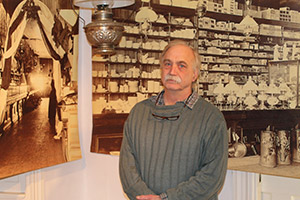 “What fascinates me is the robust shipbuilding business that existed up until the third quarter of the 19th century,” says Ned Allen, Freeport Historical Society collections director.
Comments are no longer available on this story