
WINDHAM – Since mid-December, a resourceful Windham High School student has been turning unwanted apples, oranges and other fruit into a tasty snack for 4-H farm animals.
With the blessing of school staff, Andrew Constantine, a junior from Windham, put out two cardboard boxes in early December into which students can toss their unwanted fruit after lunch.
Each Friday afternoon after school is out, Constantine collects a trash bag’s worth of fruit, including everything from raisins to apples, oranges, pears and kiwis. He transports the harvest back to his family’s Cartland Road farm to feed to his two horses, Breaker and Frank. If the week’s haul is more than the horses can handle, the fruit makes its way to the farms of his friends in 4-H.
The dozens of pieces of wasted fruit, he says, are due to a national policy in which the federal government requires schools to provide a fruit or vegetable to each student as part of a reimbursed meal. The meal costs $2.50 for high school students ($2.30 for elementary kids) and includes an entre?e, a carton of milk, a vegetable and/or piece of fruit.
If students don’t have a fruit or vegetable when they arrive at the cash register, they have to pay for each item separately, which could cost up to $5. To avoid the a la carte fees, the cashier will place a piece of fruit onto the child’s plate so he or she qualifies for the reduced meal price.
But according to Constantine and food service directors at the school, while the program aims to provide children with a healthy lunch, students who don’t want the fruit to begin with will usually chuck it into a nearby trash barrel, even before sitting down to eat the meal.
“When I put the bins out, it’s been insane how much fruit gets put in those bins on a weekly basis,” Constantine said. “The majority will come right out of the lunch line, and it’s like basketball to them – boom, right in the box.”
Constantine – described by his mother, Tina Constantine, as someone who hates to see any kind of waste – says his program is necessary since once the kids pick up the fruit in the lunch line, they can’t hand it back, per the federal school lunch program’s guidelines. Some, Constantine said, resent being forced to take something they don’t want or don’t like.
“They’re probably like me and are not fans of fruit,” he said. “They make us take the fruit, and I end up contributing to my own program because I don’t want to eat fruit, but they essentially force us to take it.”
The conscientious Constantine, who volunteers for the local library, food pantry and Civil Air Patrol, says the waste of fruit is also a waste of taxpayer dollars, which bothers him even more.
“The thing I’m really trying to show here is what they’re doing with this program is not working, and it’s costing taxpayers so much money,” he said. “Kiwis are really expensive and kids will take them and throw them right in the trash. What’s the point of that?”
The fresh fruit is expensive, as well, said Jeanne Reilly, the school district’s food services director, who says her produce expenditures are up since the program took effect in 2010.
“In order for a child to get a subsidized meal, they must accept a serving of fruit or vegetable, so the intent behind it is good, to get kids to eat more fruit or vegetables. But the practical application of it isn’t always all that seamless,” Reilly said.
Reilly and School Nutrition Coordinator Stephanie Joyce, who tried to think of ways to reduce the waste, praise Constantine for his ingenuity.
“We’ve done all we can to educate the students that they have to take a fruit or vegetable. But when we put an apple on their tray, they’re like, well, I don’t want it. But our hands are tied. The federal program that we are funded by, we have to comply by those rules,” Reilly said. “So we were actually really happy when he called us because there’s not a lot we can do about it. Andrew said this is wrong, and we know that but we have to do what we have to do.”
Before giving Constantine the green light, Reilly first checked with the state Department of Education Child Nutrition Program, which ended up approving the arrangement, Reilly said. Phone calls to the program’s coordinators went unreturned by deadline.
Joyce, the school nutritionist, said some people are skeptical that Constantine is giving the fruit to 4-H animals, but she says to them, “Well, yeah, but it was going to go in the trash. I’m not happy it’s going in the trash, but I’m happy it’s being used somewhere at least.”
Like Reilly, Joyce believes there’s little to be done to alter the federal program to prevent the waste, “but we do give this feedback to the state and they’re aware that this is happening, and they’re also happy that a student is trying to do something positive,” Joyce said.
With the collection effort under way now for more than a month, Constantine said some students are catching on, but others are still throwing their unwanted fruit in the trash.
“While we get quite a bit, I’d say a big majority still isn’t making it into the collection bins by far,” Constantine said.
And the fruit that ends up at the farms? The horses and pigs that partake are benefiting mightily, Constantine reports. With the heavy doses of Vitamin C from all that fruit, there are no symptoms in the animals of cold and flu.
“The animals? How do they like them?” Constantine said. “From what they tell me, they love ’em.”
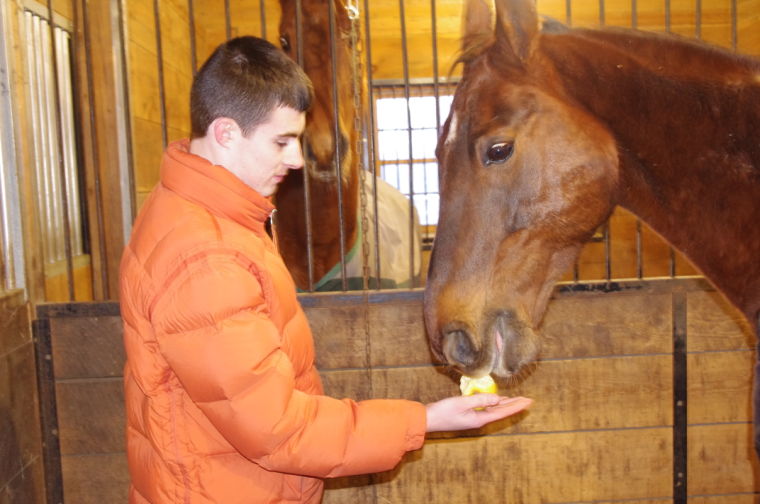 Andrew Constantine feeds his horses Frank, at right, and Breaker some of the salvaged fruit he collected from students who discard their fruit at Windham High School. Staff photo by John Balentine
Comments are no longer available on this story