
Ages ago, some upheaval in the earth’s surface created a 350-foot-high hill at the end of Highland Cliff Road in South Windham, not far from the first settlement. Heavily forested, the granite slopes and caves were the home of deer, wolves, lynx, bear and an unusually large porcupine den!
Inkhorn Brook has its start on this hill and the beaver dams in those far-off days caused huge ponds to spring up. Nearby farmers were in the habit of waiting until winter and then breaking the dams, killing the beaver and selling the pelts. One man, Ichabod Hanson, paid off his farm debt with the money he received after one of these episodes.
About 1754, an early settler named William Campbell moved onto this hill with his wife and children. She died in childbirth and a month later, he married again. His second wife had a reputation for being able to heal by the use of herbs and plants – she was thought to be a witch by many of the superstitious pioneers and few came to visit.
In 1763, 18-year-old Bill Mayberry and his wife moved here. He cleared land at the base of the hill, building a good-sized farm. During the barn raising, his neighbors and relatives came to help. As the day wore on, with “rum flowing like water,” one man climbed the highest tree to look around. When asked what he could see, he said “all over the world and a part of Canada!” He smashed a bottle of rum against the tree and Canada Hill was born!
In those early days, wild animals were common on Canada Hill. Lynx killed six or seven of Mayberry’s calves, and his neighbor William Campbell lost many sheep to the wolves that roamed the hill.
One summer day in 1775, little Betsey Mayberry and her brothers went to pick field strawberries and found a bear asleep near the berry patch. Quickly, they ran to tell their father who immediately set a trap. They returned the next day and 12-year-old John checked the trap. It had been sprung and in the nearby woods, he could see a bear limping away.
Like many a young boy, he decided to take care of this matter himself and went to the house and got his father’s flintlock, returned to where he saw the bear, and killed it. His astonished parents hauled the animal home on a “hand sled” and probably enjoyed many bear steaks at the foot of Canada Hill.
William Smith, a grandson of Bill Mayberry, was still living on his grandfather’s old farm 100 years ago, in 1912. In the intervening years, much of the wildlife on Canada Hill has disappeared as development has changed the unique area forever.
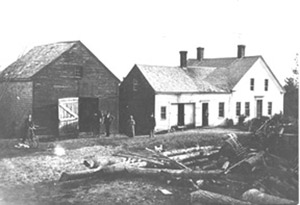 In 1912, William Smith, a grandson of William Mayberry, lived on Mayberry’s circa 1763 farm at the base of Canada Hill.
Comments are no longer available on this story