
GORHAM – Mourners from around the state will gather for a memorial service Sunday for Rodney S. Quinn, a leading political figure locally and in Maine for more than four decades.
Quinn died Oct. 27 at the age of 89 after being stricken with pneumonia.
An Air Force veteran during three wars, Quinn, a Gorham native who retired as a lieutenant colonel, rose to Maine secretary of state after launching a political career following 27 years of military duty. In recent years, he wrote an often-satirical weekly political column for the American Journal.
His death follows that of his wife of 65 years, Melba, earlier this month.
Quinn enjoyed a few careers. He was an educator, politician, author and pilot. He was a college instructor and in World War II flew with the Flying Tigers in China. During the Korean Conflict, he commanded an air transport squadron.
“He had a fascinating life,” his daughter, Kathleen “Kate” Gartland of Biddeford, said Monday.
“We all will miss Rodney’s unique and reliably provocative columns,” said Jane P. Lord, executive editor at Current Publishing. “Regardless of whether people agreed or disagreed with him, ‘Quinn’s Corner’ was always a great read. He was a gentleman, a scholar and someone I feel honored to have known.”
Lord said that Quinn always made sure the newspapers had a few columns in advance, and his family has given permission to publish these in the coming weeks.
Gartland said their father wanted his children to be self-sufficient.
“He always taught us (his three daughters) we could do anything the boys could do,” Gartland said.
Born in 1923, he was raised and schooled in Gorham. As a boy, he lived with his mother, Edith, who ran a boarding house for boys attending the Gorham Normal School. After graduating from Gorham High School, he joined the Army Air Corps.
In the military, he was stationed in the Far East, Alaska and at several posts in the United States, including the Pentagon.
During his military years, he earned a bachelor’s degree from Sacramento State and his master’s degree from Stanford University. He retired and returned home from the Air Force in 1968.
Quinn served on the Gorham Town Council for six years. He felt his greatest achievements in local government were constructing housing for the elderly and a new town center with a modern fire station.
He was instrumental in relocating Gorham’s antiquated town hall in a small brick building on School Street to its then-new municipal center on Main Street that opened in 1974. The building still serves, housing the Public Safety Department.
Brenda Caldwell, chairwoman of the Gorham Town Council, said Monday that Quinn worked hard for the town, and in recent years used his influence to benefit Gorham. Caldwell said Quinn was a Gorham councilor when she worked in the town office in 1975.
“He was a true statesman from Gorham,” Caldwell said.
Burleigh Loveitt, a former longtime town councilor and board chairman, said Wednesday that Quinn was a “dear man” and no one could have exceeded his kindness. Loveitt said Quinn was a friend and a mentor for him and his wife, Deborah Loveitt, for 35 years.
“He persuaded me to run for the council in 1975,” Loveitt said.
In 1974, Quinn was elected as the representative from Gorham to the state Legislature for two terms.
Quinn, who became a leading Democrat in the state, served as secretary of state for a decade, from 1979 to 1988.
Peter Danton of Saco, who served as Quinn’s deputy secretary of state, said Wednesday that Quinn instructed him not to embarrass the office of secretary of state.
Quinn’s advice, said Danton, was, “Do not embarrass yourself and do not embarrass him (Quinn) – and do a good job for the people of Maine.”
Danton said he had last talked with Quinn on the phone earlier this month after Quinn lost his wife.
Danton remembered Quinn as organized, efficient and responsible for the Democrats being the majority party of his time.
“He was really with it,” Danton said. “He was a good man.”
As secretary of the state, Quinn developed a model for drunk driving programs that was later adopted nationally.
Another prominent local Democrat, state Sen. Bill Diamond of Windham, knew Quinn well.
“He is the most underappreciated person I think who’s been in politics, because he was such an insider and did so much behind the scenes, under the radar, so to speak. He really had a tremendous influence on Democratic politics and politics in general,” Diamond said.
Diamond also credits Quinn with his own early political success. Diamond had moved to Windham in 1973 and three years later ran as a Democrat for a House seat representing the heavily Republican town. Diamond said he had no clue how to run a campaign back then, and Quinn, who was already in the Legislature and running for a leadership position in 1976, took Diamond under his wing. Quinn even made all of Diamond’s campaign signs in his garage and gave him some sage and at-the-time novel advice about door-to-door campaigning.
“What he really taught me was how to connect and listen to the voters that you visit. He originated the idea, which is used by almost everybody now, that when you visit somebody, you record the visit and you write them a postcard about the visit when you get home that night – whether it’s in June or October, it makes no difference. And then you send those post cards out, and it’s called a clincher mailing, a few days before the election reminding people of the visit,” Diamond said.
Diamond rose through the ranks as a representative and followed Quinn as Maine’s secretary of state in 1989. Diamond said Quinn not only worked behind the scenes to become influential on the political scene, but also, as secretary of state Quinn “had a lot of innovations there that people don’t even remember now. He was fantastic.”
One major innovation, Diamond remembers, was overhauling the automobile registration process.
“We used to do our vehicle registrations once a year and everyone would pile up at the motor vehicle places in big long lines during a one-month period, but he’s the one who spread it out over 12 months. That was him,” Diamond said.
Diamond last saw Quinn at Melba Quinn’s memorial service a few weeks ago.
“He was healthy and vibrant and talking about some of the races that he was watching. So I was just shocked [to learn of his death] because he was full of life when we talked,” Diamond said.
George N. Campbell Jr., who was commissioner of the Department of Transportation in the 1980s, also called Quinn a mentor.
“Rod Quinn knew how to work the Maine Legislature. I found that extremely helpful. He knew and was willing to share. That was Rodney’s gift,” said Campbell, of Portland, now a partner in Infralink, an international development company.
“He had a great sense of humor, a great intellect, and was a friend. He was a guy you could count on,” said Campbell.
Gartland, a nurse, said she cared for her father at his bedside at home in Westbrook when he was taken ill on Oct. 25. Gartland said her father, after declining to go to a hospital emergency room, was taken to Gosnell Memorial Hospice House in Scarborough, where he died. It was also where his wife died.
Gartland said her father had been at her mother’s side 24 hours a day for the past two or three years.
Gartland said that her father was “very devoted to my mother. Daddy was very devoted.”
In the past year, Quinn and his wife had moved to Westbrook from Mighty Street in Gorham.
In tours of Maine, Quinn had escorted a presidential candidate, Walter Mondale, and on another occasion, Rosalynn Carter, wife of President Jimmy Carter.
Besides writing the newspaper column, Quinn also authored several books. Quinn wrote “Gorham During the Great Depression,” published in 2002. He gave the copyright to the Baxter Memorial Library.
His political acumen was recognized early in his long public career. Delivering a presentation at a Gorham Town Council meeting in the early 1970s, Quinn drew praise from a then-leading town figure, Earl Files, the retired Gorham postmaster.
Speaking as a member of the public, Files commented after Quinn’s talk that the town had seen “budding political genius.”
State Sen. Phil Bartlett of Gorham, who expected a big turnout for Quinn’s memorial, said Wednesday he enjoyed Quinn’s witty newspaper columns, and had received correspondence from Quinn offering advice.
It was “always a pleasant surprise to get his notes,” Bartlett said.
Caldwell said Quinn didn’t always follow party lines and did what he felt was best for Gorham.
“He was a role model,” Caldwell said.
Democrats and Republicans alike respected said Quinn, Bartlett said.
Loveitt described Quinn as being free with criticism and praise.
“He served his country, town and state very well,” Loveitt said. “He’ll be dearly missed.”
A celebration of Quinn’s life is Sunday at 2 p.m. at the First Parish Congregational Church in Gorham, to be followed by a reception at the former Methodist Church building on School Street in Gorham.
Reporter John Balentine contributed to this story.
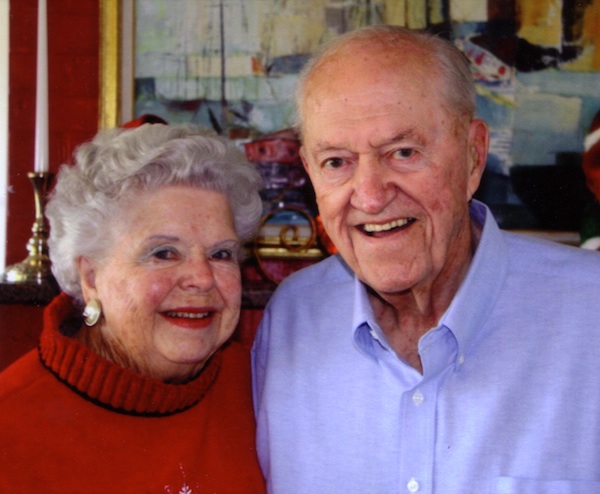 Rodney Quinn, who died Oct. 27, and his wife Melba, in this 2009 Christmas card photo. Melba Quinn died earlier this month. Courtesy photo
Comments are no longer available on this story