
NORTH WINDHAM – When you look at North Windham from the air, you’ll see a cluster of parking lots dotted with the flat roofs of big- and medium-box development, followed by a ribbon of forest and then big patches of blue. That blue stuff is water. It’s some of the purest water in the country, and it includes Sebago Lake, which provides drinking water for greater Portland so clean it doesn’t need chlorination.
There are other patches of blue in North Windham where the water table is so high that it bubbles to the surface and fills depressions known as Pettengill, Mud and Chaffin ponds. Those water bodies point to a unique and fragile feature of the environment in North Windham – the underground sand and gravel aquifer, the largest of its kind in Maine.
For the last 20 years, scientists have been studying the effect the parking lots and commercial development have been having on the groundwater. What they’ve found is a growing trend of man-made pollution linked to septic systems that leech nitrates and other naturally occurring, but still harmful, chemical compounds into the aquifer. The bottom of the aquifer is impermeable clay, so the nitrates stay in the groundwater, and since the 1990s, when development really escalated, those trends have shown rising levels of both nitrates and sodium chloride, used to de-ice the roads and parking lots.
Now that pollution is part of the debate on the $37.8 million sewer project that appears on the Nov. 6 ballot in Windham. Proponents say it would address the pollution concern to a certain degree, and allow for more development in the busy commercial district without further damaging the aquifer. Opponents, however, say the pollution problem isn’t nearly bad enough to warrant such an investment.
Nitrate numbers
According to Bob Gerber, a hydrogeologist who worked with the town beginning in the 1990s to map and graph groundwater data in North Windham, nitrates are mostly a concern for infants, although some studies suggest adults can suffer hypertension and gastric cancer from extreme exposure.
“Nitrates are a common pollutant that comes out of septic systems where organic waste is put in,” Gerber said. “And that organic waste can either be human waste – urine and feces and so on – or it can be food waste. Bacteria breaks it down and they form these nitrogen compounds” known as nitrates.
In North Windham, where each business is connected to a septic system, some very elaborate-though-failing systems, perhaps with overfilled septic tanks, readily allow nitrates to enter the aquifer. The main culprits are food processors such as supermarkets. Hannaford, for example, “used to have a fairly high nitrate level. They did a lot of food processing, so probably a lot of food waste went in there,” Gerber said.
Walmart, which has food processing, is another. In recent tests, Walmart has shown very high levels, above 10 mg/liter, that are considered unhealthy for humans.
With large-scale developers eyeing North Windham in the early 1990s (Walmart came to town in 1993), the Town Council entered into an agreement with the U.S. Geological Survey to drill about 40 monitoring test wells in and around North Windham in order to measure the effect development was having on the aquifer.
The town also commissioned a computer model study, using seismic data, to gauge the directional flow of the aquifer. That data showed the underground water flowed in the direction of the Presumpscot River and Collins Pond. Very little flows toward Sebago Lake.
Gerber was hired by the town to study and plot the USGS data starting in 1995. In 2010, he presented that information in a trend analysis using 15 years of data to show rising levels of nitrates and sodium in some of the test wells.
While salt is a difficult element to control since winter travel relies on cleared roads, the nitrates level has been of prime importance to town leaders. Most of the nitrates data indicates 0-4 mg/liter of nitrates, with one test well situated near Walmart’s stormwater run-off pond beside Landing Road showing a reading slightly more than 10 mg/liter of nitrates.
For planners, the magic number is 10 mg/liter, since that’s the federal Environmental Protection Agency’s recommended drinking water limit. Gerber addressed the Town Council, which was already discussing the sewer option, in 2009 and 2010 to share the news that a well had exceeded the federal drinking water limit and that others showed an upward trend.
Gerber has had little interaction with Windham since then, with Town Manager Tony Plante saying the town has enlisted Woodard & Curran, the sewer project design consultants, to plot and interpret more recent test well data. The 2010 and 2011 figures have shown similar results as earlier figures.
Gerber said “the concern with nitrates is the effect on infants, if they drink water or milk that has really high nitrates – 100 mg/liter or more – then they could get blue baby syndrome, or methemoglobinemia they call it, which can be fatal to infants less than 3 months old.”
Gerber also said his research indicates high nitrates can be a potential cause of gastric cancer and hypertension, “so there are other more common ailments in adults that can be exacerbated by high nitrate levels.”
Regarding the drinking water limit, Gerber said the government tends to err on the low side to ensure human safety.
“The EPA’s standards were set 40 to 50 years ago and as far as I know, no infant has died drinking nitrates at less than 100 mg/liter,” Gerber said.
While the established standard is 10 mg/liter, the point at which nitrates could become harmful to infants is 10 times that much, Gerber explained. The point is important since Windham’s readings have grown over 20 years of development to the 3 to 4 mg/liter range, and it could likely take several more decades to reach more serious levels.
“The EPA uses a factor of 10 to ensure safety. So if someone died drinking something that was 100 mg/liter, they’d divide it by 10 to be on the safe side. That’s a very simplistic way of looking at it, but that’s one of the ways they’ve set these standards,” Gerber said.
Trendspotting
Plante, who has been acting as a clearinghouse of information for residents searching for information on the sewer project, is aware of the measuring issues. His job, he said, is to follow those standards and recommend action accordingly.
“The EPA’s safe drinking limit, which we’ve used as a threshold, is 10mg/liter,” he said. “The regulatory threshold is what it is. I understand there’s a considerable side debate about what the appropriate limit should be. I’m not a scientist, I can’t say. What I can say is when we modeled the groundwater in North Windham, they were using the limit of 10 mg/liter as the threshold for saying there’s a problem.”
Plante remembers the 2010 presentation Gerber gave to the Town Council, which showed a general upward trend and says it motivated the council to get serious on presenting the sewer proposal to residents.
“The trend that appeared to be happening at that time was as development has occurred, there had been an accumulation of nitrates in the groundwater. But the trend, in general, has been upward to a point where Bob Gerber used in his remarks that we were reaching what he called an ‘action level,’ somewhere around 4-5 mg/liter, that there’s a danger you’re going to reach or exceed the 10 mg/liter level, which is the regulatory limit,” Plante said.
A sewer would prevent nitrates from getting into the aquifer and then flowing toward residential wells in and around North Windham. The Portland Water District long ago piped North Windham, so Plante says there are few people on wells in the North Windham area.
“Most people do not get their drinking water from the aquifer, so there is no imminent public health threat, and we’ve said that consistently from the beginning. Our goal is not to frighten people. Our goal is provide information,” Plante said.
Asked why all residences couldn’t be hooked into water pipes, Plante said, “because in many instances, we’re dealing with private roads, and putting public infrastructure on private roads is not easy.”
Windham resident Patrick Corey, one of the leading sewer opponents and progenitor of nosewer.com – which is his attempt to provide information and opinion not found on the town’s sewer-related website, windhamsewerproject.org – takes issue with the town’s interpretation of test well data and public education campaign.
“Nowhere on the sewer project website or informational flyer can we find reference to the idea that there is ‘no imminent public health risk,’ yet the town manager stated that they have been very careful to say that there is none,” Corey said. “Where is it? All we can find is reference to contaminants in our water. Nowhere does it say that Windham is serviced by Portland Water District except for on the very last page in the last bullet of one of Gerber’s presentations. These seem like two items that would be important for voters to know.”
Plante responds by saying he’s mentioned the fact that there is no health risk “repeatedly at council meetings.”
Corey also isn’t convinced a sewer is needed since recent data from 2011 – released by the town Oct. 18 after USGS finalized and peer-reviewed the findings – indicate trends that he says don’t warrant a costly solution such as sewer. If anything, he said, they point to a problem with Walmart’s system.
“Six wells, or 30 percent of wells tested, show a decrease in nitrate concentration. Nine wells, or 45 percent of wells tested, remain neutral in nitrate concentration. Five wells, or 25 percent of wells tested, show an increase in nitrate concentration,” Corey said. “Only one well of the 20 tested exceeded the maximum contaminant level and that is located near Walmart. Why was an unnecessary sewer project put before the voters to solve an isolated problem?”
Regarding the chloride that finds its way into the aquifer through winter salt treatment, which also show rising trends, Corey says salt would be more of a threat than nitrates if the sewer allows more development, more interconnected roadways and more parking lots.
“If we did consume water from the aquifer, and we don’t, this sewer will do nothing to remove sodium chloride, which may increase in the aquifer from increased road salt applications with the development sewer will likely bring,” Corey said. “This can increase blood pressure and cause buildup of fluids in people with congestive heart failure, cirrhosis, and kidney disease. Of course, our water comes from Sebago Lake so this isn’t even relevant.”
One of the criticisms of the Town Council and staff through the sewer study process has been what some perceive as a rushed education process. Corey, who has been one of the most vocal, says the groundwater analysis, even with 15 years of data, is too little evidence to determine whether nitrates are an issue.
“On June 5, Tony Plante tried to discourage the council from putting the sewer on the November 2012 ballot. He said, ‘By taking a step back gives us the opportunity to add a couple more data points to the groundwater monitoring. Is the trend accelerating, is the trend decelerating, is the trend staying the same? What’s happening?’ Obviously there are still questions about the groundwater trends,” Corey said.
Plante said the town has collected data and that it provides compelling evidence for action.
“The council spent 15 years patiently collecting the data and we have in most cases 10, 12, 15 data points on these groundwater wells to look at different locations and what’s going on with the groundwater. And in general, not in every instance, not uniformly, but in general, the quality of groundwater is deteriorating,” Plante said. “Commercial development has continued since the mid-1990s, and we’ve seen the levels of contaminants increase. And we don’t know how far the levels are going to rise.”
Handling growth
For Gerber, North Windham development is intimately linked to pollution in the aquifer, and if Windham wants to attract business, it needs to address the septic discharge issue.
“If they want to develop North Windham at the intensity they did before this real estate crash in 2008, if that’s the intent of the town in that commercial strip particularly, they’d be hard-pressed to do it without doing something much more serious in terms of a sewer, either requiring individual companies to put in a lot more than a normal septic tank and treatment system or something,” Gerber said. “The other option is to only allow development to go in that doesn’t increase the groundwater contamination. And that’s going to limit to some degree what you can have for business and the density of that business obviously.”
Those concerned about pollution have talked about the need for a construction moratorium if indeed pollution is a threat. Despite the taunts, Plante says North Windham will always be a commercial center since it’s at a major crossroads and already has a mature offering of products and services.
“North Windham (development) is not going to dry up and blow away. The discharge that is going into the groundwater today is not going to go away tomorrow, in and of itself,” Plante said. “North Windham is a vital part of the community. We all rely on it. But that comes with some responsibility, that we have to look at what impact it’s having, and how we respond to that.”
Plante believes “doing nothing,” which he said the council considered as one option, is not a good option since “it doesn’t address the possibility that contamination of this water sometime in the future could endanger public health, that it would endanger the quality of this natural resource, and it would limit our ability to continue to develop as a community and in terms of economic development,” Plante said.??
A sewer system aimed at draining North Windham along Route 302 and parts of routes 35 and 115 has always been an economic development vehicle, not only a pollution mitigation strategy, he said.
“That has always been part of the discussion. We have never been shy about that,” he said. “With sewer we will be able to continue to develop in a way that has less impact on the groundwater, that could help realize other goals the community has in terms keeping other parts rural, and that having sewer could help realize a different future for North Windham that would allow for denser development,” he said.
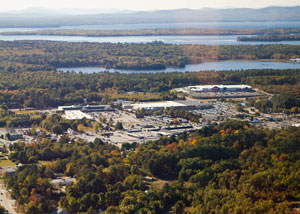 Since the 1990s, North Windham has rapidly filled with commercial development that provides jobs and shopping opportunities. However, the area is also one of the largest commercial areas in Maine without a sewer system. Septic systems now dominate the underground landscape and some leech harmful effluent into the groundwater, though not at levels exceeding the federal standards for drinking water sources. The proposed $60 million sewer, facing Windham voters in a Nov. 6 referendum, would address pollution concerns, though not everyone is convinced the levels have risen high enough to warrant such a costly solution.
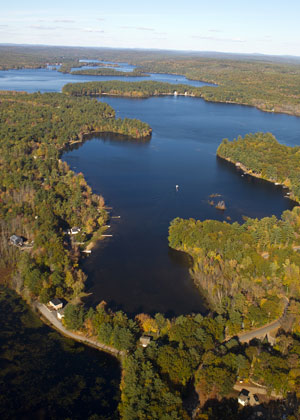 Since the 1990s, North Windham has rapidly filled with commercial development that provides jobs and shopping opportunities. However, the area is also one of the largest commercial areas in Maine without a sewer system. Septic systems now dominate the underground landscape and some leech harmful effluent into the groundwater, though not at levels exceeding the federal standards for drinking water sources. The proposed $60 million sewer, facing Windham voters in a Nov. 6 referendum, would address pollution concerns, though not everyone is convinced the levels have risen high enough to warrant such a costly solution.
Comments are no longer available on this story