
WINDHAM – A graffiti-art mural adorning a wall of Windham High School is one of 100 stimulus-funded projects across the country that has recently come under scrutiny by a U.S. senator.
In “Wastebook 2012,” Sen. Tom Coburn, R-Oklahoma, lists more than $15 billion worth of taxpayer-funded projects, some of which were funded by the American Recovery and Reinvestment Act of 2008. The high school’s mural, which was completed in May of this year and cost $13,000 to produce, ranked No. 26 on the list of taxpayer boondoggles, as published annually by Coburn.
According to Portland-based Opportunity Alliance, which oversaw the mural, the project was part of a $4.3 million grant received in 2009 from stimulus funding. About $1.4 million of the grant went to programming in the Lakes Region to fight obesity and promote healthy eating especially in the schools of Windham-Raymond Regional School Unit 14 as well as School Administrative District 61 in the Naples area. The three-year funding program ends in December, said Lucie Rioux, a director of the Opportunity Alliance. Money was also spent on school gardens, food pantries and an in-school obesity prevention education campaign.
The Windham High School mural, which features colorful abstract images of a compost bin, a skateboard, recyclable water bottles and vegetables, was painted by Portland graffiti artist Tim Clorius, who goes by the street name Subone, as well as several students at the school. Clorius spent about two weeks designing the 33-foot-by-8-foot mural with student input and another two weeks painting it.
Coburn’s report, which highlights and lampoons government spending projects such as a $3,700 Lego-block recreation of a downtown scene, $1 million in book club funding, and $505,000 in funding for a pet shampoo company, describes the Windham mural:
“Among the stated purposes of the federal program funding the mural are to reduce obesity and decrease tobacco use,” the description reads. “These are worthy goals, but there are better ways to accomplish them than spray-painting stylized composting bins on a high school wall. For example, over 4,500 free healthy school lunches could have been provided to disadvantaged children with this funding. Too bad taxpayers cannot recycle the money poured into this project.”
Clorius, who recently finished a graffiti-art project at Biddeford High School, is proud of the mural.
“It doesn’t feel great,” Clorius said of his artwork’s listing on the waste list. “But I am convinced that it does fulfill its purpose. I believe in art having a true, important power. I realize that the real purpose in my art – the meaning for art for me – is that it has a real impact.”
Clorius, who grew up in Germany, said the school mural, which is located in a hallway leading to the cafeteria, “creates a fertile ground so kids can start to identify things that they worry about and think about. I have to say, the subject of the mural was chosen by the kids themselves. They gave me those terms, and they said, ‘Can you transfer them into a piece of contemporary art?’ And they specifically said, ‘We don’t want a typical approach. We want something that’s true contemporary art, that’s of our generation.’ And I wanted to make the kids happy.”
The artwork is abstract in nature, and difficult to grasp, Clorius acknowledged. But since it’s contemporary art, that was the effect he was going for, where viewers “have to spend time with it” and search the mural for meaning, he said.
“We didn’t want to create a typical image of very simple, straightforward narrative, because it is art. And that’s the thing: It’s art. The kids wanted art, and I wanted to do art,” Clorius said. “That abstract thought, it’s also something that needs to be cultivated. Why not teach our kids how to think more abstractly and see things more abstractly? More open-minded.”
Windham High School Principal Chris Howell, who was at the mural’s unveiling in May when Clorius explained the different artistic components of the mural created solely with spray paint, said it’s too soon to tell if the mural has fulfilled its goal of getting kids to eat better.
“It’s only been here for a short period of time so whether or not it’s had an impact on the building, I will say the greatest impact was having the artist in residence for a couple of weeks as he worked on this because we had art classes go up and worked with him. Even some students participated in the development of this. So it was a great learning opportunity,” Howell said, adding that the school system was “courted” by Opportunity Alliance.
According to Rioux of Opportunity Alliance, the mural was one part of a media campaign emphasizing healthy food and sustainable food systems in the Windham and Lake Region school districts and was an approved project under the Healthy Lakes Communities Putting Prevention to Work grant.
“The CPPW grant provided us with an opportunity to support two school districts in creating sustainable policy, systems and environmental changes by increasing access to, and awareness of, healthy foods,” Rioux said in a prepared statement Wednesday.
Rioux said the mural “was unique in that it involved youth voices in the design of the project, knowing that this would have a greater impact on students throughout the school. High school students who were part of the Green Roots Club helped develop and create the mural, which was a visualization of the positive, healthy changes occurring throughout their school. It was imperative that students had ownership of the project in order for it to be successful. To that end, the students chose from three different mural artists and had input in the overall messaging and individual components of the mural.”
Rioux said the mural was also the “culmination of all the healthy food efforts that the CPPW initiative helped to create throughout the school system.” Other components included district-wide wellness policy changes, nutrition education, calorie labeling in the cafeterias, school garden creation that included student involvement, and the creation of new connections between local food producers and the school cafeterias, which supports both student nutrition and local businesses.
“As a culmination of all of these comprehensive efforts, the creation of the mural is a sustainable message to the entire school community about healthy living for years to come,” she said.
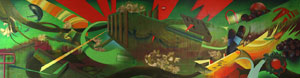 With design input from Windham High School students, graffiti artist Tim Clorius, aka Subone, spent several weeks last May at the school spray-painting a 33-foot-by-8-foot mural aimed at inspiring kids to make healthy food choices as they walk by the mural on the way to the cafeteria. Earlier this week, the mural was among 100 taxpayer-funded projects highlighted as wasteful by U.S. Sen. Tom Coburn, R-Oklahoma, in his annual “Wastebook 2012.”
Comments are no longer available on this story