
FREEPORT – Freeport’s Lindsay Sterling has been on an around-the-world adventure for the past four years, and the best part is that she’s never had to leave Maine to do it.
Since 2008, Sterling, 38, a former chef who has worked in kitchens in Freeport and Portland, has been working on what she calls her “Immigrant Kitchens” project, in which she learns one dish from a person from a foreign country and passes on that knowledge in a cooking class that raises money for the Freeport-Pownal food pantry. In the four years that she has been teaching her monthly classes at the Freeport Community Center, Sterling said, she has raised around $6,000 for the pantry.
Sterling’s latest Immigrant Kitchens series is coming up on Friday, Sept. 14, from 6-9 p.m. On that night, Sterling and 13 students (the maximum number the kitchen holds) will be learning to cook (and eat) authentic French ratatouille, a vegetarian dish from the south of France that features eggplant, bell peppers, garlic, summer squash, black French olives and herbes de Provence.
The cooking classes grew out of an idea Sterling had after leaving her job as a chef when she had her children. She said there were some aspects of the job that she missed less than others.
“I did not miss lugging tubs of onions up flights of stairs,” Sterling said. “But I did miss the cooking tricks that got passed on from chef to cook. Just the little things you learned on the way to make food extraordinarily delicious and beautiful.”
One night when she was watching chef Anthony Bourdain’s television show, where he travels the world trying exotic foods, Sterling realized that she wanted to do something like that, and then an idea struck her.
“I don’t have to travel around the world. The world is already traveling here,” she said. “I thought, why don’t I just start asking people from other countries if they would teach me how to cook. I started that four years ago and have essentially never stopped because it’s so fun and so rewarding.”
Sterling, who said she is working on “several” books in conjunction with the project, then had to figure out how to find people to teach her their native dishes. She decided to start the simplest way she knew possible, and was surprised at how well that approach worked.
“I started out thinking, ‘I’ll just ask people here and there,’ and everyone said yes, which is completely shocking to me because people are busy, it’s hard to schedule things and why would you invite a stranger into your house and give them food and a cooking lesson,” she said. “It doesn’t make logical sense, but it started working.”
Sterling said she never has to go out of her way to find someone to work with her. “Most often, it’s someone I bump into in my everyday life,” she said.
Sterling’s quest is to learn a dish from every country in the world, but she has a ways to go.
“I just looked this up,” she said. “I have learned dishes from 42 countries so far.”
“I hope to make it around the whole world,” she added, saying she expects to be at it for the next decade. “I think it will take me that long to complete the world.”
And Sterling has learned that cooking with a person from another country is a richer experience than simply learning about the food. It’s a good way to get to know about an unfamiliar culture.
“I find that spending time with a person from these countries and learning how to cook a food is a nice balance to the geopolitical tension that we read about all the time,” she said.
She cooks all the dishes at for her family. “I test the recipes at home,” she said. “It’s been sort of a family journey as well. (And) fireworks go off when everybody likes (a dish).”
One particular favorite for Sterling’s two children, ages 6 and 9, is a Bolivian dish called silpanco, which is traditionally served on Fridays in Bolivia.
“That’s one I get requested weekly from my kids,” she said. “One of the things that I love about this dish is it was all ingredients that are uber-familiar to everybody: tomatoes, potatoes, green peppers, jalapen?os, red onion, ground beef and rice.”
She said the beef is rolled out on a pile of bread crumbs, seared on both sides, and then served on a mound of rice with a fried egg on top, with the vegetables served on the side with a hot sauce. “It was colorful, it was beautiful, it was made of things that are familiar, but put together in a new way,” she said. “So the kids really like that one.”
While she was learning techniques to cook all these new and exotic dishes, Sterling found a way that her new knowledge could be put to good use – teaching classes that would benefit the food pantry, where she has worked as a volunteer.
“It’s a service project I do once per month,” Sterling said. “I worked with the food pantry in the past and I learned how much need there is. And I just thought, ‘What is something that I can do that’s related to my life that I’m passionate about that can support the food pantry?’”
And the classes have been very successful so far. Elizabeth Patten, a nutrition educator who volunteers at the food pantry, which serves Freeport and Pownal, and has attended the classes, said she really enjoys the experience of cooking with Sterling.
“Lindsay’s classes are an extension of her gregarious and adventuresome personality,” Patten said. “It’s hard not to have fun cooking with her.”
She added that Sterling has a knack for making sure everyone in the class is involved with the process of making every dish.
“One feature that struck me immediately was how inclusive she is, asking participants what we think about various ingredients, methods, or timing,” Patten said. “We’re not just watching and note-taking, we’re part of the process of concocting incredibly delicious and unusual meals.”
Most importantly, the money from the classes goes to the food pantry, and, Patten said, the help is much needed and appreciated.
“As far as Immigrant Kitchens’ proceeds are concerned, they become part of the food pantry’s general budget,” she said. “We have generous donors such as Bow Street Market, Hannaford, private individuals, Royal River Natural Foods, When Pigs Fly Bakery and many others who provide products, but having cash donations (such as Lindsay’s creative and generous program) allow the pantry to fill in many of the gaps in staple goods which really fluctuate throughout the year.
“For example, now in late summer, we receive an abundance of fresh produce, but are low on basics such as tuna, beans, rice, cereal, etc. During the holidays, there are plentiful general food contributions but fresh produce is less available. Early and mid-winter tends to be the ‘forgotten season’ since individual donors and service groups often focus more on holiday need. So programs like Lindsay’s allow pantry administrators to spread out the year’s demand by purchasing needed foods or basics as much as possible.”
Besides the financial help to the food pantry, Sterling said she has a simple philosophy on why she continues to hold the monthly cooking classes.
“I am given the gift of these dishes once a month from a stranger, so I see it as passing on the gift of sharing food,” she said.
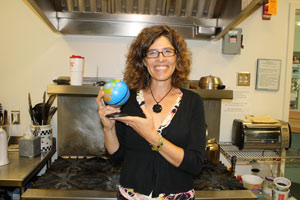 Lindsay Sterling teaches how to cook dishes from around the globe.
Comments are no longer available on this story