
RAYMOND – A new book by Raymond resident Don Perkins is the culmination of many years probing the engineering masterwork and people behind historic barns.
“The Barns of Maine: Our History, Our Stories” was released Tuesday after about four years of extensive research, Perkins said.
Perkins, 42, has lived near Sebago Lake in Raymond since 1994 and last year spoke to the Windham Historical Society on the topic of local barns.
His interest in barns began early in his career as a carpenter, which saw him building homes in the area as well as woodworking at the former Pinelyne Furniture in Windham. When carpal tunnel syndrome derailed that physically demanding career path, Perkins turned to his other love – writing – and quickly gained employment with several local and regional newspapers.
Beginning in 2007, Perkins wrote two long-running series on local barns for two newspapers, one in Gray-New Gloucester and another in the Oxford Hills region. Those articles heightened his knowledge and interest in Maine barn history and directly led to the creation of the book.
“Writing a book is something I never ever expected to do. I decided to write this after many urged me to compile my barn columns into something greater,” Perkins said. “It turns out a lot of folks like barns and their associated history. I was surprised to learn a book like this had not been written before.”
The book revolves around the complex engineering that went into early barns as well as the people who built them. Perkins also delved into the families that cared for and used them through the years.
“I realized early on that the human side of these buildings was essential, too. Thus it was fun interviewing folks, who I like to call ‘barn people,’ about their specific memories. So each barn became a two-part interview: the physical building and then its owner/history,” Perkins said.
In addition to writing the book, which is published by The History Press of Charleston, S.C., Perkins also took about 100 photographs of the barns he profiled, including the cover artwork.
As a history buff and experienced woodworker and carpenter, the book proved a happy marriage of Perkins’ major interests.
“What originally piqued my interest in barns is my longtime fascination with timber framing, which began in my teens,” Perkins said. “Timber framing with hand-hewn material is almost a lost art and as a carpenter early in my working life, hints of old-time joinery just drew me in. I guess I wanted to trace the roots of it. There was something about hand tools – old planes, plumb bobs, chisels and axes – that simply fascinated me. I think barns became a natural study since the frames are exposed; the joinery is there for us to see. History is another large interest and barns are filled with this, too.”
Of all the stories, Perkins found a few most compelling, especially related to local barns.
“In the book, I feature a barn in Bridgton and another in Sebago (built in the 1830s and 1840s, respectively) that incorporate what are called ‘English tying joints,’ parts of the hand-hewn frames where post top, tie beam, rafter and wall plate all intersect to “tie” the building together,” Perkins said. “This configuration has its lineage in medieval 13th-century England and became the standard method of assembly among the English and their descendants here in the United States for over 500 years.”
The Bridgton barn that features the tying joints also proved interesting.
“The Bridgton barn is owned by the Bridgton Historical Society and is dubbed the ‘Temperance Barn’ since it was built by upright Yankees who decided to skip a time-honored feature at nearly every old-time barn raising: a barrel of rum,” he said. “Apparently, early New England carpenters used rum almost as often as their handsaws.”
For those interested in the Bridgton temperance barn and other local barnology – a term coined by Perkins to describe his focus of study – the book will provide valuable insight.
“There are two barns in New Gloucester that are featured, too, and another at Shaker Village actually made the book’s cover,” Perkins said. “In Windham, the big white barn of the late Stanley V. Hall at the rotary is also featured, so the Lakes Region is well represented.”?
While it took longer to get published that he was hoping, Perkins, who has no set plans for a second book yet, is happy with the result.
“The process of getting published took time,” he said. “It required two publishers to finally get book this to fruition. I’m fortunate in that my second publisher actually contacted me after another author dropped my name. The whole process took about four years, which in hindsight was nice because it gave me more time to research my subject and also how to best present it.”
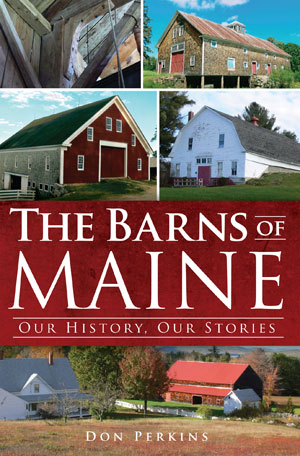 Copies of “The Barns of Maine: Our History, Our Stories,” are available at Amazon.com, Barnes & Noble and local bookstores. E-reader versions will be available in November or December. Paperbacks retail for $21.99 while e-books will be about half that price. Author Don Perkins will also sign copies at the Cumberland Fair on Sept. 26 and 27.
 “Folks like barns and their associated history,” said author Don Perkins, whose new book explores Maine barns.
Comments are no longer available on this story