
RAYMOND – The rapid rise in pharmacy robberies this year is causing alarm not only among law enforcement, but those working in the pharmacy field, as well.
“The robberies are caused by drug abuse. They’re stealing it because on the street, the values are about a $1 a milligram on oxycodone. So when you steal a bottle of 100 oxycodone of, let’s say, 80 mg tablets, you have $8,000 in your hand,” said Joe Bruno, a Raymond resident who is also president and CEO of Community Pharmacies, a chain of 10 Maine pharmacies. “So, you take a few, you sell a few. That’s how they’re living,” Bruno said.
This weekend, as a direct result of this year’s spike in robberies, an expert speaker will address members of the Maine Pharmacy Association at its fall convention in Bangor. Edward Cartwright, a former Pennsylvania police officer with extensive experience fighting prescription drug abuse, will speak specifically on pharmacy safety and security in an effort to help Maine pharmacies deal with the rising epidemic.
“We have invited him to speak at our state association convention because this has just been an alarming issue in Maine,” said Kenneth “Mac” McCall, president of the pharmacy association. “For example, in all of 2011 there were 24 pharmacy robberies, and so far this year in Maine there have been 37. That’s almost one a week.”
McCall, also a pharmacy professor at the University of New England College of Pharmacy, said the seminar is aimed at raising awareness of the issue, not only for those pharmacists and technicians under direct threat of the robbers, but students preparing to enter the field.
“I think pharmacists are more aware obviously, but a lot of pharmacy students say, ‘Well, it will never happen to me.’ But, the fact is, most pharmacists either know someone or have experienced the situation themselves,” McCall said. “So, especially for people who are new to the profession, we want them to be aware of this safety concern.”
Bruno is all too familiar with the impact of pharmacy robberies – Community Pharmacies in Corinth, Gorham and Saco have all been robbed this year. The one in Gorham has been hit three times, leading to the arrest of a Saco man.
A former state legislator, Bruno also serves as chairman of the Prescription Drug Abuse Task Force, established earlier this year by Gov. Paul LePage, which released a preliminary report in June aimed at gauging and defeating the root cause of the robberies: desperate individuals feeding their habits and also selling the drugs at incredible profit.
The drug abuse that fuels the robbery epidemic is a habit that develops over time, and is difficult to break, Bruno said.
“It’s a dependence. If you don’t have the medication, you start getting shakes and cravings. It’s just a powerful addiction,” Bruno said. “A lot of these people start out by getting legitimate prescriptions and then start taking more and more, which is what you need to do. Your body keeps telling you: I need more and more. And so the more they take the worse addicted they get and that’s when you start running into issues. When the doctor says, ‘You’re taking too much, I need to cut you off,’ you can’t just cut someone off this stuff. You have to wean them off, which is where methadone and Suboxone come into play.”
Bruno said the aim of the 17-member task force is to gather input from law enforcement, the medical, dental and pharmacy communities, state and local agencies, and education providers in order to accomplish four goals:
• Develop drug disposal solutions;
• Provide pharmacies with drug crime information to attempt to foil illegitimate or duplicate requests for drugs;
• Develop a public education campaign;
• And conduct an active review of the Maine Prescription Monitoring Program.
Fighting back
Bruno, who was a practicing pharmacist prior to 1995, was robbed back when pharmacy robberies were unheard of. There were few security measures, and employees weren’t trained in how to respond.
“When I was practicing, if you had three or four in a year it was a lot,” he said. “But we’ve caught a lot of people lately, which is a good thing. There are so many more security measures which we have put into place.”
One of those measures is better definition video captured by at least three in-pharmacy cameras – a new requirement passed two years ago by the state Legislature – as well as more cameras located outside stores to capture video of getaway vehicles.
“One of the most important things to do is get a license plate, and a get a description of the car,” Bruno said.
Cumberland County Sheriff Kevin Joyce, who will attend the pharmacy association’s upcoming convention and is helping the association to film a robbery training video for pharmacy employees, said camera images can be less than desirable, but physical description and getaway car information is highly valuable.
“We try to encourage employees of these pharmacies and customers to be cautious, not get involved, but that if they do see something that appears strange – for example, someone wearing a hood or sunglasses – if they see that going on, they can be a great witness for us as far as describing the person’s physical makeup. Any vehicles, direction of travel, etc. is also very helpful,” Joyce said.
Sheriff’s detectives have had some good fortune tracking down suspects but some still elude capture. Joyce said the criminals are desperate due to their drug dependency, and while no one has been injured in a Maine robbery, something worse could easily occur.
“Until we get our hands around this issue of addiction, I think you’re always going to have someone go out and take the chance of satisfying that addiction at the cost of robbing a pharmacy,” Joyce said. “But our goal is to find them before people get too desperate and do something more than just steal.”
Because of the rise in robbery frequency, with perpetrators either displaying a gun or saying they have one, pharmacy robbery has been elevated to a federal crime.
“So when you threaten with a gun, and say you have a gun, it is now a federal crime,” Bruno said. “So they will be involved in the federal prison system and not the Maine correctional system. Now it’s dealt with as a bank robbery where the FBI can investigate, so that’s a good thing,” Bruno said.
While pharmacy robberies lead to more drugs on the streets and creates a cycle of ever more chemical dependency, ruining the lives of many in the process, the robberies are also taking a toll on pharmacy workers.
Bruno and McCall say some employees, traumatized by a robbery and the possibility of future ones, quit the business.
“We actually had one lady who could not handle it, and left the employment because it was too much for her,” Bruno said. “This was after a robbery. She could not deal with the idea that someone else could come in and rob her again.”
Community Pharmacies, just one of the many chains to experience multiple robberies this year, provides trainings for employees and tells them to hand over whatever the robber wants in an effort to quickly get him out of the store. Most robbers request the drug by name, Bruno said.
“Some people just don’t have the personality to be able to handle this stuff,” Bruno said. “You are in fear of your life. If someone says I have a gun and will use it if you don’t give me drugs, it shakes people up.”
McCall has also seen robberies, which usually take only a few moments, cause long-lasting issues with employees. And it’s not just the $8-an-hour pharmacy techs who quit. McCall said he’s seen pharmacists, who can earn more than $100,000 a year, quit as well.
“Regardless of your paycheck, when someone points a gun at you there’s an equalizer. It doesn’t matter how much you’re being paid. And I have seen pharmacists leave the profession because they have been robbed. So it can be traumatizing. And different people will cope with that trauma differently. It doesn’t bother some people but some folks will leave the profession altogether or I’ve seen some folks choose a different career within pharmacy that doesn’t have that same risk. So it affects everyone,” McCall said.
The right prescription
Years ago, the physical layout of pharmacies was different. Pharmacists were elevated and locked doors separated the customers from employees and drug shelves where hundreds of thousands of dollars worth of drugs are located. Now, modern layouts provide few barriers. For Bruno, that’s a good thing, since patients and pharmacists can interact more closely. But for McCall, the old ways of segregating drugs and their dispensers from the public may come back into vogue.
“In the long run, we may have to reconsider how we design pharmacies,” McCall said. “They have been designed, obviously, to center around the people who we’re providing pharmacy services for. So they’ve been very open. In many cases, the counters are waist high or shorter, or the door to the pharmacy is not locked and sometimes it’s just a half-door. And so we may have to start thinking about redesigning pharmacies like banks have done so the counters are more chest high and there’s more separation between the front and the pharmacy.”
Despite the dangers, Bruno still believes in the open pharmacy concept.
“It would be like having a physical examination with glass in the way. It’s not something we want to do,” Bruno said. “First of all, it’s a personal relationship you have with that patient who comes into the store. You want to be able to interact with them. Secondly, if you start putting up windows and barriers, aren’t you just giving in to the people who are robbing you, and saying we’re afraid of you and this is what we’re going to do? I’m really opposed to it.”
Maine, Bruno says, is not New York City, where bulletproof glass and bars can separate pharmacists from customers, like a subway toll booth.
“We haven’t gotten to that point in Maine yet, and I hope we never get to that point,” he said. “But to me it really is about customer service and being able to relate to people. If you can’t look someone in the eye and have a conversation, it really makes the practice of pharmacy very difficult.”
While pharmacy workers and law enforcement are on the front lines of what McCall describes as an epidemic, Bruno said the intertwining issues of prescription drug abuse and pharmacy robberies affects everyone.
“The public is just as involved in this, because nobody wants to see a drug addict out there not only robbing pharmacies but being high, driving around, because innocent people may get hurt,” he said.
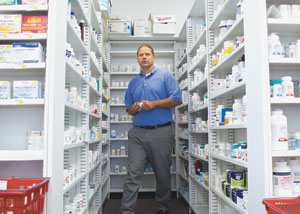 Chris Guido, pharmacist and store manager at Community Pharmacy store in Gorham, which has been robbed three times recently, says he tries to maintain a balance between security and the needs of customers.
Comments are no longer available on this story