
PORTLAND – Regional School Unit 5 gives its kids a good education for the money.
That’s the conclusion of a recently released statewide study from the University of Southern Maine’s Center for Education Policy, Applied Research, and Evaluation, which revealed that all of the RSU 5 schools were either what the study deemed “more efficient” schools or very close to that result.
Professor David Silvernail, the director of the center, said the study, which looked at data from 2008-2010, came about as a result of a request from the state Legislature.
According to the USM study, more efficient schools were defined as those showing higher student academic performance and a higher return on spending. Those schools are helping their students achieve more in the classroom while spending money judiciously to get the best results possible.
RSU 5 Superintendent Shannon Welch said she was pleased with the results.
“The RSU prides itself on providing a strong academic program while using our resources wisely,” Welch said. “And we’re proud of the data presented in the efficiency report about our six schools. This time span was 2008-2010, so it includes time when the schools were three separate districts and after we’d been consolidated, so it’s a pleasure to see our schools recognized for their financial efficiency as well as the strength of our academic programs. Our (residents) should take great pride in the fact that we’re providing a quality education with the resources provided by the community.”
The results of the study come just as Durham, one of the member towns, has launched an effort to examine the pros and cons of withdrawing from the regional school unit.
The study looked at six criteria to determine if a school was more efficient. Those were: scoring higher than the state average on what was then the Maine Educational Assessment test (a test that has since been replaced by the SAT in high school and the New England Common Assessment Program in the lower grades); scoring higher than the expected score on the statewide assessment test; beating the state average of students meeting or exceeding proficiency standards on the statewide test; topping the state average of students who at least partially meet state standards on the tests; getting a higher return on spending than the state average; and getting a higher return on spending compared to what is expected from a school based on past performance. The study determined a school’s return on spending by seeing how many students met or exceeded state standards on statewide tests per $1,000 spent on education.
According to the study, 25 schools were selected for concentrated study. Sixteen were selected because they were designated as “More Efficient,” and nine schools were classified as “typical schools.” Typical schools showed mixed student performance results in their profiles.
The study’s executive summary said: “The initial analysis of the case study evidence confirmed many findings reported in other national and international studies of higher performing schools. More efficient schools were more consistent in their high expectations and high standards for all members of the school community and implemented more rigorous curricula with engaging instruction. In addition, more efficient schools had good leadership, supportive school cultures, and many of the other characteristics found in our literature review.
“A deeper analysis of the evidence also revealed that in the more efficient schools, these features came together to form a distinctive culture: a culture that is more than the sum of the individual parts, and consists of features that cut across and encompassed the categories of characteristics found in earlier studies. What we found to be unique among the more efficient schools is a singular, sustained focus that places students and their intellectual development at the center of all work.”
Silvernail said the schools deemed more efficient were not necessarily spending less than other schools.
“It’s really how they’re using their money to get the results they are,” he said, adding that the study only took into account the money a school spent on actual instruction and learning. Other areas of spending, like transportation, maintenance and debt service, were excluded.
“It’s not that they are spending more or spending less. It’s the relationship between the amount of money they are spending and the results they are getting in terms of achievement per kid.”
Pownal Elementary School scored the highest in RSU 5, meeting the criteria for a more efficient school in all six areas, the only RSU 5 school to do so.
The other schools weren’t far behind. Freeport’s Mast Landing School, which has students from kindergarten through Grade 5, missed out on a perfect score by coming in just below the expected score for the statewide assessment tests, with an average score of 446.68 as compared to the state average of 448.27. In the cases of both Pownal and Mast Landing, researchers considered data from Grade 4 students.
Durham Elementary School (the school has since changed its name to Durham Community School and moved into a new building) also was 1 point away from a perfect score. As Durham’s school has kids in kindergarten through Grade 8, researchers looked at results for kids in fourth and eighth grade. The only category where Durham fell short was in Grade 4 expected MEA scores, posting an average score of 446.54 as opposed to the state average of 447.10.
Freeport Middle School, where the center looked at figures from Grade 8, missed out on a perfect score in the study by falling just short in the expended return on state spending, seeing 7.66 students per $1,000 spent meet the state standards against an expected return of 8.57 students per $1,000 spent.
Freeport High School, where Grade 11 student data was measured, came up short in the expected score of the state assessment test, posting an average score of 1,143.59, just percentage points below the state average of 1,143.62. The school also came out below in expected return on spending, getting a return of 5.43 students per $1,000 spent as compared to the expected return of 5.98.
The study did not review Freeport’s Morse Street School as there was insufficient data to include it in the study.
Lisa Demick, the Pownal Elementary School principal for the past three years, was not at the school when the study started, but she said the high achievement, especially when it comes to giving parents and taxpayers the most bang for their buck when it comes to education, can at least partially be credited to the formation of the RSU.
“I think our teachers here are really benefitting from the extra professional development that they can get now that they’re part of Durham and Freeport,” Demick said.
“I think it’s one of the benefits of the RSU,” she said. “That’s one of the ways that they have been able to cut costs (by sharing resources). They’ve been able to keep the community-focused small school, but now we have the benefit of the professional development as part of a whole district.”
Demick is also the math strategist for the district, and she works with teachers in all of the other schools to help strengthen math programs. She said having shared strategists helps get students the best education possible at a lower cost than if each school tried to go it alone.
“If you look at the old per-pupil expenditure, it was much higher,” Demick said. “Now many of our specialists are shared among buildings.”
Demick also said the small size of the school and the nature of the town are a major factor in the school’s success, as well.
“I would say Pownal has a long history of good academic results,” Demick said. “One of the things that plays into our high student achievement is that we have smaller class sizes than many schools. Eighteen is our largest class size.”
“We have wonderful parent support,” Demick added. “When you have a smaller school, you know your kids really well, so you don’t have to wait to start to get them interventions.”
Durham’s school looks quite a bit different today from the one that was the subject of the study. The former Durham Elementary School has moved into a new building and been rechristened the Durham Community School.
Even though the school fell just short of top marks, Silvernail said, it still had a strong showing, especially among students getting ready to head into high school.
“I would say the school itself is doing a good job because it’s showing up as all yeses marked in eighth grade,” Silvernail said. “In my mind, what you want to say is, as the kids exit that school and into high school, are they prepared? And I would say, yes they are. They’re well on track and they’re completely on track by the time they exit eighth grade.”
Will Pidden, who has been Durham’s principal for 10 years, said the school strives to give its kids the best education possible.
“That piece that we work hard at is that value-added piece,” Pidden said. “As the children come through, we take them from wherever they are (academically) and help them continue to grow. If they come in strong, we work to make them stronger. If they have some deficits, we address those and try to get them to become strong.”
Like Demick, Pidden also thinks the formation of the RSU has led to better educational opportunities for Durham.
“Some of our program options have greatly improved, more of a result of the RSU than as a result of the (new) physical plant,” Pidden said, adding that the new school building, opened in 2010, has much improved facilities that have also made a difference in how kids learn. “For example, we didn’t have any gifted-and-talent support for kids at the upper end of the spectrum. Now, we share gifted and talent resources with the RSU.”
In regards to Freeport Middle School, Silvernail said even though the return on spending is off from the expected result, that doesn’t mean the school is doing a poor job in educating its students.
“It’s basically saying that they are spending more to get the results than other schools that are comparable,” Silvernail said. “They’re doing well, except that they’re spending more to get the results of other schools that have similar results and similar types of students.”
Freeport Middle School Principal Raymond Grogan said that he felt the data for his school was somewhat skewed because part of the study predated the formation of RSU 5. He said he believed the results would be different if researchers looked at the school’s results since the formation of the RSU.
“Because of the RSU, we’ve been able to become more efficient,” he said. “That will make us better and our test scores have come up since we’ve became an RSU.”
Grogan said no matter what the data showed, he believed kids at Freeport Middle School were getting a high-quality education.
“I think they’re getting a great education, Grogan said. “My own child will be here this year, as well. The teachers at Freeport Middle School are incredibly dynamic and they do some great things.”
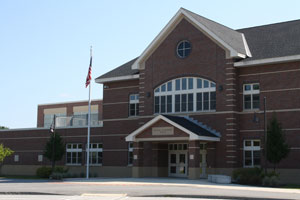 Durham Community School, then known as Durham Elementary School, posted close to a perfect score in a recent school efficiency study.
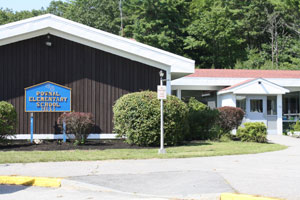 Pownal Elementary School was recently deemed a more efficient school in a study by the University of Southern Maine’s Center for Education Policy, Applied Research, and Evaluation.
Comments are no longer available on this story