
FREEPORT- You don’t have to go very far to see how much the price of lobster has dropped.
Consumers can pick up lobsters at seafood markets for less than $4 a pound – at some places, a lot less. Many restaurants, too, have cut lobster prices.
While that may seem good on its face, the fact is that the dropping prices, which have been tied to a glut of soft-shelled lobsters shedding faster as a result of a milder-than-normal winter, are drastically hurting local fishermen and local processors.
Freeport’s Tom Bennett, 35, has been fishing for lobsters since he was 19, said he has heard of fishermen getting prices as low as $2.30 to $2.50 a pound for lobsters on the dock, a price that will not allow them to make a living. “They don’t even pay you as much for lobsters off the boat as a pound of bologna,” he said last week, standing on the Freeport Town Wharf by the Harraseeket River.
“The price of lobsters is down, but the price of bait and everything doesn’t fluctuate,” Bennett said. “You still have to pay the same amount for bait and fuel and your help. They don’t want to take a hit because the price is down. If you get two barrels and pogys and a barrel of redfish, you’re talking about $400 of bait on your boat before you even start, then you put $100 of fuel in, then you’ve got a helper on there for $100-$125. You do the math, you’ve got about $600 (invested before you go out),” Bennett said, making it difficult, if not impossible, to catch enough lobsters in a day to make a profit.
Darryl Murray, the owner of the Freeport Seafood Co. restaurant, which just opened this summer, said his restaurant is keeping its lobster prices low right now, and they are buying them locally. “We’re selling lobster (dinners) right now for $9.95,” he said. “We buy just about all of our lobsters here of the Harraseeket docks or people that work here in Freeport.”
Murray said he has heard mixed stories about the plight of local lobstermen this season.
“It depends on who you talk to,” he said. “Some (fishermen) are dealing with it and some (fishermen) are having a rough time because they feel the prices are so low it doesn’t even cover their costs.”
Being a new restaurant, selling lobsters at a low price has certainly boosted sales.
“We’re averaging about 100 (lobsters) per day,” Murray said.
But, not all restaurants are dropping their prices to reflect the lower wholesale prices.
“What I find in a lot of other places, it hasn’t been reflected in the prices that they charge,” Murray said. “I have a restaurant in the Lakes Region (the Freedom Cafe in Naples), I have reduced my prices a little, but all of the other guys that sell lobsters in my market haven’t discounted their prices at all.”
Retail sales of live lobster have been strong as local stores work with local fishermen. At Bow Street Market in Freeport, lobsters are selling this week for $5.99 per pound, which is slightly higher than some other retailers, and the store’s lobster tank bears a sign that reads, “We support Maine lobstermen.”
“I would probably say we sell a good 300 pounds per week,” said Patrick Hill, Bow Street Market’s meat and seafood manager, adding that the store gets deliveries from local lobstermen from Potts Harbor Lobster, which is based in Harpswell, six days per week.
Kelly Brodeur, Bow Street Market’s assistant store manager, said the store’s lobster price is based on what it pays Potts Harbor Lobster for its supply, and that price fluctuates depending on what Potts Harbor charges them for lobster. Brodeur said the store is also reaching out to lobstermen’s associations and the Maine Lobster Council to see if there is anything more it can do to help local fishermen.
‘IT’S SUPPLY AND DEMAND’
Robert Bayer, the executive director of the Lobster Institute, a U.S. and Canadian organization based at the University of Maine that works to both sustain the lobster population and help keep the lobster fishery viable, said there is a simple reason for the low price – too many lobsters on the market.
“It’s supply and demand and there is an oversupply of a perishable product,” Bayer said.
But it is harder to explain the glut of lobsters on the market.
“Nobody really knows (why there are so many lobsters),” he said. “It’s likely related to climate change. But there is no smoking gun and we don’t know what this means for the future. “I don’t know what can be done. You don’t know if it’s going to happen next year. This may be a one-time thing or this may be the new normal. You just don’t know.”
Bayer said the annual lobster shed, where the crustaceans shed their shells and grow into legal size, is staggered, generally starting in Massachusetts and working its way up the coast to Maine. But this year, the lobsters were on a different pattern, shedding much earlier.
“This year, it seems like it’s happened all at once,” he said, “and we just don’t know what is going to happen next year.”
For a lobster to be legal, it must measure between 3 1/4 to 5 inches from the eye socket to the base of the tail, Bayer said, adding that the larger lobsters are vital to sustaining the lobster population. “They are a very important breeding lobster,” he said. “Those big lobsters produce a huge number of eggs.”
Bayer said the situation with depressed prices facing local lobstermen this season is unprecedented.
“There’s never been anything like this, ever,” he said. “It’s creating hardship, with low (lobster) prices, your fuel price isn’t changing and your bait price isn’t changing, (fishermen) may have boat payments. It’s pretty tough.”
“Everybody throughout the supply chain is definitely having a hard season,” agreed Annie Tselikis, the education coordinator of the Maine Lobstermen’s Association. “It’s definitely going to be a tough year across the board for the entire industry.”
Bennett said he has certainly seen the effects with his fellow fishermen.
“It’s affecting everyone who’s trying to do this,” he said. “You see boats tied up more days this year than any because I think guys are trying to put a little more bait in (their traps) and haul one less day a week, maybe two less days per week.”
Hauling fewer traps could be one possible solution Bayer also said a closure of the lobster fishery, perhaps for as little as two weeks, similar to what is done in Canada, could help the situation.
But even on a temporary basis, that likely is not going to happen. In a statement last month, Maine Department of Marine Resources Commissioner Patrick Keliher said closing the fishery isn’t an option.
“The department will not be closing the lobster fishery,” Keliher said.”Based on the concerns that have been raised by the industry, I have reviewed our statutory authorities and they do not allow us to shut down the fishery for economic reasons.
”The governor and the Department of Marine Resources share industry’s concerns regarding the low price of lobster due to excessive supply, and we are committed to seeking ways to prevent this scenario in the future through appropriate marketing and management strategies,” Keliher continued. “I have spoken to many industry members about this issue and will continue to solicit ideas going forward.”
‘NOBODY’S HAPPY’
The complaints about the falling price of lobster aren’t limited to Maine. Fishermen in Canada have been complaining about the low prices, and have even turned to blockading some eastern Canadian lobster processing plants to stop the delivery of lobster crossing the border from Maine.
Linda Bean, the owner of Linda Bean’s Maine Lobster, a company that has restaurants in Freeport, The Portland Jetport, Port Clyde and Delray Beach, Fla., as well as a lobster processing plant in Rockland that ships lobster meat for retail sale around the country, said that with only three processing plants in the state, Maine has a hard time competing with Canada. Maine processors are not on a level playing field.
“(The Canadian government) will help pay for processing equipment,” Bean said.
The fact that Canadian fishermen are protesting the importation of Maine lobster shows that this is a widespread problem, she said.
“Nobody’s happy with these low prices,” said Bean.
Bean said her plant in Rockland processes about 2 million pounds of lobster a year in Maine, all obtained from local Maine fishermen.
“We don’t ship to (meat) Canada (for processing) or buy Canadian lobsters to mix with ours in any way,” she said.
But while it would seem that lower prices for wholesale lobster would help boost profits at her processing plant, Bean said that simply isn’t the case.
“The fact that we’re buying twice as much at half the price doesn’t really change anything,” she said. “In fact, it puts more of a burden on our processing plant to hire workers to take care of it. So it’s putting us in a bind, as well. It’s a matter of supply and demand and there’s way more supply than demand.”
But, Bean said, because her company processes its own lobster, it can help the local fishermen by always having the ability to purchase what they catch.
“Our doors have never closed,” she said. “If they want to fish, we’ll buy it.”
CREATING NEW MARKETS
While increasing the lobster meat processing capability in Maine is one possible solution, Tselikis said she doesn’t believe that is the answer.
“Everyone keeps on talking about processing, and let’s do more processing,” she said. “But processing is not a silver bullet for this industry. Because you still have to sell the product once you’ve processed it. Processing just increases the shelf life and makes the product into a usable form so it can easily go into restaurants, food service or retail.”
To that end, Tselikis said, the Maine Lobstermen’s Association is looking to enhance the promotion and marketing of the Maine lobster brand with an eye on creating new markets for the product and increase demand for Maine lobster both in the U.S. and around the world, in hopes of driving prices up.
“There’s a lot of opportunity abroad,” she said. “But there’s a lot of opportunity in this country, as well.”
Bean said she is also working to get her Maine lobster products into more markets, both in retail and in places that do a high volume of food service, such as Walt Disney World.
“We’d like to get it into major markets,” she said. “Places that do major buying.”
But in the end, those solutions are not going to pay dividends to fishermen who are hurting right now. Bennett said he thinks a lot of his fellow fishermen are going to have a tough time paying all their bills and making a living with the current pricing situation. “I think a lot of guys profit margins are cut down drastically,” he said.
But when asked if he would consider hauling up his traps and look for another line of work, Bennett didn’t hesitate to say he would be sticking with lobstering. “I’m this far into it, there’s no backing out now,” he said.
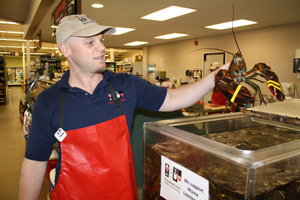 Patrick Hill, Bow Street Market’s meat and seafood manager, plucks a large lobster from the store’s tank. Hill said the store, which gets all of its lobsters locally, is selling about 300 pounds per week.
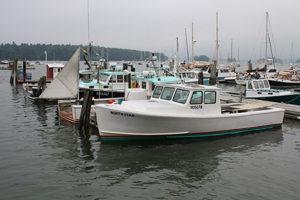 Lobster boats sit at their moorings on the Harraseeket River in Freeport. Falling prices for lobster have been hurting local fishermen all season.
Comments are no longer available on this story