
DURHAM –Durham’s David Barber has a creative side when it comes to wood. Now it’s his livelihood.
After he got out of the Navy, Barber, 44, began working with wood, eventually studying furniture design and woodworking as he began his second career.
After a number of years of training and working in local shops, Barber, with some help from a Veteran’s Administration grant, started his own business, Forwood Thinking, in February. He hopes to build the business into much more than a simple woodworking shop. Barber’s plans include having other woodworkers come and use his equipment, making his shop a true community wood shop.
Forwood Thinking is open by appointment only. Anyone interested in working with Barber to design custom-made furniture can contact him via email at thebarberofmaine@yahoo.com or by phone at 449-2012. Samples of his work can be seen on Forwood Thinking’s Facebook page.
Barber recently took a few minutes to answer some questions from the Tri-Town Weekly about his business.
Q: Tell us about your military service.
A: I joined the Navy in 1994, I was stationed in Virginia Beach where I joined Carrier Air Wing 8 attached to the aircraft carrier USS Theodore Roosevelt. We soon became the primary carrier for the 1995 Bosnian conflict. I continued working as an air wing photographer’s mate until my enlistment ended in 1997.
Q: How did you get started in working with wood and building furniture?
A: A barn-raising event at the National Building Museum in Washington, D.C., inspired my appreciation for honest wood joinery that later led to a timber framing job in South Bristol. I then qualified for a veteran’s vocational rehabilitation program through the Togus VA, which granted me educational and start-up small business benefits. I majored in furniture design and woodworking at the Maine College of Art, studied at Haystack Mountain School of Crafts and the Center for Furniture Craftsmanship in a nine-month comprehensive furniture program.
Q: When did you decide to start your own business? When did you open?
A: I’ve trained for the past six years in local cabinet shops and have worked on the design and construction of my own shop. My wife, Irene, a landscape designer, along with family and friends, have given me great support in the jump to business ownership. I officially became operational in February of this year.
Q: What kind of equipment do you have?
A: I have commercial-grade machines, primarily from Minimax and Laguna, which can handle all project sizes. Pictures of the shop are available on Facebook.
Q: What is your vision for Forwood Thinking? Are you looking for it to be more than just your own shop, such as a place where people can come and work on their own projects?
A: My vision is to fill the niche as a community design/build wood shop that can serve individual clients, as well as local businesses in the wood and building trades. With a name like Forwood Thinking, I don’t like to be labeled as one kind of shop, but open to many creative projects. I recently finished designing and building truck bed components for a custom 1931 Model A. I have experience in a variety of furniture, cabinet and marine projects. I’ve also tried to build a creative shop environment to attract other wood artists to work with me and on their own projects.
Q: How has the response been to your business?
A: So far, I’ve received positive feedback and have gained projects through word of mouth. I am now designing a built-in cabinet unit, building a small kitchen project, and finishing a custom cherry table. I am available, by appointment, to meet with clients throughout the week.
Q: What are some of the pieces that you have made that you are most proud of?
A: A few years ago, I built a Frank Lloyd Wright-inspired chair of ash and oak. I used a drawboring technique that required no adhesives, just offset pegging. It is a great example of lasting strength through precise joinery.
Q: How long does it take to make an average piece of furniture, such as a table?
A: First I meet with the client, understand their needs and wants, see their space and talk dimension and style. I then come up some designs and images to see if we are heading in the right direction. Once a design is approved, materials and hardware are ordered. Next comes the milling, assembly, and finally finishing, with the whole process, depending upon size and complexity, can be one to five weeks.
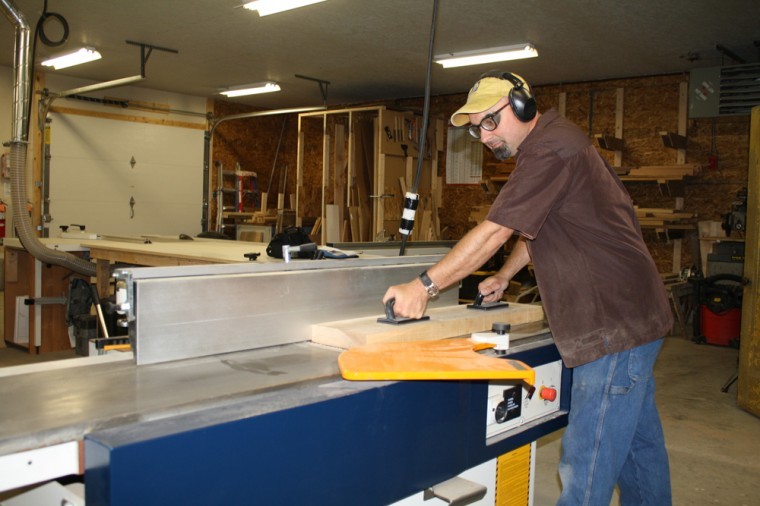 David Barber of Durham works in his shop last week. In February, Barber opened his own furniture design and woodworking business, called Forwood Thinking. (Staff photo by Mike Higgins)
Comments are no longer available on this story