
(Editor’s note: Looking Back is a weekly column including news items reported 10 years ago in The Current, which celebrated its 10th anniversary in September 2011.)
Issue of July 3, 2002
Joan Gordon and her partner, Clark Rundell, are biomedical entrepreneurs.
They saw a problem: laboratories don’t have good control samples for testing DNA. Many rely on samples from patients or their own employees for the controls in their experiments. The fix: Produce a synthetic DNA sample that could be tested against DNA sent to the labs.
But as any good entrepreneur knows, making money takes more than just a good idea. Gordon and Rundell needed investors. To get them, they needed to develop a product, which would require expensive equipment and laboratory space. They picked Scarborough as the place to start their business.
With the construction of the $14 million Maine Medical Center Research Institute, an expanding biosciences program at a local university and plenty of developable land, Scarborough could become home to more and more biotech companies. Harvey Rosenfeld, the president of the Scarborough Economic Development Corp., said the 1,000 undeveloped acres along the Haigis Parkway could some day be home to biotech companies.
“I always look at the Haigis Parkway as a potential for biotechnology and research centers. But we’ve got to get the infrastructure in place. When they’re ready to come, I want to have the infrastructure in place for them.”
G. Rick Dobson Jr. has been elected president of the South Portland/Cape Elizabeth Rotary Club for the 2002-03 year. Dobson took the helm on July 1 and will serve for one year, replacing last year ’s president, Bob Packer.
Cape and Scarborough schools have no formal policies on the Pledge of the Allegiance – some schools rarely recite it and others every day – and are not worried about the effect of a recent federal court decision declaring the pledge unconstitutional.
In Cape Elizabeth, elementary and middle school students say the pledge daily, according to Superintendent Tom Forcella. At the high school, students hear the pledge recited over the school’s intercom system each Monday morning.
After Sept. 11, some CEHS students petitioned the administration to institute the recitation of the pledge daily rather than just Mondays. Principal Jeff Shedd asked the student government for its advice. In late October, the student government decided not to recommend any changes.
About 40 residents from Prouts Neck and Black Point gathered at Camp Ketcha June 27 to express their wishes that natural areas in the neighborhoods be preserved forever.
Most were senior citizens, but the youngest resident in the room was only one month old. Her parents, John and Ruth Hughes, were there, Ruth said, to make sure their opinion was heard in the town’s visioning process.
Ann Delehanty knelt down at the edge of a pond and dipped a plastic pitcher into the water. Tall clusters of grass sprouted from the water’s surface. A nearby frog released a plaintive “croak.”
As Delehanty drew the pitcher out, small pieces of sediment swirled inside.
Delehanty was checking the turbidity of a detention pond, the water that serves as the first line of defense against pollution for the Scarborough Marsh Watershed.
Delehanty, a biologist for IDEXX, has been volunteering her time to improve water quality in Scarborough. For the past two years as new homes and subdivisions have been popping up all over town, she has been working to ensure the development doesn’t mean more pollutants washing into the rivers.
Her work came at a perfect time for the town, which will have to begin conforming to new regulations the Environmental Protection Agency is enforcing under the Clean Water Act. The new regulations will require developers to come up with better systems for managing runoff, and towns to educate residents about how to limit pollution, something Delehanty has been doing since the fall.
Several residents of Littlejohn Road met with Cape Elizabeth Police Chief Neil Williams last month to discuss the problem of speeders on the residential street. About 20 residents had signed a petition asking the police to help with the problem.
Meeting organizer, Peter Hollingsworth, said he has seen people go by at speeds up to 50 miles per hour. The street’s speed limit is 25 miles per hour.
Doug Campbell may have the most understanding neighbors in all of Cape Elizabeth. He is a bagpiper who practices at home.
Sometimes – rarely – he plays the instrument in the back yard. His neighbors tell him they enjoy it, but he worries that could come to an end.
More often, he practices inside, where his family has become so accustomed to the loud noise that nobody bats an eye when he starts to play.
Sometimes, Campbell practices at Fort Williams, but he finds that can be more trouble than it’s worth. When he’s practicing, people come by and consider it an impromptu performance.
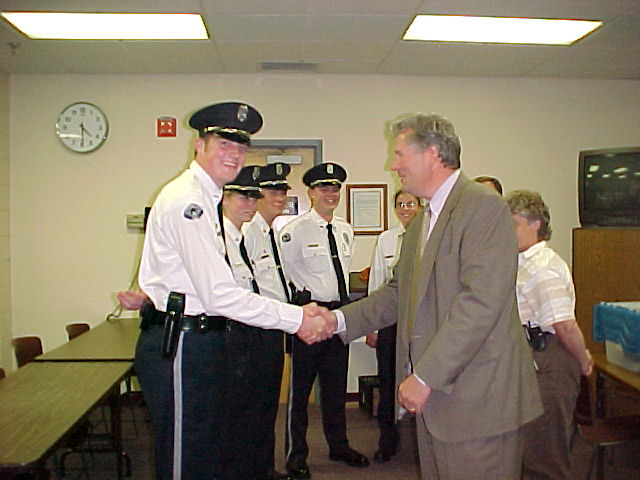 Chief Robbie Moulton of the Scarborough Police Department shakes the hand of Explorer Captain Brian Nappi and wishes the rest of the Post good luck before a trip to Flagstaff, Ariz., in this file photo from July 2, 2002. The group was headed to compete at the National Law Enforcement Explorer’s Conference. (File photo)
Comments are no longer available on this story