
PRESUMPSCOT RIVER – If you were outside recently, you surely noticed that the bugs are back! Buzzing around and keeping busy, insects are just as happy about the nice weather as we are.
It’s during the month of May that the aptly named mayfly cycles into its final stage of life: adulthood. And keeping busy is exactly what it does, as this fly has only a short 24 hours of adult life to find a mate and reproduce, all while avoiding predators.
Flies may be a nuisance, but as topics of study, they are beyond fascinating. The mayfly begins its life as an egg, laid in freshwater streams or brooks during May. Its life cycle lasts just about a year, beginning and ending in the month it is named for. Mayflies remain in the egg stage for a few days to a couple of weeks, depending on the species of the mayfly. It emerges from its egg as an aquatic larva.
The best way to identify a mayfly larva is by its legs and tails. Mayfly larvae have six legs and two or three (more common) tails, depending on the species. Mayflies are clean water indicators; as larvae, they are only able to survive in fresh, unpolluted water. When shaken loose by strong currents, mayfly larvae make great meals for Brook trout, another of Maine’s clean water residents.
As the mayfly larva matures, it sheds its skin, or molts, numerous times. The moments after molting are a vulnerable time for the mayfly; it is easy prey until its outside skeleton has hardened. After its final molt, usually during an evening in May, the larva will leave its river home and crawl out of the water onto a nearby tree or hard surface. The once-aquatic insect will dry and hatch into a winged mayfly, thus beginning its short 24-hour jaunt in the air. Male mayflies will cluster over the water, and as the females arrive, the males will reach out and select mates. The female will lay her eggs in the water to later develop into larvae, and then the adult mayflies will die.
Trout anglers watch for mayfly casings, as trout are aware that recent mayfly hatches create easy meals. Mayflies don’t bite people, so do be sure to enjoy their brief spring fling if you’re lucky enough to see it.
Every year we spend the first couple of weeks in May helping our partner schools release fry (baby trout) into rivers, as part of our Trout Hatchery Program. This year we took 400 students on a journey raising baby trout and exploring their habitat: clean water. Before the students release their baby trout into the river, they test the water and examine the bugs that live there.
Mayflies are clean water indicators; as larvae, they are only able to survive in fresh, unpolluted water.
Megh Rounds is an environmental educator at the Portland Water District. She can be reached at mrounds@pwd.org.
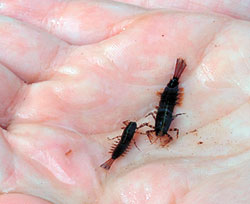 Above is a photo of the larva stage of a mayfly, which are found only in clean-water environments such as the Presumpscot River.
Comments are no longer available on this story