
GORHAM – The deaths of 23 horses since Easter at Whistlin’ Willows Farm on Nonesuch Road in Gorham are unprecedented, according to the state.
In more than 30 years, “I’ve never seen anything like this,” Dr. Donald Hoenig, a Maine Department of Agriculture veterinarian, said Tuesday.
Hoenig said all 23 horses either died or were euthanized by local veterinarians after succumbing to symptoms of botulism, a form of food poisoning. Hoenig said the horses appear to have contracted the toxin from balage – a method of gathering chopped hay or plant material into large, round bales and sealing them in container, usually by wrapping them in plastic, at a high moisture content, to increase forage value per acre.
“We know they were fed both balage and dried hay,” said Hoenig. “The balage is where we are focusing right now.”
Hoenig said the toxin caused the paralysis in the horses – they couldn’t stand up and couldn’t swallow.
Meanwhile, the state is requiring the farm owners, William and Anne Kozloff, to excavate a drain around the site where the horses were buried to eliminate danger of groundwater contamination.
“The horses were not buried properly,” Hoenig said.
The state is requiring a “curtain drain” be installed to divert water around the burial area. Hoenig, who was at the farm Tuesday, said the farm owners are cooperating.
“We’re working with them to make changes to the burial site,” Hoenig said.
Hoenig said installation of drainage would bring the burial site into compliance with state rules.
Some neighbors of the farm have been concerned about contamination of water by the carcasess. Hans Hansen, a resident of South Gorham, who has drilled artesian wells for more than a half century, described the ground at the farm as hard-packed.
Hansen, who was not involved with burying the 23 horses, said he had upon occasion during the past 20 to 30 years previously dug graves to bury horses at that farm.
“I never saw a problem” with the water table, Hansen said.
Hansen believes any fears by neighbors about groundwater contamination are unfounded.
“There’s a panic over nothing,” Hansen said. “If there is a problem, the state will figure it out.”
According to the Whistlin’ Willows Farm website, the stable breeds, raises and markets horses for show and pleasure. The website also said the 175-acre farm boards horses. The site said the farm is home to “over 50 horses,” meaning it has lost almost half of its stock since the first reported death on April 7.
“I believe they (deceased horses) were all owned by the farm,” Hoenig said.
The state has contacted the feed supplier, Hoenig said. He declined to release the name of that company because, “We don’t think we know everything we need to know just yet. We are right in the midst of the investigation, so we want to make sure we have all of the facts straight.”
Hoenig said there appears to be “very little” danger to other area stables. Still, because botulism is “very hard to test for,” he cautioned similar operations from using balage.
“It’s not really a good practice to feed balage to horses because of the possibility of botulism,” he said.
Gorham Police Chief Ronald Shepard said Tuesday that his department had not received any complaints about the farm or the horses “until someone called about the dead ones. We notified the state.”
An animal welfare staff member and a humane agent, Hoenig said, determined there were no humane issues with the surviving horses at the farm.
The stable, Hoenig said, has changed the feed it’s using and no additional horses have become sick in the past few days.
The Kozloffs did not return a telephone call, but responded this week to an email by saying they were “not at liberty to comment right now.”
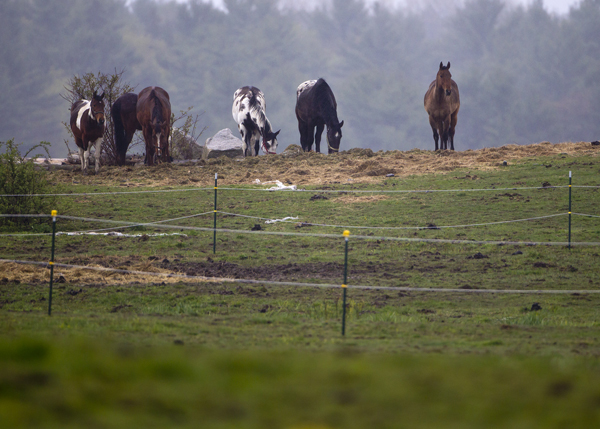 Horses graze this week at Whislin’ Willows Farm on Nonesuch Road in Gorham, where the deaths of 23 horses in April are being investigated. (Photo by Rich Obrey)
Comments are no longer available on this story