
STANDISH – After 20 years of failed proposals aiming to create a beach on Sebago Lake for Standish residents, the previously illusive prospect may be closer to reality.
Twice in the past – in 1992 and again in 2002 – beach proposals were raised by the Portland Water District in which beach access was traded for removal of the Standish Boat Launch in what is the environmentally sensitive Lower Bay, close to the district’s intake pipes for its nearby water treatment facility.
But with last week’s signing by the Portland Water District’s board of trustees of a preliminary beach proposal drafted and already approved by Standish officials, the likelihood of a beach is greater than it has been in several years. And with officials on both sides pointing to a new spirit of cooperation, this time, if voters approve, residents could be visiting a Sebago Lake beach within five years.
But both sides have been here before. Previous attempts saw much work performed to draft engineering and design plans on different proposals. Both times, after intense lobbying campaigns, Standish voters rejected the proposals.
Now, after another decade has gone by, the town and Portland Water District are on the road to another project – simpler in scope – that would open public access to the Sandbar Beach, located on the western side of the lake. The Sandbar Beach is already open to boaters, but the landlocked beach, which is more than 100 yards long and set in an idyllic location overlooking Big Bay and Frye Island, is inaccessible by land.
While the location is just outside the district’s two-mile, no-bodily-contact zone – meant to protect the drinking water supply – it is upstream from the intake pipes, since the lake flows in a counter-clockwise rotation from its upper reaches, down to Lower Bay and up the eastern side to the basin where the lone outlet is located. Previously, the district has thwarted plans for a western-shore location due to the hazard posed by bacteria from bathers.
For the last two years, a seven-member committee, made up of Standish councilors, residents and a Planning Board member, has been working with three Portland Water District trustees to hammer out an agreement – called a memorandum of understanding – regarding the Sandbar Beach. The Standish Town Council approved the memorandum in February and the nine-member board of trustees unanimously signed the document at its meeting last week.
The memorandum is a starting place for the more serious upcoming discussions regarding an official lease for the property, which sits on 200 acres of what is known as the Cargill lot. According to the memorandum, the town is interested in 15-20 acres of the lot and would build an access road from nearby Harmon’s Beach Road, a parking lot and bathroom facilities. Because the sandbar is inaccessible due to water level, separated by a small inlet, a walkway bridge of some type would be built.
The Cargill lot, named for the family that sold the property to the water district, is among many thousands of acres the Portland Water District owns in the area of Lower Bay. In all, the district owns about 9 miles of shoreline. And while the district opened some of its land to recreational use in the mid-2000s, much of its property remains off-limits, since it forms the watershed for greater Portland’s drinking water supply.
Bill Lunt, who’s been a district trustee for 16 years and has worked with Standish officials on previous proposals, as well as the current plan, is buoyed by both bodies’ recent signing of a memorandum. Lunt said while a memorandum has been struck, the real work now begins between the trustees and town officials brokering terms of a 25-year lease.
“The reason the district is more amenable to it is because it’s outside the two-mile limit, which allows bodily contact,” Lunt said. “And quite frankly, we’re not done yet because all the memorandum does is shows that both entities are willing to talk about it and hoping to get it done based on some broad parameters. Now we need to negotiate the actual lease for the property. And then there’s going to be a management plan, how we control the beach, who does what, those kinds of issues. So the heavy lifting isn’t over yet.”
Lunt has watched previous signed memorandums give way to tense lease negotiations that ultimately fail when voters are asked to weigh in. The deal would also need voter approval, since needed development such as a road and parking lot would likely cost more than $75,000, the point at which capital expenditures need such approval. But Lunt believes there’s a new spirit of cooperation between the two sides, and he hopes Standish will finally get its Sebago shoreline beach.
“There’s a terrible, terrible trust issue between the district and town of Standish, but I do think some of that is changing,” Lunt said. “There’s some of the old guard that’s still there. And there’s always the old, old, old issues that keep coming up, and it’s like, let the old stuff go. Some of the stuff that’s been thrown at me is stuff that took place before I was even born, and I’m 69 years old. But it’s ancient history.”
Lunt said he is referring to hard feelings held by some in Standish provoked by what was seen as an overzealous water district taking land by eminent domain more than 100 years ago. Then, as well as now, residents have felt cheated because the district owns vast property in Standish for which it pays little in property tax, since the land is held in tree growth. But that animosity is subsiding, he says, partly due to recent actions to improve public relations on the district’s part.
“There’s a very strong part of me that says we need to get something for Standish because they are, in fact, sacrificing a great deal of property that could be highly taxed if the water district wasn’t there. And I’ve understood that my entire life,” Lunt said. “But what I think tipped the ball is that we adopted a policy that allowed us to open our property around Lower Bay that always used to be no-trespassing. Sixty to 70 percent of our land we opened up for limited recreational use, so I think that was the tipping point that got us on track so we could talk together,” Lunt said.
Others involved with the issue hold out hope the cooperation will continue through to a signed lease and management plan, the next two phases of the project. Those have to be decided before costs can be calculated and voters can decide on whether to spend money to make the beach a reality.
Good feelings
Lynn Olson, a Standish councilor who was one of the signers of the memorandum, praised the work of Standish’s ad hoc committee, which developed the memorandum.
“It took a long time because it’s a complex issue. And obviously the water district is concerned about the safety of the water quality, so we’re just thrilled we have gotten to this point and that the work of making it come true can take place,” Olson said.
Standish Town Manager Gordon Billington, who has seen two previous efforts fail to bring a beach to Standish, is wary of the coming phases and voter sentiment, but still hopes for a different ending.
“We’ve been working for quite some time with the district. Our comprehensive plan sets out a strong desire for a beach and the trustees recognize that their charter does have provisions in there for Standish residents to use a beach outside the two-mile limit. So it’s certainly been part of the discussion for a very long time,” Billington said. “But I’ve heard a lot of people doubtful. The third time ought to be the charm. That’s a good way to put it.”
Councilor Karen Tompson, who chairs the ad hoc committee, praised the work of fellow committee members: Councilor Lou Stack, Councilor Michael Blanck, Planning Board member Steve Nesbitt and three Standish residents, Joyce Matthews, Tanya Adriance and Wayne Newbegin. Newbegin, she added, has a special rapport with Lunt, which helped advance the proposal. Tompson sees much work ahead as well, but remains optimistic.
“This is definitely a long time in coming, and we have a long way to go, the next step is forming a committee which will work on the lease and management plan. The ad hoc committee will be disbanded,” she said.
Terry Christy, a former longtime town councilor who worked on a previous proposal at the nearby Pine Cove Beach, is excited about the developments.
“It’s a long time in coming. People in the town of Standish have wanted a beach for a long period of time and a lot of good people have put in a lot of hard work to get to this point. Now, the council and trustees have come together and they understand each other and I’m tickled pink. It is excellent news,” he said.
Christy said the ability of the two sides to effectively negotiate may signal a de?tente of sorts, a putting aside of perceived injustices to forge a mutually beneficial relationship.
“It’s symbolic because for a long time there have been people in Standish wary of the water district, but I think to a certain degree that has been misread by a lot of people and I think they’ve always wanted to do something with the town of Standish, but the legalities have always gotten in the way with that,” Christy said. “But there’s a long road ahead, there’s going to be a lot of work to get to the point where people will be able to go down and use it.”
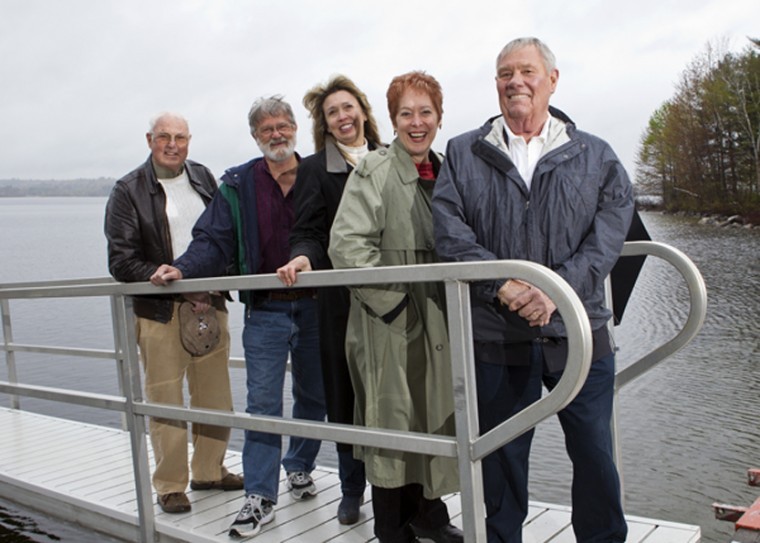 Members of the negotiating team that developed the agreement between the town of Standish and the Portland Water District that could lead to a Standish residents beach on Sebago Lake brave the rain and wind to pose on Tuesday on the gangway to the water district security boat. They are, from left, Standish Town Manager Gordon Billington; water district trustee Bill Lunt; Town Councilor Karen Tompson, who chaired the Beach Ad-hoc Committee; Town Council Chairwoman Lynn Olson; and Wayne Ross, president of the water district trustees. (Photos by Rich Obrey)
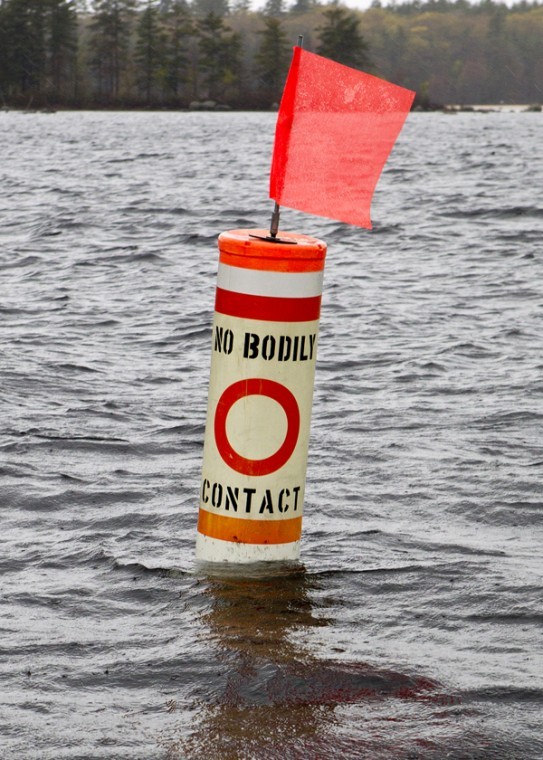 One of the many buoys marking the two-mile “no-bodily-contact zone.”
Comments are no longer available on this story