
STANDISH – The Standish Town Council has a big decision to make in coming weeks regarding a recently crafted downtown zoning ordinance that aims to create a village atmosphere on the Route 25 corridor through downtown.
Prompted by the Higgins family, which owns a key central property in the downtown, the council is set to decide on whether to amend the ordinance to allow drive-through retail businesses, which would open the area to banks and pharmacies.
Opponents of the drive-through amendment argue that it could have adverse impact on the new village code, which is future-focused and aims to make Standish more pedestrian friendly and discourage vehicular traffic. On the other side are those wanting to lure business to the downtown and lift restrictions that have so far banned large-scale developers from the village center.
Reflecting the importance of the topic, about 50 people turned out at the April 10 council meeting for a several-hour-long discussion on the amendment submitted by Councilor Lou Stack that would allow for drive-throughs in the downtown Route 25 strip. And while nothing was resolved by the end of the meeting, councilors and the public explored all sides of the issue – the significance of allowing property owners to develop, the need in a struggling economy to allow businesses to move into town and the importance to stay true to a new zoning code adopted after several years of hard work by residents and town planners.
While the council will decide the amendment’s fate, the matter will first be turned over to the ordinance review committee, a standing committee made up of town councilors. They are expected to make their recommendation to the full council in coming weeks.
A central issue
Standish residents Robert and Izzy Higgins have been trying to sell their 3-acre lot in the southwest corner of the routes 25 and 35 intersection – also known as Standish Corner – for about eight years with no luck.
In 2005, they were the subject of a lawsuit aiming to include their home in a proposed Standish Historic District. After $14,000 in legal fees, they were able to opt out of the proposed district and keep their property on the market. However, with the downturn in the economy in 2008, the property got little attention from the kind of large-scale developers who could invest in the prime lot. In 2011, they were able to sell the 200-year-old house on the property to a restoration expert who transported it to the Rockport area. Also in 2011, the pharmacy giant, Walgreens, expressed interest in the large corner lot. However, the deal fell through when Walgreens discovered Standish’s zoning ordinance, adopted in June 2011, banned drive-throughs in the downtown district.
Faced with an impending retirement that was to be financed partly with the sale of the Standish Corner property – formerly owned by Bob Higgins’ father, who operated a garage on the property – the Higgins family is getting more proactive in their own future by requesting an amendment to the code to allow drive-throughs commonly used by retail establishments such as a pharmacy or bank.
“They have passed a very restrictive zoning ordinance with the idea of making a tree-lined, walkable village out of that intersection of route 25 and 35,” Izzy Higgins said, “But that’s not going to happen in my lifetime and I’m not entirely sure it’s ever going to happen. But this is their plan and all the businesses that have been interested in our property up until now have been pharmacies, banks, whatever, and they all want drive-throughs. It’s a prime commercial property with frontage on two streets. Developers look at it and salivate because there’s a high traffic count and it’s perfect for business.”
Higgins brought her zoning amendment request to Lou Stack, a member of the Town Council, who submitted the request on her behalf. The order would allow drive-throughs for retail establishments only, not restaurants such as McDonald’s, as has been rumored.
Stack sides with Higgins, saying the development of the property would lead to the creation of needed sidewalks, which he said would aid in the “walkability” of the area as well as employment.
“My concern is that the property gets sold so that there can be businesses and jobs brought to the town, which is my whole intent here,” Stack said.
Form-based code
Standish’s new downtown zoning plan was adopted last June after the town qualified for grants to pay for planning services. Standish worked with outside consultants to incorporate the new pedestrian approach to the downtown, known as form-based code.
In form-based code, according to Planning Board vice chairwoman Carol Billington, sidewalks are widened, the roadway is narrowed to slow traffic, residences and businesses are allowed to share mixed-use buildings, and the exterior design of buildings is more regulated. The goal of the code is to allow more types of businesses to occupy a zone, which would allow for a greater village atmosphere and reduce the need for residents to drive to different zones for school, work and shopping needs.
In a process that started in 2003 and ultimately ended last year with the adoption of the form-based code, Billington said the last thing those who were involved with the effort to get Standish moving away from vehicle-focused zoning and toward a walkable downtown is to allow drive-throughs, which hit at the very heart of the code’s intent, she said.
“For me, the problem is they’re asking that the entire zone be changed to allow drive-throughs, not just their one piece of property,” Billington said.
Billington spoke last Tuesday night and pleaded that the council not change the entire zone, but to perhaps consider an exemption for the Higgins property that would allow drive-throughs for retail uses. She sees that as a workable compromise.
“The heart of the changes is to calm the traffic, and the noise and the speed, so I suggested they look into the contract zoning,” she said.
It’s the economy
Higgins offers a differing view on the form-based code. She described the new zoning ordinance adopted last year as an “incredibly complex system touted as business friendly but that is anything but.” She says local residents and businesses weren’t aware of the “sweeping changes” that the code would bring, and that legitimate businesses that could anchor the corner are not welcome.
Higgins isn’t the only business feeling the pinch.
Kari Kelley, owner of Blasted in Stone located in the old Fairpoint building at Standish Corner and a resident of Standish since 1991, says the corner is the town’s most strategic commercial spot and its current state, in which two of the four quadrants are eyesores featuring a shuttered gas station and vacant land, is less than ideal for existing businesses in the area.
“The restrictions are really tight. I do like the small village feel and I feel there are ways to allow other businesses to move in here,” Kelley said. “We here in Standish have to drive different directions to get some of the items we need, so, in my opinion, to see these properties empty is sad because we want to see Standish grow.”
Terry Christy, a former longtime town councilor who often plays a mediating role at contentious meetings, and did so at last week’s debate, describes the Higgins parcel as a “showpiece parcel. It’s in the middle of town. There’s a lot of history associated with Standish Corner going back to the good old days. It’s not the same as it used to be, but it still has a charm about it.”
Christy said he was glad the council agreed to forward the matter to the ordinance review committee.
“I feel pretty adamant that no law is written in stone,” Christy said. “It’s always open to interpretation as time passes to make sure it’s doing the job it was supposed to. And I would hope any law we have on the books, that I as a citizen would be able to come in if I have a problem with it and ask about it. And that’s what’s been done here.”
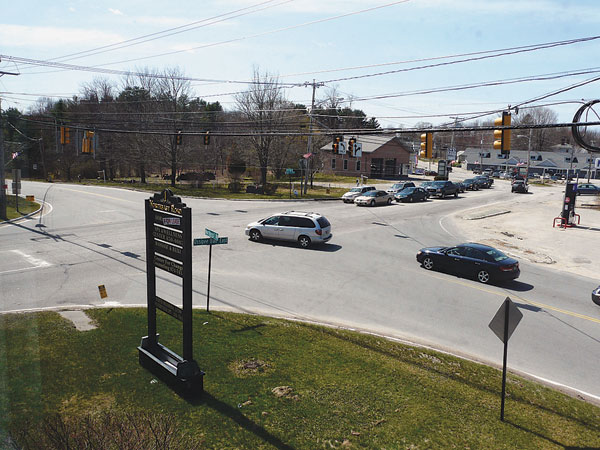 The intersection of routes 25 and 35 in Standish is one of the town’s busiest. After losing a potential developer due to a stricter building code in the village district, one of the abutting property owners is petitioning the town to allow for more uses in the zone.
Comments are no longer available on this story