
WESTBROOK – With its diverse population, Westbrook High School is fairly typical – its student body includes athletes, artists, musicians, scholars and the academically challenged.
Also, like most high schools, Westbrook High School has students who struggle with drug and alcohol abuse. The school employs counselors to help those with serious issues, and it also has peer-counseling groups that allow kids to talk to fellow students about problems and get some perspective from someone who knows exactly how hard it is to be a teenager.
Now, in an effort to get families and the community at large to help in the battle against teen substance abuse, Bruce Dyer, the high school’s substance counselor for the past 10 years, will host a city-wide forum Monday, April 30, at 6:30 p.m., at the high school auditiorium.
“We’re attempting to reach out to parents and community members to pull them into the conversation,” Dyer said. “This isn’t a school problem, this is a community issue. Our thought it that when we talk about the drug issue in our community, that having a partnership among community, parents and school is an effective one.”
The forum will feature a panel made up of Dyer, Westbrook Public Safety Director Mike Pardue, District Court Judge Keith Powers, representatives from the Westbrook schools and Westbrook High School graduate Kyle Shangraw, a member of the class of 2005, who will be sharing his story about his struggles with substance abuse.
Dyer said the idea for the forum has been in the works since December, when the school administration began to look for ways to help boost its response to drug use in the schools.
“We wanted to be as far ahead of the curve as possible,” Dyer said.
Dyer is quick to add that while some students are struggling with drug and alcohol problems, that fact shouldn’t color the perception that the high school is worse than any other school in the area. He said there are many kids at Westbrook who are staying clean and some of them are working to help their classmates.
“We have great kids at Westbrook,” Dyer said. “When we take a look at the drug and alcohol problem, it emanates out of the community. We’ve got some kids at the high school who are making some terrific decisions. They are great role models for the younger kids. And making a positive impact to their community and the climate and the culture of the school.”
Sam Stauble is a junior at Westbrook, and is one of those students who is trying to help out other kids. He is a part of the RSVP (Reducing Sexism and Violence) program at the school, whose members talk to their peers about unhealthy relationships and the problems that drugs and alcohol can cause in those relationships.
Stauble, who said he has stayed away from drugs, knows that there are kids at the school who have problems with substance abuse. He said it’s not that hard to see.
“You know when guys are leaving school for a half an hour, they’re going to go smoke,” Stauble said. “I’ve never done anything and it’s not even an issue for me anymore.”
But, Stauble said, he doesn’t think the issue is limited to Westbrook.
“I think drugs are everywhere,” he said. “It’s not just a Westbrook thing or a city thing, I think it’s everywhere. It’s not cool, they just don’t know, they’re just sucked in by the culture that they see on TV, so it’s become a more natural thing to conform to the least common denominator.”
Dyer agrees with Stauble’s assessment that today’s popular culture and it’s attitude toward drugs and alcohol can be problematic, especially with impressionable teenagers.
“The culture sends a lot of mixed messages about alcohol and drugs,” Dyer said. “The media frames this out as being a good time, there are no consequences attached to using alcohol. It’s all one good time: no pregnancies, no one throws up, no one gets sick, no one goes to jail, no one dies. Kids think, ‘Gee, this is never going to happen to me,’ but it does happen. The RSVP program talks about unhealthy relationships as being a byproduct of drug and alcohol usage. Date rapes, abusive relationships are part of this whole experience and there is a definite dark side when kids get together and use substances.”
Aisha Errington is also a junior at Westbrook and, like Stauble, is a member of the RSVP program. She said she has had friends try and get her to go to parties, and while she succumbed to that pressure initially, she has changed her ways.
“I’ve felt peer pressure to go to parties and stuff like that,” Errington said. “I did a couple of times, but I’ve learned my lesson. I still get people bothering me (to go to parties), but I stay away now.”
Dyer said that having kids like Stauble and Errington working with their peers and setting examples is “tremendously effective.”
“Kids who are using, when they take a look at a student who has remained clean, have a lot of respect for that student,” Dyer said. “Often, the kids who are caught in the web of addiction say ‘I wish I could be like that.’ So it is effective for kids to tell their stories and to share their experiences.”
Both Stauble and Errington said that they felt forums like the one being held at the end of this month are valuable to help educate families about the dangers of teen substance abuse and how to fight it.
“I think they do (help),” Stauble said. “Because the more you know, the more you can have an educated decision on why you’re doing what you’re doing and whether you should or shouldn’t do it,” Stauble said.
“I feel like half the problem is that kids don’t know that they have an issue,” Errington added. “They won’t admit that they have a problem, so they don’t know how to get help. I feel that if kids are more aware and knew that they had a problem, they would be more apt to go and find help.”
This isn’t the first such forum to be held in Westbrook, Dyer said that there have been two similar forums during the past 15 years and both of those have been successful and he is hoping for the same success with this year’s forum.
He said he hopes that the the forum will help shine a light on the problems in Westbrook and the fact that it isn’t just kids that are involved.
“I think when we take a look at the issue in Westbrook and the seriousness of it, that people in Westbrook need to say, ‘Enough is enough,’” Dyer said. “Drugs and alcohol are getting into the hands of our kids through adults. There’s a source behind the supply. It’s important for parents to be vigilant, to ask the right questions.”
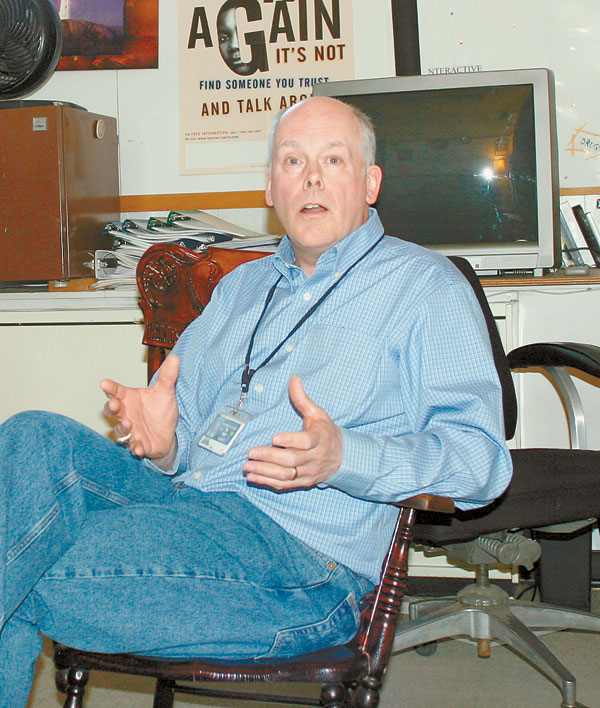 Bruce Dyer, the substance abuse counselor at Westbrook High School, will be hosting a community forum about the problems of teenage substance abuse at the high school on April 30.
Comments are no longer available on this story