
RAYMOND – Last summer, Julie Sutherland brought 25 rescued rooster chicks to her home on Ledge Hill Road in Raymond. Almost a year later, the 16 surviving chicks are full-grown roosters, and their early morning crowing has ruffled the feathers of a nearby resident.
Now, the rest of the town is being asked to weigh in on the neighborly dispute, in the form of a public hearing March 6 on a proposed ordinance banning prolonged animal noises. At the heart of the matter is a debate on how one person’s right to own animals in a rural area jibes with another’s right to a silent night’s sleep.
The ordinance would expand on a barking dog ordinance adopted in 1984 by banning all animal noises that last 10 minutes or longer. It would also ban repeated episodes of intermittent animal noise lasting 30 minutes or longer.
A first violation of the ordinance would result in a written warning by the animal control officer or a sheriff’s deputy. A second offense within six months would result in fines of at least $50 and up to $200 for a third offense, plus any attorney costs.
According to Joe Bruno, chairman of the Board of Selectmen, once the public has spoken March 6, selectmen can amend the ordinance or vote to drop the proposal altogether. If the board approves an ordinance, it would need to be approved by a majority of residents at the annual town meeting in June. That vote could take place by secret ballot or by a show of hands at the meeting, which is June 5.
Sutherland, who moved to 51 Ledge Hill Road two years ago after many years in Yarmouth, rescued the 25 rooster chicks at the Paris Farmers Union store on Auburn Street in Portland last summer. The remaining roosters now live in a small barn along with two rescued horses.
“It’s country. This is part of country living,” Sutherland said. “I love my roosters. I rescued them, and we’re concerned about the town pushing their ordinance through because it is not fair to us people who have livestock.”
While animals are commonplace in the rural neighborhood, Sutherland’s roosters made an impression on her neighbor across the street, Wayne Gelston. Gelston, who says he and his wife had lived in “peace and quiet” for 20 years before Sutherland’s roosters arrived, is at his wit’s end and has even posted a YouTube video documenting incessant crowing of the birds. Last fall, Gelston approached the town in an attempt to find a solution to the noise pollution.
“The last thing we want to do is infringe upon the rights of anyone to own an animal, because we love animals,” Gelston said. “People who lived there previously had animals, other neighbors have animals, and it’s never been a problem. But no one anticipated someone would bring 25 roosters, and that’s where the crux of the issue is.”
Sutherland doesn’t see it that way.
“Our rural lifestyle, our right to have animals is in jeopardy,” Sutherland said. “The proposed ordinance gives 10 minutes for continuous howling or barking. Now, my horses are out playing, what am I going to have to do, go put them back inside? It’s a joke.”
While upset her neighbor didn’t approach her first, but went straight to the town for help, Sutherland mainly sees it as a property rights issue. Gelston sees it in a similar way, that his property rights are being trampled by incessant noise.
With the two at an impasse, former Raymond Fire Chief Denis Morse offered to host a mediation session three weeks ago. The two sides and Morse met at the neutral location of Raymond Town Hall and sat in a room together for an hour and a half in an effort to find a compromise. The effort was partially successful.
During the mediation, it came out that the roosters’ started crowing at 4:30 a.m., in anticipation of feeding and in response to sunlight, as well as wild animals moving through the yard around dawn. Morse suggested Sutherland close the windows to the roosters’ stall at night, and she agreed. Sutherland also agreed to install sound-dampening foam insulation in the stall to limit noise further. She made no further concessions, but Morse feels headway was made.
“Really, what we’ve done is take two things out of maybe eight, and made it better,” Morse said. “And that’s really all you can do when you have a person who has the rights that the farmer does. We just appealed to [Sutherland’s] better side [and the] Gelstons got a few hours in the morning, and that’s all you can do. In my opinion, it was worth two hours of my time and two hours of their time to, ironically, give them two more hours of peace and sleep in the morning.”
After acting as mediator, Morse is stumped as to which side has more rights in the situation, and he doesn’t want to get in the middle of it.
“I don’t think there’s a right or wrong when someone has the right to have the animals,” he said. “What happens is, ultimately, it’s really a compromise situation and you need to appeal to a person’s kindness.”
While Sutherland is limited in how much she can tighten up the barn, since hay, horses and roosters all need ventilation, she is adamant that she won’t get rid of the rescued birds. She sees it as a farming issue. While the roosters serve no egg-laying purpose since there are no accompanying hens, Sutherland says they are excellent for pest control, eating ticks, black flies, horse flies and any kind of bug, “even better than hens.”
Gelston, on the other hand, sees it as an affront to neighborliness and his quality of life.
“It would be like me putting a rifle range on my land and saying, you’re stuck with it. I would never consider doing that to my neighbors,” Gelston said. “I’d go to my neighbors first and say, ‘Is this going to be a problem for you?’ She moved in here and just dumped [the roosters] on us.”
A political libertarian, Gelston says he hated to resort to government intervention by way of a new ordinance, but Sutherland’s refusal to bend leaves him no choice.
“All I want to do is to live my life, and I don’t think that’s a lot to ask,” he said. “The way I look at it is, neighbors are supposed to be neighborly. And to say, the heck with you, there’s nothing you can do about it, and you’re stuck with this, that isn’t going down well with me. That isn’t the way we’re supposed to be.
“And I do I hate when they write more and more laws and more regulations but we have no option since the ordinance was written so restrictively just for dogs, it doesn’t include any other animals.”
Sutherland thinks the ordinance as drafted is overbearing, unenforceable and was a waste of money to develop. She jokes that the town would have to outlaw noises from crows and coyotes at the same time, since they, too, make a racket for sometimes longer than 10 minutes.
Sutherland also thinks the ordinance is written in favor of complainants, since they wouldn’t need to provide verification. With the help of friends who are judges and lawyers, as well as Raymond Animal Control Officer Sue Field, Sutherland has drafted a competing ordinance that would require verification by an authority before a fine could be levied. The verification would need to be made at the same time of day, as well.
“They have no policy in there about the ACO or (police) officer coming over to confirm the complaint. You just automatically get a fine. So, if Mr. Gelston calls and says the roosters are crowing, the ACO would come down and I’d get a fine. That isn’t right,” Sutherland said.
Sutherland’s version of an ordinance will be presented in the form of a petition signed by some her neighbors and other farm animal owners in town. As of last week, she had about 20 signatures and expects to have more by March 6.
“My version is fair to everybody, where some of the burden of proof has to go back on the complainant,” she said. “They can’t just call because they’re mad at somebody or don’t like somebody’s animal. It has to be proven.”
Another neighbor, Peter Blunsden, thinks the whole situation is unfortunate and is against any ordinance. He doesn’t mind when Gelston clears wood from his property, featuring long durations with a whining chain saw, and he also doesn’t mind when his other neighbor’s roosters crow.
“The roosters don’t bother me,” Blunsden said. “Can I hear them, yeah, because I live in a rural area. I hear a lot of animal noises. I hear barking dogs. I hear birds of all sorts. I hear coyotes. So, the roosters don’t bother me.”
What does bother Blunsden is the proposed ordinance, which he calls discriminatory.
“If there’s going to be a noise ordinance in town it should be a comprehensive noise ordinance that would take into account all forms of noise: chain saws, motor vehicles, lawn equipment, etc. To single out animal owners of any kind, I think it’s discriminatory,” he said. “Now, that having been said, I don’t think there should be an ordinance of any kind because I think it’s a violation of the property owner’s rights. But if discussion is going to take place, it needs to be a discussion of all noise.”
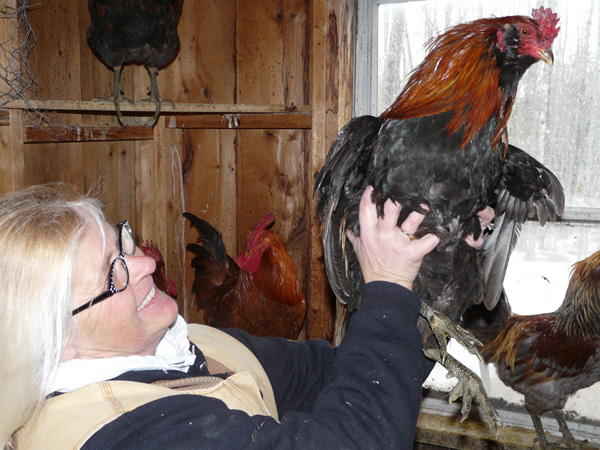 Julie Sutherland, of Leach Hill Road in Raymond. (Staff photo by John Balentine)
Comments are no longer available on this story