
GRAY – Like its name implies, Fiddlehead Art & Science Center in Gray has grown both in size and scope through the years. That growth was celebrated last Saturday night during Fiddlehead’s 10th anniversary celebration at the Ramada Inn in Lewiston.
Opened Jan. 14, 2002, in an 800-square-foot space in Gray Center as an after-school program focused on the arts, the center quickly outgrew the space and moved six months later to Pineland Farms in New Gloucester. Through the next four years as enrollment increased even more, Fiddlehead expanded from a 1,500-square-foot space to a 4,000-square-foot building on the Pineland campus.
Then, in April 2007, Fiddlehead moved to its Shaker Road location in Gray, where an 8,000-square-foot building it purchased with a federal low-interest loan allowed for further programming.
And just as a fiddlehead turns into a fern, the nonprofit organization founded by Mary Jo Marquis, who’s no longer involved, and Jacinda Cotton-Castro, who is the executive director, now offers a wide range of music, art, performing arts, mathematics and science classes both after school and during the day.
In addition, the center operates a preschool program and kindergarten. While the majority of participants are children under 13, there is a large number of teens and adult offerings developed in recent years, as well.
According to Cotton-Castro, Fiddlehead has seen a “steady increase” in enrollment through the decade. More than 100 people of all ages now take private music lessons during the week, for example. A total of 36 are enrolled in the preschool and about 50 students are regular attendees of after-school programs, helped partly since Gray-New Gloucester school buses drop off right at the center at 25 Shaker Road.
As she celebrates 10 years leading the educational organization, the Lakes Region Weekly recently interviewed Cotton-Castro about the program and its importance in the lives of area children.
Q: Where did the name Fiddlehead come from?
A: We had a brainstorming session in front of our fireplace with some of the founders of the organization. And I had left (Central Maine Power) in product development and branding, and we just did one of those name games and started throwing out names. We were going to be Pineland Art and Cultural Center, but one of the early board directors said, “This may sound silly but what about Fiddlehead” And the minute she said that, that’s when Fiddlehead took on its own thing.
No one owns Fiddlehead, Fiddlehead owns us. It has been its own entity right from the beginning, and that’s what been so beautiful about it. And the minute that word was said, we all could envision the opening of a fiddlehead, from fiddlehead to fern (which mirrors) the growth and development of a child in different stages. We knew immediately that was the right name. It was perfect.
Q: What is the philosophy behind Fiddlehead?
A: It’s about fueling the passion, creating a love of learning in a hands-on, minds-on environment. How do we awaken those curiosities? How do we get kids excited about learning? That’s huge. (Our programming is) all the things you wish you had in school all day. They can come here and do after school. We do fiber arts, knitting, Lego robotics. Can you learn math and reading and all academic things through what we do? Absolutely, it’s proven out there in the Maine Learning Results. And so, by having that hands-on, minds-on excitement, they love being here.
Q: Do you try to complement local schools’ curriculum?
A: We don’t necessarily complement, but we definitely work in partnership with SAD 15 and they’re so kind to us in that the kids get directly dropped off to us here. So 50 percent are coming from Gray-New Gloucester. The other percentage, though, comes from Windham, Raymond, Casco. We’ve got some from Cumberland, North Yarmouth. It’s amazing. We draw from everywhere. I’ve heard Limington, Limerick, and I just say what, why are you coming all the way up here? But it’s because they can’t find what we do.
So it’s about awakening their curiosity, unfolding that potential of a child. Because we all think back to our childhood and say, “What if? What if I had taken a painting class earlier? What if I had picked up a violin? Where would I be today?” The ability of a child to be a sponge is really amazing, and it goes to the age of 10, 11, 12, and it’s where they can learn so quickly.
Q: So, the things you’re exposed to as a kid, those are things you’re likely to be interested in when you’re an adult?
A: You’ve exactly hit who we are and why we’re here: To expose kids to those different areas. And for me, I grew up in the backwoods of Maine, so it’s also about keeping kids safe. During those hours from 3-6 p.m. – they call them latchkey kids – it is really important to get them in a safe environment, first of all.
Then, it gets to the engagement part. I was 36, 37, when I started taking art lessons, and I said why do I have to wait so long? Why didn’t I go with the foundation I had when I was younger. But a lot of it wasn’t available, plus parents didn’t know what to do. But today’s parent is much more educated and aware just based on their own experience. And the foundational learning of what we offer from our pre-school and kindergarten all the way up to the after-school program is huge. Their instincts, their nature, we’re just trying to help pull out what their passions are.When you are born, you have these gifts inside you, and then it’s just a matter of finding out how to get those gifts out.
Q: What’s it like dealing with today’s younger kids?
A: I think children need boundaries. They need to know the rules. I think if you provide them that framework in a safe environment, but still allow for creativity so they can go in and out of the box – because they still need to be creative. It’s different. It’s very fast. We have to change our program fairly frequently and you have to get them engaged. And that’s up to us to do a great job at what we do. But they’re in a technology world. It’s very, very different. And everything else can pale in comparison.
Q: I’m sure this all costs a lot of money? During the recession, did you have to adjust your tuition costs?
A: We didn’t. It was really hard. About 60 percent of our budget is covered by memberships. The rest we really depend on individuals, grants, businesses and fundraising. Our board has to fundraise about $30,000 a year. And it’s hard. It’s been very, very hard in this economy. You just have to pull back where you can, which makes you stronger. You had to have a solid base going into this really hard economy. Fortunately, I believe we did.
And you have to meet the needs of the customer. You can’t stand still. A great example is Fiddlehead Unlimited, where children can come here up to five times a week. It’s a great alternative to after-school care. Are we a day care? No. We’re an enrichment center, but what’s so nice is some of them needed morning care. And did we do that? You bet we did. We made it arts and science-oriented. If you’re standing still, you don’t make it. A true entrepreneur knows that you have to keep moving and meet the needs of your customers.
Q: Can you believe 10 years have gone by already?
A: When I stop to pause is when it really makes me aware of the impact we’ve had on the community, the literally hundreds of kids who’ve come through the doors that we’ve had an impact on one way or another.
Some of the children who were like 10 when we started – they call themselves “the Originals” – they’re now, like, 20, and guess what, some of them are coming back. They’re teaching here now. They are running our summer programs. And I’m really hoping one of these children now will come back and run Fiddlehead. That would be cool because they’re going to get why it’s so important. They’re going to understand where the heart comes from. Yes, we have to be a business and we have to survive but if you forget where it started from, the heart, the love that came from it, then it’s different.
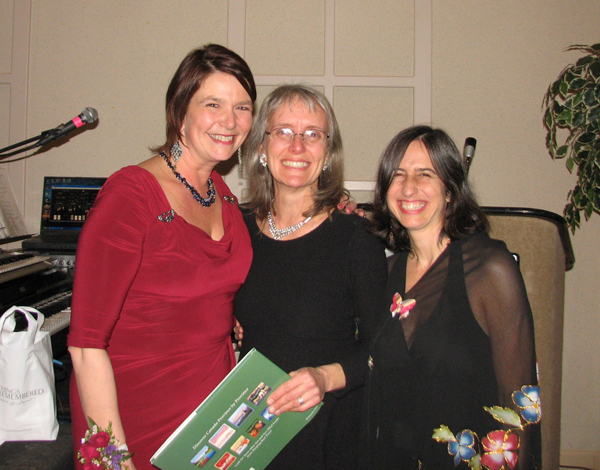 Celebrating Fiddlehead’s 10th anniversary at the Ramada Inn in
Comments are no longer available on this story