
STANDISH – Standish native Seth McLaughlin has been busy rising
through the journalism ranks over the last decade. As a reporter
for The Washington Times, a daily newspaper based in Washington,
D.C., the 34-year-old McLaughlin has been following the Republican
presidential candidates as they stump around the country hoping to
become the nominee, a process that has recently ramped up with last
week’s Iowa caucus and Jan. 10’s New Hampshire primary.
STANDISH – Standish native Seth McLaughlin has been busy rising through the journalism ranks over the last decade.
As a reporter for The Washington Times, a daily newspaper based in Washington, D.C., the 34-year-old McLaughlin has been following the Republican presidential candidates as they stump around the country hoping to become the nominee, a process that has recently ramped up with this week’s Iowa caucus and Jan. 10’s New Hampshire primary.
Through the year, McLaughlin has been assigned to cover the GOP hopefuls, all the while pumping out copy for several deadlines a day.
In September 2001, fresh from graduating from Clark University in Worcester, Mass., McLaughlin, son of John and Ann Marie McLaughlin of Moody Road, began his journalism career at The Suburban News (now the Lakes Region Weekly). After getting a taste of the small-town news scene, the 1996 Bonny Eagle High School grad enrolled in a journalism master’s degree program at the University of Illinois at Springfield. He then worked the Rhode Island State House beat for two years at the Providence Journal. He ventured onto the national scene working for The Washington Times, covering the Virginia state Legislature starting in 2006.
After budget cuts erased his position, McLaughlin freelanced for a few years before he was hired back by the Times in 2009, the same year he married Roselena Ramirez, herself an accomplished television journalist.
Despite his busy schedule and the approaching New Hampshire primary on Tuesday, McLaughlin this week responded by email to questions from the Lakes Region Weekly on his job and his outlook on covering national politics.
Q: In general, covering Capitol Hill and the GOP presidential campaign sounds like a daunting task. How do you determine what to write about? Do you write about what everyone else is writing about to “Keep up with the Joneses,” or do you try to search for unexplored topics?
A: It is a bit of a juggling act.
Following the crowd is part of the gig because frankly part of being a reporter is to document history as accurately as you can – even if the event, subject or person seems boring, bogus or out-to-lunch. The trick – and skill in the job – is to find the additional storylines that can be developed into a deeper look at a person, trend, policy, etc.
Q: What’s your outlook on Washington politics? Many Americans are growing weary of their politicians. You’re on the inside. What are these politicians like in real life? Do we expect too much of them? Do they promise too much?
A: Lawmakers are a reflection of the American public and maneuver within the boundaries of the American democratic system. The byproduct includes an electorate that often thirsts for big promises and elected leaders who are more than willing to offer them up big plates of promises – even when they often can’t deliver on that pledge.
Meanwhile, cable news networks and some of the partisan talking heads that pose as journalists add fuel to the fire with their tabloid-like news coverage – which is often thick on blame, and thin on context.
Q: After years of covering Washington, what do you know now that you didn’t know before about human nature?
A: It’s a tough question because I’ve often found that politics, in general, often is slightly tethered to reality – especially on the national level. To reach as broad an audience as possible or to protect themselves from political blowback, Democrats and Republicans dumb down complex policy battles into sound bites and talking points that will give their team a political edge, while making it harder to decipher what’s true and what’s not.
Q: You started at The Suburban News covering area politics and feature stories 10 years ago. We know you’re on a bigger (the biggest?) stage now, but does your job compare in any way to that one?
A: A story is a story, whether I’m covering the Windham Town Council for The Suburban News or the U.S. Congress for The Washington Times. The only real difference is that I’m writing for a national, rather than local, audience.
Q: What’s your guiding professional philosophy?
A: There are lots of suits in Washington. I don’t want to become a suit and don’t want to sell out. I hope to do good work, write the truth as accurately as possible and learn from the wiser and more talented journalists around me.
Q: Are reporters able to really think about what they’re doing these days as the pace of news has quickened, especially as news staffs have shrunk?
A: I feel the job of a news reporter is basically two-fold: document history and, when possible, to drill down into issues and ideas that give people a deeper perspective. Some reporters feel more comfortable in a format that allows them to have more time to digest the stories they are covering. Magazines tend to offer that.
With newspapers, you always will have to feed the beast – though the longer I do this job the better I have become at writing stories faster and setting aside time to develop other possible story angles, etc.
On a side note, I just asked my wife, who also works as a journalist, the question. She said that life will never be able to be boiled down into television and newspaper reports. Our goal is to make it as close – and accurate – a reflection as possible.
I think she’s on to something.
Q: While out on the campaign trail following these GOP hopefuls, what do you do when you’re not working? Hang out with other reporters? Is there any downtime? What’s the life of a national reporter like?
A: Downtime is hard to come by on the road because my schedule is often determine by a candidate or event – not what I want for lunch or the city I hope to check out.
So, for food, I often find myself ripping through beef jerky in the car or plopping down at a local watering hole to grab a bite after deadline. Anytime I can catch a Celtics or Pats game it’s a bonus and I tend to gravitate toward places that show the UFC, especially when Bonny Eagle’s own Mike Brown is fighting.
As for hotels, it’s a crapshoot. I’ve spent some time in some nice ones and some creepy joints. In Iowa, I’m pretty sure had a sticker for a floor. This week, in New Hampshire, my room is big, complete with a fridge, cook-top and sofa.
Q: Your writing is smooth and readable. It was like that at The Suburban News as well. If you’re able to explain it, can you tell us about your writing process?
A: Thanks, though the jury is still out on whether others feel the same. My writing process basically is the same as it has always been: collect information, digest it, contextualize it and try to explain it in a simple and clean way that readers can relate to what I see.
Q: What are the other reporters in the national press corps like? Is it cutthroat, or is there a friendly camaraderie? Is there a pecking order?
A: The same is true on the national level as on the local level. The bigger you are and the larger audience you have, the more access you have to anybody looking to get their voice out.
As for the other reporters, I have many friends, but try to stay away from the cliquish or cutthroat nature of the press corps.
Q: How did your growing up in Standish and going to Bonny Eagle High School help you get to be where you are now? Any advice for others who want to follow in your shoes?
A: It sounds cliche?, but growing up in Maine I think instills in you a down-to-earth mentality. At the same time, I had great parents and a great group of friends, who to this day are like an extended family. Also, as a student, I had good teachers at Edna Libby, the junior high and high school, where I also had great sports coaches who helped develop who I am today. Lots of luck was involved as well.
Q: Most writers need a familiar place to do their writing. Where do you do your writing when on the campaign trail?
A: I’m writing in a rental car right now. ‘Nuff said.
Q: Nothing’s as glamorous as it sounds. You’re in the trenches sometimes having to spit out stories for a fast-approaching deadline, such as debate nights. How do you handle that pressure?
A: This campaign season some of my deadlines for stories come 20 minutes into a debate, which sometimes include introductions and the pledge. So, you create a well-edited shell story ahead of time that provides context and then you hope that some sort of news comes out of the opening minutes of the debate.
Q: You have to write for several editions of the paper as well as the newspaper’s website, right? Can you give us an example of how a story might evolve?
A: I’m lucky to work next to one of the best reporters in Washington, Stephen Dinan. I bounce ideas off him daily and he takes them to the next level.
Q: Do you get to come home to Standish very often? Are you able to visit near the New Hampshire primary, or when they’re stumping in the area?
A: Yes, I have made several trips to New Hampshire this year and try to squeeze in a trip to see my folks on the dump road.
Q: The Washington Times is seen as having a conservative bent, as opposed to the New York Times or Washington Post, which are seen as more liberal-leaning sources of news. As a reporter, do you think that’s an accurate portrayal of the various top outlets, and, even if it is or isn’t, how does that play out in your daily interaction with sources and politicians?
A: I think that readers often confuse the fact that editorial boards of newspapers usually are entirely separated from the journalists working at a paper. Whatever the case, as a journalist, we have to deal with the blowback of how our employer is perceived.
For instance, I covered Virginia Sen. Jim Webb’s victory over George Allen in the 2006 Senate race. While I often wrote a similar story to that of the Washington Post reporters, I was treated entirely different based on the parts of the state I visited. If I was in the more conservative parts, people showered praised on me and my employer and dumped on the Washington Post, which they saw as having a liberal bent because of their editorial board. Meanwhile, in the more liberal-leaning parts of the state, I got the cold shoulder.
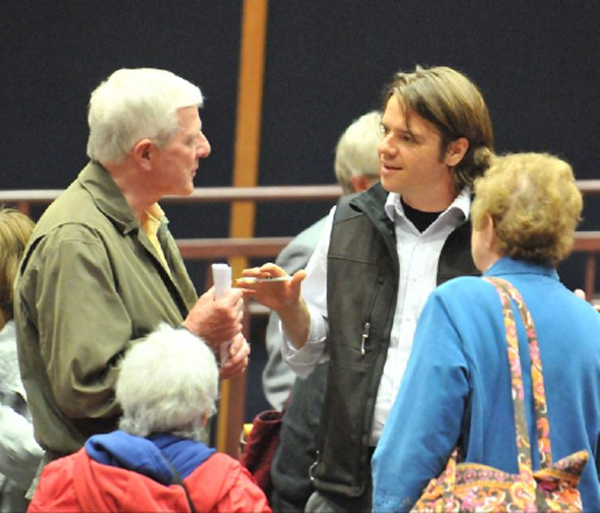 With pen and paper in hand, Seth McLaughlin interviews a couple
Comments are no longer available on this story