
WINDHAM – Now that Thanksgiving has come and gone, local athletes are now gearing up for the winter sports season.
And one thing that all athletes, from the pros all the way down to high school and youth athletes, have in common is the need to have a preseason physical make sure that they are healthy enough to step out on the court, ice, track, ski hill or wherever they play.
Last month, the importance of sports physicals was driven home with the news that Jerome Harrison of the NFL’s Detroit Lions was diagnosed with a brain tumor, which was only discovered when he was taking a physical to complete a trade to the Philadelphia Eagles.
While stories like Harrison’s are extreme cases, it still shows that pre-participation physicals are a valuable tool when it comes to making sure young athletes aren’t at risk during games and practices.
The need for physicals isn’t just limited to high school and youth athletes, even the pros have to go through the process. And while the requirements of professional leagues are often much more stringent, doctors are looking for the same problems in the pros that they will be looking for in the high schoolers.
Recently, players from the Maine Red Claws, the local entry in the NBA’s D-League, went up to Mercy Hospital in Windham for the annual preseason physicals. Dr. Patrick Pierre, the team’s physician, said during the physicals, doctors would measure basic vital statistics like: height, weight, blood pressure, pulse and the player’s medical history as well as some more involved tests.
“We do a cardiac evaluation,” Pierre said. “And we screen for specific things like abnormalities in the structure of the heart and we also screen for any orthopedic problems or old injuries that might arise from there. But we also screen for diabetes and cholesterol as well.”
Pierre explained the process while examining Tyc Snow, a guard who hails from Mississippi Valley. Snow is an old hand when it comes to athletic physicals, having had them through high school and college and during his time in the D-League.
Snow said that even if a player didn’t think there was anything wrong, it’s vital to get checked out on a regular basis to make sure players know how to stay healthy. “It’s very important (to get a physical),” Snow said, adding that he comes from Mississippi, which has a high obesity level, which he attributes in part, to a lack of medical knowledge on the part of players and parents. “I recommend that everyone get a physical at least once per year.”
Pierre agreed with his patient. “I think physicals are a great opportunity to talk about conditions and healthy living, healthy diets and especially for kids, it’s important not just for the child to know, but also for the parents,” he said. So they have a better idea of the exercise they should be getting and what they should be eating.”
“It’s very important for (people) to identify health issues and also to educate both kids and parents in terms of healthy eating and exercise and (physicals) are also very important in identifying issues or medical problems that might limit the child’s participation in the sport or that might also cause problems in terms of injuries,” Pierre continued. “In some cases, it might be a chance to find something that’s more serious. There have been instances where we have been able to identify something, a genetic disorder, where it was helpful for the rest of the family to get screened as well.”
While professional athletes get a physical before every season, the requirements are a bit looser for high school athletes. Most local high schools require an updated exam every two years.
Pierre said the two-year rule for high school athletic exams is a pretty standard one. “Most of the time a pre-participation physical is good for two years,” Pierre said. “Usually they’re covered by insurance, it depends on the person’s insurance. A lot of this is preventative care. And part of the preventative care is trying to find any conditions that might limit the kid’s participation or looking for conditions that might cause serious injuries in the future.”
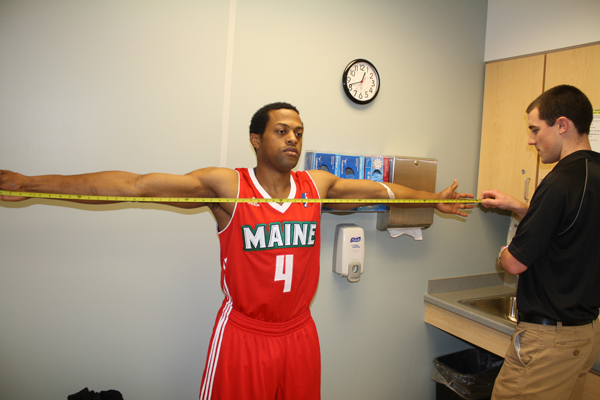 Guard Tyc Snow of the Maine Red Claws spreads his arms as
Comments are no longer available on this story