
WESTBROOK – A holding company once created to manage more than 60 acres of land off Stroudwater Street initially destined for a multimillion-dollar commercial development plan has filed for bankruptcy.
Jason Snyder, the owner of the land and the holding company, 500 Westbrook LLC, filed paperwork in U.S. Bankruptcy Court on Nov. 4 under Chapter 11. The paperwork lists the company as the debtor, and Snyder as the company’s manager.
Details of the filing show Snyder owes more than $1.9 million to Kimco Capital Corp., of New Hyde Park, N.Y., the company holding the $1.25 million mortgage Snyder has on the property. In addition, Snyder owes a total of $435,000 to nine separate creditors, including $4,000 to the city of Westbrook. Six of the creditors are law firms, which Snyder retained in the past for various legal services, totaling $219,000. The remaining creditors are a design firm, a public relations company in Portland, and two other firms.
The future of the property, and even the company itself, remains in question. The filing is the latest in a bumpy road for 500 Westbrook LLC, and comes as a lawsuit from Snyder’s business partners looms over the company, threatening to dissolve it altogether.
Snyder, 40, is the son of developer Arthur Snyder, who bought run-down buildings in the Old Port during the 1970s and turned them into condos, offices and retail shops. Starting in 1959, the elder Snyder began purchasing property on both sides of the Westbrook-Portland line, including the 60-acre parcel now in question. Jason Snyder, along with his brother, Simon, inherited the property when Arthur Snyder died.
Jason Snyder announced with fanfare three years ago his plans to build Stroudwater Place, which he described as a $300 million, 1.65 million-square-foot, upscale retail and recreational development project. Chief among his backers was high-profile partner Arthur Emil, known for, among other things, owning Windows on the World restaurant at the top of the World Trade Center in New York.
The announcement touched off a process of negotiating the terms of the development with the Westbrook City Council. It took nearly a year, and in December 2008 the council finally approved a contract zone, which seemed to be the last obstacle for the project.
But in order to proceed, the project needed two things: a strong economy and strong financial support. The recession and the death of Emil in August 2010 put a damper on Snyder’s plans.
Since then, Snyder has offered new proposals, notably to build a $85 million, publicly funded arena on the property to replace the aging Cumberland County Civic Center. Snyder said the new arena could be located on one end of Stroudwater Place, which at the time he said he would be building.
But in November 2010, the civic center’s trustees rejected his proposal, opting instead to support a $33 million renovation plan for the building in Portland. Voters backed the move in a referendum question last week.
In discussing the matter last fall, the trustees had harsh words for Snyder’s proposal.
“This is about saving a failed project in Westbrook,” trustee Mark Maroon said at the time. “That’s the end game. It needed to be said.”
Trustee Richard Ranaghan Jr. called it a “dead issue,” adding, “There’s no need to discuss that any further.”
Snyder floated yet another proposal for the property in March 2011. In a surprise move, Snyder sent a letter to the Maine Turnpike Authority and the Maine Department of Transportation, which is involved in the Gorham East-West Corridor Study that aims to solve traffic congestion problems.
Snyder’s letter, which was delivered at a public meeting discussing the study, proposed a 5,000-foot road be built through his property, connecting routes 25 and 22. At the time, Snyder told the American Journal the plan was to use a portion of the land he had earmarked for Stroudwater Place, but exactly how the land ownership would be transferred, what it would cost, and who would pay for it were not clear.
Meanwhile, Emil’s son, David A. Emil, still owns 10 percent of 500 Westbrook LLC, and the Arthur Emil Family Trust owns another 10 percent. According to documents filed in Cumberland County Superior Court in October, Emil and the family trust, represented by trustee Oded Aboodi, have sued to have the company dissolved.
According to that lawsuit, Snyder and the Emil family created the company in 2006 to manage development of the Stroudwater Street property.
“The company has been wholly unsuccessful in its efforts to develop the Westbrook property,” the plaintiffs’ principal attorney, Eric J. Wycoff, of Pierce Atwood in Portland, wrote in the lawsuit.
Wycoff alleged that the company is in default on its $1.25 million mortgage to Kimco. The lawsuit indicates Kimco foreclosed on the property in August 2011.
According to the lawsuit, the company owed $1,892,488 to Kimco as of Feb. 1, and Kimco plans to sell off the property to pay for it at auction. In the suit, Wycoff alleges that Emil has suggested on several occasions that Snyder sell the property, or ask Kimco for a forbearance, but Snyder has refused.
“Since at least November 2010, Snyder has been managing the company’s affairs without soliciting David Emil’s input,” Wycoff wrote in the suit.
Snyder, according to the court docket, has not filed a response to the complaint, even though the deadline was Nov. 11. When asked this week if Snyder or his attorneys had been in touch, Wycoff mentioned the bankruptcy filing, but declined to comment further.
Snyder did not respond to a request for an interview. Snyder’s attorney in the Emil lawsuit, George J. Marcus, said that lawsuit is now on hold due to the bankruptcy filing. Marcus said Snyder filed for bankruptcy in order to reorganize the company, not to escape legal action.
“I would expect within the course of the bankruptcy, the current lawsuit will also be resolved,” he said this week.
Richard P. Olson, a Portland attorney, is representing 500 Westbrook LLC in the bankruptcy case, and said the filing will also put the foreclosure process on hold, too.
The exact value of the land is not clear. Despite the $1.25 million mortgage, the city of Westbrook lists the land as a single, 59-acre piece of property with an appraised value of $408,300, and an assessed value of $202,600. In the bankruptcy filing, Snyder lists the property’s value as $4 million.
Olson said the city assessment might not have taken into account the potential value of the land when fully developed. The $4 million value, Olson said, came from Snyder himself, and may change as the case progresses, but “you have to start someplace.”
Snyder has lost disputes over the value of his properties before. In 2004, Snyder sued the turnpike authority, arguing that the price for another 27-acre parcel taken by eminent domain should have been $2 million, significantly more than the $560,000 the authority spent to take the land. The lawsuit was struck down by a Superior Court judge.
In 2005, Snyder sued over a 1999 deal where the city of Portland took yet another parcel by eminent domain, the result of a dispute over an attempt to sell the land to the U.S. Postal Service. After the 47-acre parcel went for $1.7 million in 1999, Snyder’s suit claimed that he later discovered the land should have been valued at more than $9 million, and he acted in 1999 without all the facts. Again, a judge denied Snyder’s claim.
Olson said eminent domain cases do not necessarily represent accurate descriptions of land values.
“People who are victims of eminent domain are often dissatisfied,” he said.
Olson said there is no clear plan for what the ultimate result of the bankruptcy filing will be, unlike some filings that are usually a prelude to, at best, a restructuring and emergence from bankruptcy protection, or, at worst, liquidation.
“This is one of the cases where I don’t know what the resolution’s going to be,” he said.
Right now, there is no scheduled hearing or action on the docket for the Emil lawsuit. Snyder will meet with his creditors on Dec. 6, and one of Emil’s attorneys is listed as a recipient of the meeting notice.
As to Stroudwater Place, Marcus said, Snyder has no plans to liquidate his company, nor is he abandoning his plans to develop the parcel.
“I think the future is very positive,” Marcus said. “I think he has a very, very valuable asset.”
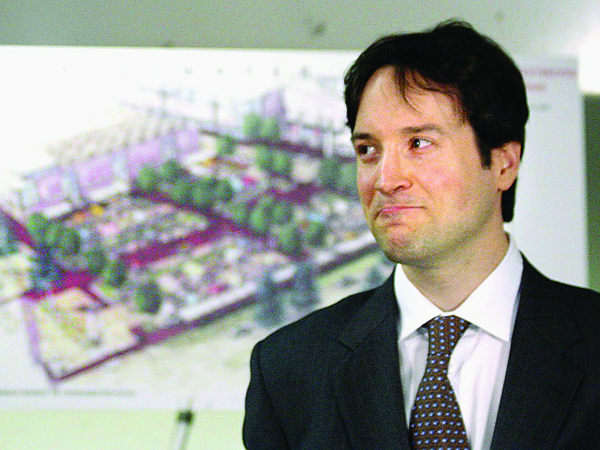 Jason Snyder unveils his plans in 2008 to build Stroudwater
Comments are no longer available on this story