
WESTBROOK – The former Salvation Army building in Westbrook, spiffed up with new carpet and new store shelves, has a new mission – a convenience store opening this week by an Iraqi immigrant.
After witnessing his share of violence, injustice and death, Hassan Faraj, 50, is now living the proverbial American Dream. He and his family live in safety, he is starting a business, and he even plans to apply for U.S. citizenship.
Faraj has accomplished this the old-fashioned way, through hard work and determination, along with some help from a Maine-based group that helps immigrants and refugees like Faraj to build a new life.
“I think they face a lot of challenges just by starting a business in a language that’s not their own, in a culture that’s often confusing,” said Sarah Guerette, a business counselor at Coastal Enterprises Inc., of Wiscasset.
The nonprofit group, according to its website, is geared toward economic development and offers, among other services, financing and other forms of support for job creation and business development.
Guerette said that includes reaching out to potential entrepreneurs who need assistance. The group’s StartSmart program in particular, Guerette said, is geared toward immigrants and refugees who want to start a small business, but don’t know how or what kind. To date, the program has helped more than 900 people from 84 countries since it started in 1997.
The program was a big help for Faraj, who said he came to America looking over his shoulder, more worried about what he and his family were running away from than what they were running to. Moving with his family to America has been a night-and-day experience.
“The difference between Arabic countries and America? About five centuries,” he said.
Faraj said he was a judge in Baghdad, and declined to discuss his life there in detail, only to say the Iraqi militia killed three of his children before he and his family could flee the country.
The family – Faraj, his wife, three sons, and two daughters – first went to Egypt on a three-month visa. Life there was not much better. The government, he said, was prejudiced against him and his family due to his nationality. When thieves stole some of Faraj’s belongings worth about $5,000, the local police did nothing, other than to advise him to simply steal it back.
“They don’t (allow) me to do any job, and they don’t (allow) my kids to get an education,” he said.
Eventually, Faraj and his family moved to the United States in 2007, settling in Houston, Texas, where Faraj worked as a truck driver and his children could go to school.
But he and his family still were not happy, living in a crime-ridden neighborhood, with no solid plan for the future. It was when one of his children’s teachers, a Maine native, suggested he move here, that Faraj’s family came to Portland in October 2010.
Guerette said Faraj learned of Coastal Enterprises Inc. via word of mouth, and reached out to the group’s Portland office for assistance. Guerette said Faraj knew he wanted to start a business, and even had some of his own money to help set it up, but he didn’t have enough, and had no idea what kind of business to run.
Guerette said the group helped Faraj decide on starting a market in Westbrook, granted him a loan for the rest of the seed money he needed, and helped him get the required licenses. And the group is not done helping. Guerette said she will be back to help Faraj keep the business going, and perform routine tasks like filing tax returns.
“We really try to be there for our clients through all those steps,” she said.
Faraj has named his store, located at 11 Bridge St., Tigris Market. Despite the obvious ethnic influence, he said, the market will largely be an American convenience store, with sandwiches made on the premises, along with coffee and ice cream. Opening Thursday, Sept. 15, the market will have a Middle Eastern flair, too, with certain ethnic foods and products also available.
The experience, Faraj said, has been positive enough to motivate him and his family to apply for U.S. citizenship next year, as soon as possible.
“Here, when I live in America, I feel better than in my country,” he said, “and the future will be more successful for me and my family.”
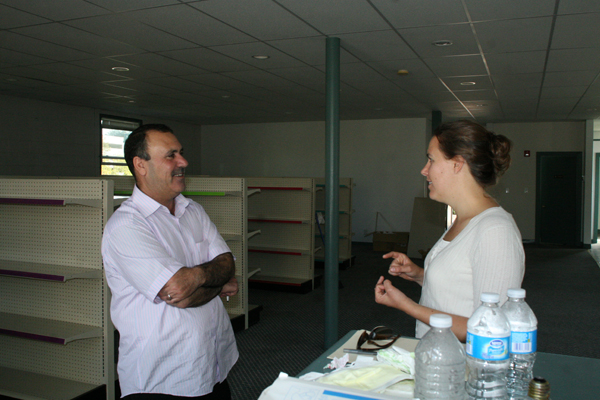 Hassan Faraj, an Iraqi immigrant seeking U.S. citizenship, talks
Comments are no longer available on this story