
SCARBOROUGH – On a recent, sunny Thursday afternoon, the Pine Point Beach in Scarborough was full of the usual collection of swimmers, tourists and sunbathers looking to beat the heat, soak up some rays, build a sand castle, or otherwise enjoy themselves.
For Pat Gallant-Charette, however, the waters provide much more: a training ground for crossing the English Channel, a daunting body of cold, dark water between Great Britain and France. For thousands of years, the channel has served as a buffer between Britain and mainland Europe, a barrier that has proven difficult to negotiate even for navies at war, let alone a single person with nothing more than wit and strong limbs to get across with.
“The English Channel is the Mount Everest of marathon swimming,” Gallant-Charette said.
And she should know. The Westbrook native has attempted to do it twice now, and is hoping later this month to make good on a promise she made to herself to return to England and finish what she started twice.
“The English Channel has been on my mind for five years,” she said.
Despite her ambition, Gallant-Charette, 60, insists that swimming the channel is not an obsession, merely the latest in a series of goals she has challenged herself with ever since she began marathon swimming over 10 years ago.
It started not long after her brother, Robert, died of a heart attack at age 34 in 1997. Gallant-Charette said she recalled her son Tom, then 16 and a member of the Westbrook High School swim team, told her he wanted to swim in the annual 2.4-mile Peaks to Portland race in honor of Robert. It was a fitting tribute, Gallant-Charette said, since Robert, himself an accomplished swimmer, had won the race twice.
“I said, ‘That’s so sweet, I wish I could do that,’” she recalled telling her son, “and he said, ‘Well, you could if you tried.’”
That became Gallant-Charette’s inspiration to begin training. A year later, she entered the race. She didn’t win, calling herself a “back of the pack” swimmer, but she did it.
“I found it was a lot of fun,” she said. “I just love being out there.”
The challenge of swimming long distances has proven addictive for her, she said. As soon as she knew she could make the 2.4-mile trip, she said she started to wonder if she could swim there and back without stopping. Once she was able to do that, she started seeking out longer and longer swims.
Her training involves spending one to three hours six days a week in the water, swimming parallel to the coast. The waters off the beach, she said, have a rhythm that resembles the motion of the water in the channel. Just like a marathon runner, Gallant-Charette varies her time spent working out. Once a week, she puts in a solid four hours, and every few weeks, she said, she will do a 10-hour swim. She begins her training in April, when the water temperature hovers in the low 40s.
“I quickly got acclimated to colder water,” she said.
Eventually, the health benefits of her regime became obvious. In her youth, Gallant-Charette was active and athletic, but ever since marrying and having kids, she steadily gained weight, spending more time on the sidelines cheering for her children than actually participating in sports herself.
But swimming has been good for her. Her muscles have gotten stronger, she shed some of the extra pounds, and her blood pressure and cholesterol have improved.
“I was still at the back of the pack, but I found I wasn’t tired anymore,” she said. “I feel stronger now than I was when I was 20.”
Gallant-Charette has never needed to win races, or beat anybody else, she said, only the goals she sets for herself. That’s what led her to try swimming the channel. Her first attempt was in 2008, and from the start, she said, it was clear that no one does this swim unless they really mean it. The shortest distance across the channel, from Dover, England to France is approximately 21 miles, but currents can force swimmers to go as far as 34 miles.
If Gallant-Charette completes the swim, she will win a race of sorts. She will be the oldest American woman to complete the crossing, as the current American record is 59 years. The oldest woman to complete the swim is Sue Oldham of Perth, Australia, who completed the swim in 2010 at age 65.
There are financial demands, too. Gallant-Charette found she was not allowed to swim unless she registered with the English Channel Association first, for $1,000.
Then, she said, she needed to hire a boat and crew to function as a “spotter.” The spotter boat, she said, serves as a guide and coach to the swimmer. If a swimmer appears to be in trouble, Gallant-Charette said, the boat crew must pull them out. That boat and crew, she said, cost $4,000. Unlike other athletes, Gallant-Charette has no sponsors, and gets the money to finance her swims the old-fashioned way: squirreling cash away here and there, asking relatives and friend for cash, not gifts, over the holidays.
“I save all year long,” she said.
Swims of that length in salt water are not like laps in the pool, either. Gallant-Charette said after hours of constant effort, the salt in the water actually begins to etch into the skin, causing friction burns on the arms. In addition, ordinary bathing suits chafe where hems meet the skin, causing more irritation and wounds.
But she took up the challenge anyway. She and her husband Jim, 61, often plan vacations around a swim, and they did so in 2008, hoping to celebrate Gallant-Charette’s successful crossing of the channel.
And she came so close. The trip took 16 hours, and covered 32 miles. In that time, she was stung twice by jellyfish, and kept going, even into the night, when it was so dark she would have swum in circles without lights from the spotter boat to guide her. She even swam through what was believed to be diesel pollution in the water, which burned her face and wound up leaving lesions in and around her mouth at the end of the journey.
But the rip currents at the end were Gallant-Charette’s undoing. If they are moving parallel to the beach, she said, one can swim through them fairly easily, but if tidal shifts change them to a circular motion, no one, no matter what their condition, can make it, and anyone caught in those currents has to turn back.
That’s what happened to Gallant-Charette in 2008. At 1.7 miles from the French coast, she was maddeningly close. In recalling the tale this week on Pine Point Beach, she pointed over the water to where the coast doubled back, and several small cottages were nestled along the rocky coast. The buildings were close enough to pick out windows with the naked eye.
“I was closer than that,” she said.
But like any good athlete, she dried off and vowed to try again, which is a common reaction to failure, according to the Channel Swimming Association’s Julie Bradshaw. One man from Germany, Bradshaw said, finally made it across the channel after his 12th attempt.
Gallant-Charette was all set to go for the second time in 2009 when wind conditions forced the swim to be canceled, so last year she tried a simpler goal: the Strait of Gibraltar, a stretch of water at the mouth of the Mediterranean Sea, between Spain and the northern coast of Africa.
Of course, “simple” is a relative term. The strait is anywhere between nine and 12 miles, Gallant-Charette said, depending on where currents deposit you on the shore when you’re done. She said she wasn’t trying to set records, but she did anyway, quite by accident.
“When I reached Africa, I was just glad it was done,” she said, recalling with surprise that people were cheering for her when she arrived.
Her time, it turned out, was 3 hours, 28 minutes. At the time, she was the fastest American woman to have ever made the trip, and the third-fastest woman in the world since 1928. All this while pushing 60 years old.
Since then, the record she set has been broken, but she has gotten a lot of attention for it, with new friends on Facebook and correspondence from leaders in the marathon swimming field.
A full-time nurse, Gallant-Charette said she will be dedicating each mile she swims to someone she has known who has battled cancer, lived with a disability, or otherwise touched her. The final mile, she said, is for Maine Medical Center Mended Hearts Support Group, a group that helps heart disease victims and their families.
In addition, Gallant-Charette said she has also encouraged fellow swimmers to participate in Swim for Your Heart Feb. 14, an annual Valentine’s Day event dedicated to heart health awareness.
Gallant-Charette will find out what challenges the channel holds for her this time during a 10-day window, from Aug. 18-28, when she expects to take to the channel.
“I never imagined I’d be a marathon swimmer at age 60,” she said.
When asked what advice she had for anyone else thinking about taking up marathon swimming, she said, “I’d say, if they enjoy swimming, then to give it a try. There are some people who’ve never tried it and find they love it, and I’m one of those.”
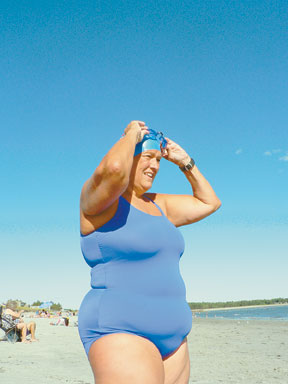 Westbrook’s Pat Gallant-Charette, 60, gets ready for a swimming
Comments are no longer available on this story