
WESTBROOK – Last week, a small army of NASA scientists, teachers and volunteers touched down in Westbrook to help get kids excited about careers in science and technology.
The event, called “Space Day,” actually took place over several days. On Monday and Tuesday, volunteers visited area elementary schools to read books about the space program to the kids. On Friday, a more extensive series of presentations took place at Westbrook middle and high schools, including lectures, videos and various hands-on activities for the students. Gov. Paul LePage’s wife, Ann, read to elementary school kids early in the morning, and during the opening presentation at the high school, issued a proclamation naming May 6 Space Day in Maine. At the middle school, students were treated to a display of moon rocks, which were escorted by armed guards.
Sharon Eggleston, an engineer at Lockheed Martin in Bath, coordinated the event, and said she has been running similar events annually throughout Maine for the last 10 years. Typically, she said, the Space Day events target school districts that show a marked decrease in interest in careers in science, technology, engineering and math, or what she called “STEM” careers.
“We go wherever the need is,” she said.
Eggleston said she had the advantage of seeing and being enthralled, along with the rest of the country, by the 1969 Apollo moon landing. Today, she said, it is easy for young people who didn’t watch history unfold live before their eyes to think of space exploration as routine and unremarkable.
Those who do have an interest, she said, are further discouraged by the small number of applicants to the space program who actually become astronauts, but that doesn’t mean one can’t have a meaningful career working for NASA.
“(These kids) don’t realize there are 35,000-40,000 people behind the astronauts, working to get them into space,” she said. “Those jobs are out there for them.”
Amy Troiano, a science teacher at the high school and the local liaison for the project, said she is looking forward to taking part in the balloon experiments this fall. One of her hopes, she said, is for the students to see how STEM-related fields relate to each other.
“I think they see science as something different from math,” she said.
Interim School Superintendent Marc Gousse said he also has high hopes for the program inspiring students throughout the district.
“We could have the next astronaut (here). We could have the next scientist,” he said. “You never know where this is going to take the kids.”
The event, while district-wide, comes in advance of a special project coming to the high school this fall, part of a $400,000 grant from NASA to the Maine Space Grant Consortium, a collection of small businesses, educational institutions and nonprofit research organizations in the state.
According to the consortium, sophomore biology students at the high school will participate in weather balloon experiments, where the high-altitude balloons will carry sensors, bacteria samples and other payloads.
Anita Bernhardt, science and technology specialist and regional representative for the state Department of Education, was also on hand to see the events on Friday. She cited recent national reports that confirm students in Maine and nationwide just don’t have the interest in science and technology careers that they used to.
“There are groups of kids who have the skills, but not the aspiration, and that’s bothersome,” she said. “We want to change that picture.”
The balloon program, she said, is a pilot project. The department intends to study the reactions of the students. The goal: to see if this really does ignite interest in STEM careers. If that happens, she said, this fall’s project will be a “good model” for future projects in the district and throughout Maine.
On Friday, a balloon similar to what students will be using this fall floated close to the ceiling in one half of the gymnasium, where groups of high school students rotated through during the day, listening to lectures from a NASA scientist on how they work, and what the experiments will accomplish.
In the other half of the gym, a series of tables offered activities for the students. On one table, a machine launched paper airplanes the students folded themselves, and nearby, “stomp rockets” allowed students to launch foam-rubber missiles into the air using foot-pedal air pumps.
In the auditorium, Brian Ewenson, a professional aerospace educator and astronaut trainer, said he has been giving presentations to students for more than 10 years. He said he tries to cut through the belief that national space centers in Florida and Texas are too far out of reach for small-town kids from Maine.
“You can come from here and do big things, but you have to do the work to get there,” he said.
There were other sessions throughout the school going on during the day, as well, including displays of launchable model rockets, and even robots playing soccer on a miniature field set up in one classroom.
Presenters included high school teachers from other parts of the state, students from Bowdoin College, and even sailors volunteering from the DDG111 Spruance, a naval destroyer awaiting commission and berthed in Bath.
Freshman Najee White said he has always had an interest in science, particularly astronomy, but learned a lot about being an astronaut from the presentations.
“It’s (like) nothing that ever seen before,” he said.
White picked up some of the freeze-dried astronaut food on display in the gym and said he’d eaten freeze-dried ice cream before during a field trip to the Children’s Museum of Maine in Portland.
“I could eat quite a bit of this stuff,” he said.
Eric Little, a junior, said he is interested in mechanical engineering, and liked the hands-on exhibits.
“This is really fun. There’s a lot of cool stuff to look at,” he said.
Little said he wasn’t sure he would be able to adjust to life in space, saying, “It’d be weird to get used to,” but said he would enjoy the experience.
“I would want to look back at the earth and see what it looks like from far up,” he said.
Kaitlyn Joyce, a sophomore, is one student who has changed her thinking about science due to the event. Before Friday, she said, she was focusing on English and social studies classes, but now she is planning to change her classes next year to include engineering.
Joyce said she is thinking about engineering after watching the soccer-playing robots.
“They were able to watch the ball, and they interacted, almost like little kids,” she said.
Joyce said she found herself more interested in science than she thought she would ever be.
“I really didn’t see the different sides of science until today,” she said.
Junior Gabe Crouse was enthralled with materials offered by one presenter during the hands-on potion of the event.
“I want to be an astronaut when I grow up,” she said.
Crouse said she didn’t need any encouragement to pursue a career in space.
“If I had that opportunity, I probably would go,” she said. “I’d want to go to the moon. That would be cool.”
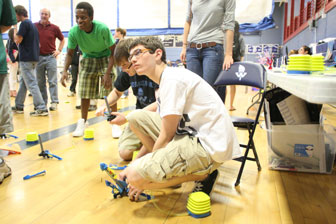 Junior Eric Little lines up his shot with a “stomp rocket,” a foam-rubber projectile launched by a foot pedal that pumps air through a hose, Friday as part of Space Day. (Staff photo by Sean Murphy)
Comments are no longer available on this story