
GORHAM – A proposed new highway linking Gorham with the Maine Turnpike, under review in a two-part regional study, would spur economic development for the town, a Gorham official says.
The recommendations of the recently concluded $1 million first phase of the Gorham East West Corridor Study call for municipal land use changes, more public transit and spending in the $100 million range for a highway system upgrade improving transportation in the corridor. Under one scenario, a new road would be built through the corridor from a point near exits 44 and 45 of the Maine Turnpike to the southern end of the Bernard P. Rines Highway, the bypass of Gorham Village that opened in December 2008.
That idea, said Matt Robinson, chairman of the Gorham Town Council, “opens up Gorham to more economic development.”
Paying $800,000, the Maine Turnpike Authority largely bankrolled the first phase of the study, with the Maine Department of Transportation paying $200,000. Highway improvement options would be analyzed in Phase 2 of the study, set to begin in October and estimated to cost $2 million.
Four municipalities – Gorham, Scarborough, South Portland and Westbrook – are the core communities in the study. To continue their participation in the next phase, the four communities need to endorse Phase 1 recommendations by signing a memorandum of understanding.
Robinson believed the Gorham Town Council at its June meeting would agree to stay involved in the study. Municipal councils in Scarborough and South Portland could decide in May whether to stay on board for Phase 2.
It’s unclear when the Westbrook City Council would hear the matter.
“We haven’t had a recent update on that study,” City Council President Brendan Rielly said Wednesday.
Rielly said a city concern is that traffic flow doesn’t negatively impact Westbrook and affect its downtown businesses.
“The concern I have is to make sure the study is not skewed to benefit Gorham to the detriment of Westbrook,” he said.
Scarborough Town Council Chairwoman Judith Roy said the council would give full consideration to the corridor study at its next meeting on Wednesday, May 4.
“I think we’ll probably be moving forward,” Roy said recently.
In 2007, the Legislature and then-Gov. John Baldacci authorized the corridor study headed up by the Maine Turnpike Authority and Maine Department of Transportation along with the Portland Area Comprehensive Transportation System (PACTS), a metropolitan planning organization for the Portland area. Community participation is voluntary and a community could withdraw from the study with 30 days notice.
Paul Godfrey of HNTB Corp. in Westbrook is the study manager.
“The key finding from this study is that there does need to be new east-west capacity in this region to address long-term congestion and mobility issues,” Godfrey said in a meeting with the Scarborough Town Council.
Godfrey said he also met last week with the South Portland City Council. He expects all four core communities would sign a memorandum of understanding to continue the study.
“We’re hoping all sign by June or July,” Godfrey said.
Other communities, including Buxton, Hollis, Portland and Standish, have an opportunity to join the study.
The study, which began in 2009, outlined two highway improvement plans for the corridor stretching west to Gorham and Standish. Scenario 1 engineering and construction costs are pegged at $85.9 million and Scenario 2, a $110 million package, which includes a new road linking Gorham to the Turnpike. The estimates do not reflect right-of-way acquisition, environmental impacts and wetland mitigation costs.
The corridor has been identified as one of the worst in Maine for traffic snarls. In Westbrook, more than 22,000 vehicles daily travel the four-lane William Clarke Drive (Route 25). Both study scenarios figured on additional turning lanes at intersections along William Clarke Drive, which is already under reconstruction in a $5.5 million state project.
According to study recommendations posted online, Road Scenario 1 improvements in Scarborough would include a non-toll, two-lane bypass of Payne Road. The scenario would also widen Gorham Road (Route 114) to four lanes from the proposed Payne Road bypass to another bypass proposed for the overlap of routes 114 and 22.
Under the Road Scenario 2 package, a new road impacting the four communities would be built through the corridor from a point near exits 44 and 45 of the Maine Turnpike to the southern end of the Gorham bypass.
Robinson said the road option would “clean up” the congested overlap area of routes 22 and 114 in South Gorham.
“It would move a lot more traffic,” Robinson said about study improvements to be analyzed.
Either highway option or a combination of both could be in the mix to address long-term traffic congestion in the corridor.
Both options include a local bypass of downtown Standish and upgrading the former Mountain Division rail line to handle freight from Portland to Standish. The rail line runs through Gorham, Westbrook and Windham.
For the next phase of the study, Scott Tompkins, a spokesman for the Maine Turnpike Authority, said this week it has budgeted $750,000. The turnpike has ready cash, but the Maine Department of Transportation is asking the Legislature for $1.25 million earmarked in its proposed budget to cover its share in continuing the study.
Mark Latti, a spokesman for the transportation department, said the next phase of the study would include fieldwork like surveying, title research and identifying any habitats of wildlife endangered species.
But, the study scope is looking at more than just roads. Transit recommendations include extending public transportation along major routes including 1, 22, 25 and 302. The study is recommending that the four communities designate future residential and commercial growth areas. Density would help preserve rural character of the corridor.
Gorham already has implemented a plan for cluster developments that would preserve open space. Robinson said Gorham is looking at bus service.
The town hopes to be awarded a Maine Department of Transportation grant to construct an asphalt bicycle path along a discontinued railroad bed, paving the way for more commuters to bike to work.
“We’ve been proactive on what they’re looking for in the second phase,” Robinson said.
“The study has proposed a ‘three-legged stool’ approach to the growing traffic congestion on major corridors west of Portland, using more careful development practices, an increase in public transit, and selected road improvements. The study has shown that it will take all three solutions to preserve mobility and safety and protect quality of life, major contributions to keeping this fast-growing area economically viable,” a study statement said.
The draft Study Report can be viewed at www.gorhamcorridor.org.
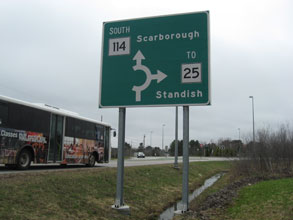 This bus Tuesday on South Street (Route 114) in Gorham is headed into the roundabout at the southern end of the Bernard P. Rines Highway, a bypass of Gorham Village. One option under review in the Gorham East West Corridor Study would be a new road linking this intersection with the Maine Turnpike. (Staff photo by Robert Lowell)
Comments are no longer available on this story