
WINDHAM – While the towns of Windham and Gorham sent many of its sons to fight in the Civil War, they also sent something just as valuable: gunpowder, produced in the Gambo mills with the help of the powerful Presumpscot River.
In honor of the 150th anniversary of the start of the Civil War, which occurred with the firing on Fort Sumter on April 12, 1861, the Windham Historical Society and Presumpscot Regional Land Trust are co-hosting a lecture and tour April 30 of the former mill site, out of which came a full quarter of the gunpowder used by the Union Army.
David Tanguay, a Society member and former teacher at the Windham High School, will host a lecture regarding the mill’s history from 9:30 to 10:30 a.m. at the Society’s headquarters on Windham Center Road. In the afternoon, Donald Wescott, a Gorham resident and member of the Land Trust that owns the Gambo property, will lead a walking tour of the site starting at 1 p.m.
The historians, both of who have extensive knowledge of the history of the site, are hoping many people will take advantage of the talk and tour.
“We’ve worked together previously, but last year, the Windham Historical Society started talking about the sesquicentennial coming up and what could we do, and I said, well, the most significant thing that Windham-Gorham did was the powder mill, in addition to the hundreds of lives sent, and I felt we really needed to put that out there,” Tanguay said.
A dynamite tour
The man who wrote the definitive history of the Gambo powder mills’ history is 87-year-old Gorham resident Maurice Whitten. His 1990 book, “The Gunpowder Mills of Maine,” delves into the various owners, site names, workers, manufacturing methods and explosions at the Gambo mills from their beginnings around 1824 until the demise of the Oriental Powder Company in 1907, when the manufacturing of gunpowder moved westward with the expansion of railroads, roads, canals and other infrastructure requiring the use of heavy explosives.
But before its demise, the Gambo mills employed hundreds of local men over the years, many of whom have surnames still common in the towns today. The workers made black powder used for rifles and cannons as well as explosive charges, and because of the hazards, got paid almost double what other workers at the time earned. While pay was good, the process was dangerous and required all hands to wear felt-bottomed boots to cut down on possible sparks. Despite efforts at safety, 46 men perished during multiple tragic accidents when careless behavior led to massive explosions.
The mill operated on steam power created by the nearby Presumpscot River, which was channeled through still-evident “raceways” to feed the dozens of mill buildings spread out on both sides of the river. The constant flow of water from deep Sebago Lake down the river allowed the Gambo operation to hum, except during rare droughts. And it never ran faster than during times of war, when black powder – the propellant used to fire cannon balls and rifle shot – was needed most.
According to Whitten’s book, the mill is best known for supplying 25 percent – or 6,500 pounds per day – of the black powder used by the Union Army in the Civil War, though it also supplied the Russian Army during the Crimean War (1854-56) and Russo-Turkish War (1877-78).
When demand for gunpowder from New England waned during America’s westward expansion, the mill finally closed leaving only foundations, some pathways and canals that tour participants will see on April 30.
Whitten’s interest
A former chemistry professor at Gorham State Teachers College and University of Southern Maine, Whitten became intrigued with learning more about the Gambo operation after taking part in a 1964 bus tour of Gorham during bicentennial celebrations of the town’s 1764 incorporation.
“The man gave quite a long talk regarding the Cumberland and Oxford Canal, which goes through the Gambo area,” Whitten said. “And as we were driving over the Gambo bridge, the man waved his arm, pointed into the woods and said, ‘I understand there’s an old gunpowder mill in that direction but I don’t know anything about it.’ Since I had always been interested in the history of science and technology, I wanted to learn more about it.”
Whitten ended up learning much about the Gambo mills and is highly respected for his book, which Wescott will use as the basis of his tour. Wescott is a neighbor of Whitten’s on Lincoln Street in Gorham and read the book after becoming a steward of the Gambo mill site a few years ago.
“The tour is for anybody who wants to learn more about history, especially with this year being the sesquicentennial of the start of the Civil War,” Wescott said.
 David Tanguay, left, and Donald Wescott will host a program and tour concerning the Gambo gunpowder mills in the Little Falls/South Windham area on Saturday, April 30. Here, the two historians stand on the Gambo walking bridge at the end of Gambo Road discussing the charcoaling factory, which was located on the island in the background. Alder tree trunks were floated down the river to the building, whose foundation can be seen underwater in the above photograph, and then burned into charcoal, one of three ingredients in black powder. The Gambo mills manufactured 25 percent of the powder used by the Union Army in the Civil War. (Staff photo by John Balentine)
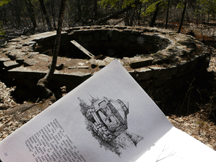 David Tanguay holds up a page from Gorham historian Maurice Whitten’s book, “The Gunpowder Mills of Maine,” depicting a wheel mill that served to grind the three elements of gunpowder – saltpetre (potassium nitrate), charcoal and sulfur – together into a powder, which could then be used, according to the mixture, for use in blasting, rifles or cannons. The foundation of the wheel mill still stands today, as does a spindle from the assembly. (Staff photo by John Balentine)
Comments are no longer available on this story