
Although much of the action took place hundreds of miles away, south of the Mason-Dixon line, southern Maine played a large role in the Civil War, which began 150 years ago this week with the firing on Fort Sumter.
Kathy DiPhilippo, a historian for the South Portland Historical Society, said one of the state’s three camps to train soldiers was located along the Fore River in present-day South Portland. She said that camp, which was officially set up by the state in 1862 and named Camp Lincoln, before being renamed Camp Berry in honor of Hiriam Berry, a Maine native killed at the Battle of Chancellorsville, served as the training grounds for soldiers from York, Cumberland, Oxford and Androscoggin counties.
“Our role in the Civil War was significant because people came from all over southern Maine and western Maine to muster in and train here in South Portland,” said DiPhilippo.
According to Paul Ledman, a Cape Elizabeth resident, history teacher at Scarborough High School and author of “A Maine Town Responds: Cape Elizabeth and South Portland in the Civil War,” 410 men from Cape Elizabeth were credited as serving in the Civil War.
Ledman spoke Monday about the impact of the Civil War on Cape Elizabeth at a Cape Elizabeth Historical Preservation Society event at the Thomas Memorial Library. Ledman’s discussion this week was just the first of many events that will be held during the next few years as museums and organizations and historians throughout the state turn their focus to the Civil War.
DiPhilippo said last week that two of Maine’s most famous infantries, the 17th Maine and the 20th Maine, both trained at Camp Lincoln in the summer of 1862.
The 20th Maine, the famed infantry lead by Brunswick native Joshua Chamberlain, came to the camp to train in August 1862, DiPhilippo said, before heading off for three years of battle, including the defense of Little Round Top in the Battle of Gettysburg in July 1863.
Soldiers in Cape Elizabeth, which at the time also included the city of South Portland, played a significant role fighting for the Union side. Company E of the 17th Maine Infantry was almost entirely made up of Cape Elizabeth men. The 17th Maine was in service from August 1862 to June 1865 and saw action in some of the bloodiest battles of the Civil War, including the battles of Fredricksburg, Chancellorsville, Gettysburg, Wilderness, and Locust Grove, as well as the Siege of Cold Harbor.
Of the 33 Cape Elizabeth men in Company E, commanded by Cape Elizabeth residents Captain Ellis Sawyer and First Lt. George Fickett, only five left the infantry in June 1865 unscathed.
In fact, of the 1,371 soldiers who were enrolled in the 17th Maine, 207 were killed, 552 were wounded and 163 died of disease. It is the highest loss of any Maine infantry.
“They were welcomed as conquering heroes and marched down Congress Street with the citizens wildly cheering them. Probably never had a returning regiment been so enthusiastically received in Portland,” said William Jordan in his book, “A History of Cape Elizabeth.”
While Maine sent many of its men to fight down south, Fort Preble, now the site of Southern Maine Community College, played a role in the only Civil War battle that was fought in Maine, the Battle of Portland Harbor.
On June 26, a group of Confederate raiders, led by Lt. Charles W. Read, entered Portland Harbor in a fishing vessel they had captured and attempted to destroy ships and shipping facilities in the harbor. The Confederates captured the Caleb Cushing, a cutter ship that belonged to the U.S. Revenue Cutter Service, a precursor to the United States Coast Guard.
“To have the Confederates come right up to Portland Harbor, it was quite a bold move,” DiPhilippo said. “You really didn’t see activity like that here during the war.”
That bold move was foiled, however, after it was witnessed from atop the Portland Observatory. News of the attack spread quickly, and the Confederates were not able to leave the harbor before Union forces intervened. The raiders were captured, but not before abandoning the ship and setting it on fire. They were held at Fort Preble for a few days, but because of the outrage of having Confederate forces in Cape Elizabeth, they were moved to Fort Warren in Boston.
During Read’s raid, which lasted from June 6 to June 27, 1863, he traveled along the eastern seaboard commandeering ships and destroying them. In total, Read captured or destroyed 22 U.S. vessels.
These tactics by the Confederates disrupted the shipping economy in Cape Elizabeth, said Ledman. “It sent up insurance rates and it had a chilling effect on commerce,” he said.
Ledman said while 410 men from Cape Elizabeth were credited as serving in the Civil War, only 140 of them were listed on the town’s 1860 census. This, he said, can possibly be explained by the fact many wealthy men both locally and across the nation could pay either young men or immigrants to serve in their place. Because of this policy, he said, it is difficult to determine how many residents of Cape Elizabeth actually fought in the war.
Regardless of the number, Jordan noted in his book that the Civil War was something that was closely followed in town.
“As the war progressed, Cape Elizabeth continued to do its part,” said William Jordan in his book. “There was hardly a public or private meeting held that did not involved some direct reference to the rebellion.”
According to a section about the Civil War in Scarborough in the town’s 350th anniversary book, Earlene Ahlquist Chadborne said Maine residents, including many in Scarborough, were quick to embrace the Union’s fight against slavery.
“When the southern forces captured Fort Sumter signaling the war’s start, the hills and valley’s of Maine resounded with martial fervor,” Chadborne wrote. “Several Maine communities raised volunteer regiments within 24 hours of President Lincoln’s call to arms. Like Mainers everywhere, Scarborough residents supported the Union cause.”
Chadborne said while many residents in Scarborough went to fight, many more were at home doing what they could to support the effort.
“The entire community rallied behind the troops. Residents in each section of town met at local schools to roll bandages, knit socks and gather provisions to send to the front.”
That is not to say that everyone in the area was sympathetic to the Union’s cause. The local opposition to the war, Ledman noted, could be seen in several of the 140 letters written to and from Scott Dyer, a Cape Elizabeth resident who fought in the war. The letters are in the Cape Elizabeth Historical Preservation Society’s collection.
“Cape Elizabeth had a lot of opposition to the war,” Ledman said. “This was a very conservative community in many ways.”
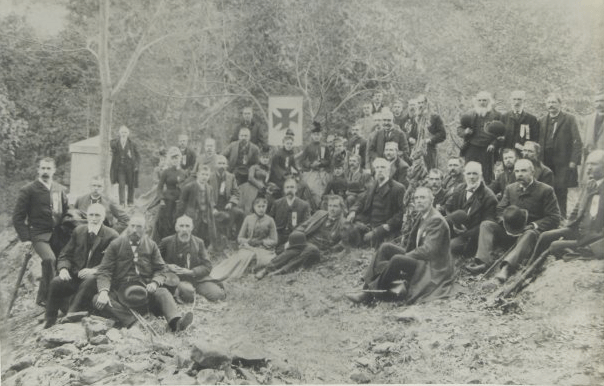 the 20th Maine Infantry, which was led by famed general and Maine native Joshua Chamberlain, reconnected for a reunion at Little Round Top in Gettysburg, Pa., in 1889. The regiment trained in Cape Elizabeth. (Courtesy photo)
Comments are no longer available on this story