
WESTBROOK – The story of Dusty the dog is a well-known tale to those who work at the Westbrook-based Animal Refuge League of Greater Portland.
Animal control officers picked him up abandoned in a parking lot outside a shopping center in Portland recently, and brought him to the shelter, where Executive Director Patsy Murphy said the 5-year-old black Labrador retriever’s head looked deformed.
“It looked like he’d been hit by a car,” she said.
It turned out Dusty hadn’t been injured, just neglected. A pair of ear infections had gotten so bad he needed surgery to repair the damage, costing about $4,000. If not for the shelter, that might not have happened, and now Dusty is in a foster home, fully recovered and looking and acting like any other dog. Not every nonhuman visitor to the shelter needs this much medical attention, but they all need love and a place to call home, which the shelter strives to provide.
The Animal Refuge League of Greater Portland has been making a difference for animals in the greater Portland area for a century now. And, as the shelter prepares to observe its 100th anniversary this year, Murphy is planning to reach out even more to the community, to promote animal health and adoption of all the furry four-legged friends, and to expand what the shelter offers to animals in need.
“I love anything that makes a difference in the community,” she said.
The shelter began life in Portland in 1911 as the brainchild of a group of elderly women living in the city’s West End, who wanted to do something about the stray cats and dogs seen in town, Murphy said.
Back then, there was a decidedly different philosophy about stray animals. It’s possible, though not confirmed, that dogs and cats were seen as a nuisance just as much as they were regarded as animals in need, Murphy said, and there was definitely a high rate of euthanasia among captured animals.
At first, the shelter operated out of various living rooms in the city, with the help of a veterinarian on Deering Avenue, but eventually, it moved to a proper home on India Street, and soon the attitude about what to do with stray or rejected animals began to change. Former Maine Gov. Percival Baxter, himself an advocate against animal cruelty, was one of the shelter’s first financial backers.
Before long, the animals’ needs forced the shelter into a larger building on the corner of Center and Pleasant streets in 1928, and eventually to 449 Stroudwater St. in Westbrook in 1956, using land donated as a gift. Already, there were signs the shelter was growing beyond the “dog pound” image. Photographs in old newspaper clippings show workers helping with a goat, and one clipping claimed the shelter once was home to a seal. Past records also indicate the shelter has been home to other small livestock animals such as chickens, Murphy said.
The shelter has ongoing contracts with 14 communities in southern Maine: Buxton, Cape Elizabeth, Chebeague Isalnd, Gorham, Gray, Long Island, Portland, Pownal, Raymond, Scarborough, South Portland, Standish, Westbrook and Windham. All these communities bring lost, abandoned, abused or injured animals to the shelter.
Deb Estrella has been the animal control officer in Portland for the past 20 years, and said the shelter has been invaluable to officers like her, who deal with wayward animals of all types. When she first worked in Portland, Estrella said, the shelter often euthanized animals brought in, even those with only basic health problems.
“If they brought in a cat that sneezed, it was a done deal,” she said.
She also remembered that the shelter never used to take small animals like rabbits, leaving Estrella to come up with creatively humane solutions of her own.
“I used to bring them all home,” she said. “I had a barn full of rabbits because I had no place to put them.”
Today, Estrella said, the shelter’s growth and capacity has been a welcome change. In a given year, she said, she couldn’t count how many animals she brings to the shelter, guessing “hundreds.” She also said she was pleased to see the shelter no longer puts animals down without a very good reason, a clear sign both of the progress of the shelter and the public mentality about stray animals.
“All the old-school thinking is gone,” she said.
David Sparks also knows a lot about how far the shelter has come over the years. He has been dealing with them weekly, if not daily, since 1987, first as the animal control officer for Westbrook. Back then, he said, the shelter had two or three employees, and he also remembered the shelter’s bad reputation as a “kill” shelter, meaning it euthanized many of the animals that went there. Certainly, that has changed dramatically since then, he said.
“Over the years, the Animal Refuge League has progressed a great deal,” he said.
Now, Sparks runs Sparks Ark Animal Emergency Services in Windham, where he takes in injured or nuisance animals and runs educational programs about wildlife. Today, Sparks represents another aspect of what’s available to handle stray or neglected animals. Anything the animal control officers or the shelter can’t handle, he takes care of. That means some exotic breeds of animals, such as reptiles and snakes, but also many types of birds.
Sparks said he is grateful to see the shelter has expanded to take on so much of the area’s needs, and was confident that without the shelter, there would be no way to meet those needs.
“Frankly, the load that they take in now, I wouldn’t be able to hold,” he said.
Today, the shelter is still located on Stroudwater Street, occupying two buildings on 77 acres. A mile-long exercise trail for the dogs winds through the property.
Inside, there is clear evidence that the shelter has come a long way since the old days, and has services that go well beyond mere cats and dogs. Between its own facilities and connections to people like Sparks, it can help pretty much any kind of furred, feathered or scaled creature one can think of. One whole room at the shelter, affectionately called the “critter room,” smelled of hay where rabbits slept in neat rows of cages.
Sharing the room were cages containing chinchillas, hamsters, ferrets, and other small residents. Near the door, a collection of domesticated mice ran madly on exercise wheels and squeezed through a cardboard paper towel roll in their cages.
And, of course, there were dogs and cats, clearly the largest number of residents at the shelter, and the focus of much of the shelter’s facilities. Feline guests greet visitors in cages just inside the shelter’s front door. On Monday, two cats, a calico named April and a gray and white named May, shared a cage near the front desk. April sat quietly, looking totally unimpressed with visitors who deigned to invade her domain, while May leapt about the cage, batting at dangling cat toys and string.
Just down the hall is the “multi-room.” The room was filled with cubbyholes, soft pet beds, folded blankets set on chairs, and about 10 reclining cats. Murphy said cats that have stayed at the shelter without being adopted for a longer period get moved there, where they can feel more like they are in a home, rather than a cage. There are even two windows which, on nice days, are open, allowing the cats to jump outside into a caged outside area for fresh air and sunshine.
“It’s a happy little room,” she said.
Toward the back of the building, a large room with large pens housed the dogs. Loud barks and yelps announced their presence to anyone coming in. There are all sizes and breeds, but, Murphy said, a big problem lately has been the prevalence of large dogs, like “Bruno,” a Rottweiler mix who, at 10 months old, already weighed at least 100 pounds. Many owners abandon them, she said, because in the poor economy, they can’t afford to feed or take care of them.
Then there’s the laundry, more than 250 pounds of it a day, washed both for the animals’ comfort and to keep the beds and cages neat and clean. On Monday, a huge pile of blankets, towels, leashes, toys, dog beds, and other soft items in a back room stretched nearly as high as a grown person’s head.
“This actually looks pretty good,” Murphy said. “Usually it’s up to the ceiling.”
The shelter cares for an estimated 4,000 animals in one year, and houses 300-400 animals on any given day. While this may suggest a chaotic environment, the shelter keeps tight control on everything that happens. With the exception of the critter room, breeds are never mixed together in any one place. New arrivals, either surrendered to the shelter or brought in off the street, are kept in separate cages – and in separate rooms – from other animals while the shelter workers evaluate them. There is a detailed medical screening and assessment process to identify any diseases they may be carrying. Workers also assess the disposition of the animal, whether it is aggressive, frightened, or even pining for a missing owner.
In the shelter’s second building, animals with serious medical problems are cared for. There is an “isolation ward” for animals with communicable diseases, such as feline leukemia, and any animals with temporary health problems are kept there until they are well again.
Unlike the days of old, Murphy stressed that the shelter does not euthanize animals unless they are in extreme pain due to an untreatable disease, or if they are too aggressive to adopt out, such as dogs bred for fighting. Murphy said the change in the shelter’s policy serves as a reflection of the change in society’s attitude about euthanizing adoptable animals.
“It’s a symbiotic relationship,” she said, referring to the public’s relationship with the shelter.
In all, Murphy said, the shelter places 95 percent of its animals, even those with chronic health problems or deformities.
“We’ll work with (animals with) one eye, three legs, one ear, we’ll work with it,” she said.
Even animals with advanced age can find homes. Murphy said on Monday that the shelter just found a home for an 18-year-old cat.
“It’s not about the quantity. It’s the quality of their lives,” she said.
As any pet owner knows, just keeping one pet at home can be expensive, when one factors in food, veterinary care, toys, spaying or neutering, and other needs. With 4,000 animals in the shelter’s care every year, the costs can get extreme. Murphy said the nonprofit shelter’s annual budget tops $1.4 million.
Murphy said the shelter does occasionally receive grants, but it’s hard to find them for animal-related groups like hers. This year, some private businesses have begun fund drives to support the shelter, but, Murphy said, the largest piece of her annual revenue comes from countless $25 donations made by the general public. Dusty’s surgery cost the shelter $4,000, which is an unusually high single expense for the shelter, leading to a special fund drive asking the public to help pay for it.
The shelter also relies on donations of supplies. Nearly all the pet food they feed the animals is donated by members of the public, grocery stores, and other businesses. Many of the linens come from hotels, salons and spas.
The shelter’s workers consist largely of volunteers, too. While there are 33 paid part-time and full-time staffers, there are also about 150 volunteers, Murphy said.
As for the future, Murphy said, the shelter could always use more space. Right now, trainers have to rent a separate location for obedience training for the dogs. Murphy said she would also like to have a classroom for bringing in schoolchildren and the public for lessons on animal health and care. Some improvements are less costly. Murphy is working on expanding programs such as Dog’s Day Out, where area businesses take some of the shelter’s dogs for the day to introduce them to the public. Programs like these, she said, are not only good for the dogs, but good for the public’s image of what the shelter does.
And, despite the constant outpouring of help, Murphy said the shelter is always looking for more support.
“The economy waxes and wanes,” she said. “Every year is challenging.”
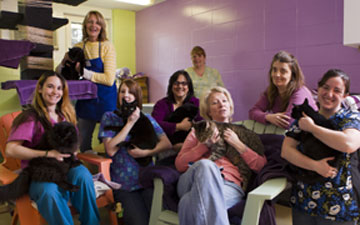 Felines in the multi-cat room get some extra hugs and rubs from Executive Director Patsy Murphy, center, and some of the staff and volunteers at the Animal Refuge League, from left, Casey Webster, Lori Anthony, Justine Higgins, Joanne Majka, Melanie Harper, Bonnie Waterman and Nicole Egan.Photos by Rich Obrey
Comments are no longer available on this story