
WESTBROOK – When Mike Nugent signs in to Facebook, he does the same thing as most users: posts some pictures, lets people know what he’s been up to and what’s going on around him.
The only difference is that his posts detail police arrests of the past week and his photos are mug shots of criminals.
Nugent is a lieutenant in the Westbrook Police Department and an administrator of the Westbrook Police Facebook page. The page has 3,800 fans who, when they log on to the social networking site, all receive police updates along with information about what their friends had for dinner or what they thought of Lady Gaga’s latest fashion faux-pas.
On Mondays, a “weekend update” post reveals the arrests made over the weekend. On Fridays, “this week at WPD” lists the arrests officers made throughout the week.
A recent Monday “weekend update” stated officers responded to 287 calls for service last weekend with seven suspicious incident reports, five car accidents and 167 traffic stops.
“We get a lot of positive comments on things we do post,” Nugent said. “A lot of folks are surprised at the volume and nature of the calls.”
Other postings throughout the week vary, but include a mix of significant arrests, winter driving alerts, public information on local sex offenders and warnings about construction or road closures.
“It’s a good means of sharing information,” Nugent said.
Facebook has even helped police track down wanted criminals. Police sometimes post wanted posters leading to tips about the whereabouts of a suspect. Once in a while, the suspects even see themselves on the Facebook page and turn themselves in, he said.
“We’ve had a pretty good success rate when we’ve put up those posters,” Nugent said.
Eric Conrad, a representative of the Maine Municipal Association, said it makes sense for public works and police departments to use Facebook to provide necessary information to a wide range of residents, but added other municipal departments should carefully weigh what information they want to convey.
“I think what a municipality first has to ask itself is, ‘What is the purpose of using Facebook?’ And then they must be careful what they communicate reflects that goal,” Conrad said.
He said any municipal department using Facebook should create policies for its use, including whether there is any review of postings before they go live and whether one particular individual should be responsible for posting all outgoing information.
“A lot of people are experimenting with social media these days, but a municipality really has to think about guidelines for its use,” Conrad added.
Another thing cities and towns need to consider is that Facebook users are free to comment on posts, Conrad said. There may be a need to monitor responses to make sure they don’t reflect badly on the department or the community as a whole.
Nugent, who is one of three administrators of the city’s police page, said people have remained mostly civil, but he has posted occasional reminders about etiquette. Any post about child or animal abuse “inflames people and generates harsh feelings,” he said, adding he has even banned some posters outright for rude comments.
Some criminals have complained about their photographs and arrest information appearing on the page, but Nugent said, “The bottom line is it is public information.”
Nugent said he deletes arrest information from the page after six months, always reminds people that suspects are innocent until proven guilty and deliberately posts less public information than he legally could.
Westbrook City Administrator Jerre Bryant said both the library and community services departments have looked at using Facebook, but the police department is the only one locally using it to a great extent.
“It can be a very good communication tool and a marketing tool, for that matter,” he said.
However, Bryant remains hesitant to expand the city’s use of Facebook because of potential liabilities, he said. He said he has concerns with a perceived lack of control over the content on the site.
“When you’re a public entity you’ve got to be very careful about what you’re putting out there,” he said. “I don’t have a high confidence in the ability to regulate what gets put on there.”
In Gorham, the town government has only recently established a Facebook page. Town Manager David Cole said they are in the early stages of taking advantage of what Facebook has to offer.
“We are just beginning to explore this and currently consider the Facebook page as another option to provide information to people, mostly with notices about something,” he said.
Bryant said Westbrook would also be approaching the tool with delicacy and caution.
“I just think there’s a lot of risk associated with this that I’m not comfortable with,” he said. “The plan is to approach it very cautiously.”
Aside from having to block the rare uncivil poster, Nugent said, Facebook has been a good tool to let citizens know what police face on a daily basis.
“It hasn’t really had any downsides,” he said. “It’s easily policed and it doesn’t take a lot of time to update the page … It pretty much runs itself at this point.”
Staff writer Kate Irish Collins contributed to this report.
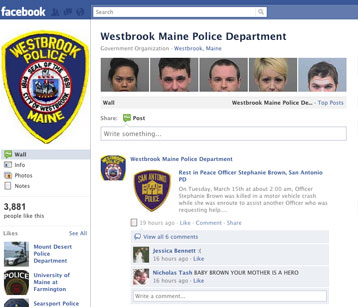 A screen snap of the Westbrook Police Department’s Facebook page, which is updated frequently.
Comments are no longer available on this story