
LAKES REGION – Even after a seemingly brutal succession of storms last month, snow removal budgets in the Lakes Region are right on track.
As another Maine winter passes its unofficial halfway mark, local public works departments are likewise about halfway through their winter maintenance budgets, aided in large part by the timing of the storms and a supply of sand leftover from last year’s mild winter.
Windham Public Works Director Doug Fortier says Windham has so far spent 50 to 60 percent of its budget for salt, sand and overtime usage. The town has logged 23,704 miles so far this year in 14 storm events, he said. Fortier said he’s spent about 35 percent of his repair budget so far, as well.
“What’s helped us is we’ve only had one or two weekend storm events. No holiday storms, so that all cuts down on overtime,” Fortier said. “So I’d say we’re sitting pretty good.”
Towns in the Lakes Region receive their road salt and calcium chloride (which melts ice at lower temperatures than sodium chloride) from Mass.-based Eastern Salt. Most towns started out the season with sand and salt leftover from the relatively mild winter of 2009-2010.
Naples Town Manager and Road Commissioner Derik Goodine said Naples “is right about where we should be,” so far, using 50 percent of its budget.
“We’ve only really had about three major storms, and most of that has been snow, rather than ice or rain, which helps contribute to us using less salt,” Goodine said. The more potential for ice, the more salt has to be used, Goodine said.
Naples contracts with Naples-based P&K Sand & Gravel Inc., which plows 45 miles of roadway in the town.
In Casco, Road Commissioner and Town Manager David Morton said the budget is doing well, especially since the town had leftover sand from last year. Like Naples, Casco contracts out for plowing services on a multi-year basis, but the town provides the roughly 5,000 yards of salt and sand used by the plowing contractor R.N. Willey & Sons Co. based in Casco.
“So we’re doing pretty good, although March can be a tricky month where there’s a lot of melting and thawing and freezing. So you can end up using quite a bit of product at the end of the season,” Morton said.
Sebago was likewise lucky to have extra sand at its disposal this year as well. However, that sand came from a gravel pit in which the town built its sand and salt shed. Road Foreman Tim Mayberry estimates the town saved $25,000 to $30,000 on sand by having its own supply.
Sebago, Mayberry said, has used 55 percent of its budget to maintain its 43 miles, “so, we’re actually doing real good,” Mayberry said.
In Standish, Public Works Director Roger Mosley estimates his department, which plows 70 miles of road with private contractors covering another 50 miles, has expended about 50 percent of its salt and sand budget.
“We’re on target. We budgeted for an average Maine winter and that seems to be what we’re getting right now,” Mosley said.
And in Raymond, Public Works Director Nathan White said the town has spent a quarter of its sand budget and about half of its overall winter maintenance budget.
“We haven’t had any major breakdowns, we’re managing the overtime,” White said. “I’m only worried about the fuel and overtime. We’ve got quite a balance of winter sand.”
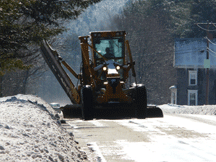 A snowplow clears slush and ice along Route 114 in Standish last week. Despite numerous storms in December and January, Standish and other Lakes Region towns are on target to meet their winter maintenance budgets this season. (Staff photo by John Balentine)
Comments are no longer available on this story