
NAPLES – First stunned that a local legislator would propose a bill closing the Songo Lock to all boat traffic, business owners in the Lakes Region who rely on an open lock to survive are relieved that the bill has died.
However, the issue the bill was meant to address – the spread of milfoil – is still very much a concern, and those who make a living off the water around the lock say a solution must be found that does not at the same time harm the area’s fragile economy.
Rep. Paul Waterhouse, R-Bridgton, had submitted the emergency bill, LD 242, that would have closed the historic lock located in South Casco in an attempt to limit the spread of milfoil. Waterhouse’s bill had the backing of the Bridgton-based Lakes Environmental Association, which called for the lock’s closure last summer when hot temperatures led to rapid milfoil growth in the lower Songo River, located below the lock.
While the environmental group approved of the bill, area business owners, as well as state Rep. Rich Cebra, R-Naples, fought to kill the bill, which procedurally died Tuesday night, Cebra said Wednesday. Members of the state House of Representatives disagreed with members of the Senate as to which committee would handle the bill, which effectively killed it, Cebra said.
“While there is currently no bill in the Legislature dealing with milfoil in the Songo, it needs to remain a priority in our area,” Cebra said. “And I look forward to working with local business owners, local government and other interested parties in protecting our lakes and rivers.”
Waterhouse did not return repeated phone calls for comment.
‘A major deal’
The Songo Lock, built in the 19th century as part of the Cumberland and Oxford Canal, allows boats to navigate the entire Songo River between Sebago Lake and Brandy Pond. Marinas rely on the lock to provide passage for boaters between the Lakes Region’s two main water bodies, Sebago Lake and Long Lake. The Naples economy especially relies on the tourist dollars generated by boaters wishing to access the entire river.
Already frustrated with the Lakes Environmental Association’s attempt to shut down the lock last summer, marina owners this week were irate that a legislator would propose a bill out of his district and that the association’s executive director, Peter Lowell, would attempt to use the Legislature to bypass local concerns without notifying other interested parties.
“It’s crazy, unbelievable,” said Dan Craffey, owner of Moose Landing Marina in Naples on Tuesday morning. “It’s hard enough to run a business in the state of Maine. To go over local people’s heads just shows these people are out of touch with what’s going on. It infuriates me like you wouldn’t believe. Just to threaten the lock’s closure is a major deal.”
Craffey said he had already received calls canceling summer boat rentals due to Waterhouse’s proposal. He, like other marina owners, is pointing the finger at Lowell for backing the proposal.
“I take this personally,” Craffey said. “I work seven days a week. We have employees and their families relying on these tourist dollars and someone in an office in Bridgton shouldn’t be able to make these types of decisions. (Lowell) should come down here, work here for the day, meet my employees, and then he’ll know how his actions affect Naples. It’s insulting.”
Dick Dyke, owner of several business in Naples, including the proposed KonTiki excursion boat that would run back and forth from Naples to Sebago Lake through the lock, was likewise disturbed that Waterhouse and Lowell would support a bill to close the lock.
“If there’s anyone who wants to protect the lakes and rivers, it’s me,” Dyke said. “But obviously, I think that this was a pretty bad idea, introducing a bill without getting much public input. It’s not good legislation, and I’m glad they’ve killed it.”
Causeway Marina owner Dan Allen was likewise upset by the proposal. Allen rents out 60 boat slips and has a fleet of 25 rental boats, of which he estimates 70 percent of tourists use to navigate the Songo River into Sebago Lake. If the lock had closed, Allen predicted, he’d lose 60-70 percent of his business.
“It wouldn’t just shut down the lock, it would shut down Naples,” Allen said. “It would shut down everybody. Marinas, restaurants, everything. Everybody’s business would be half of what it is.”
Allen said this summer will already be a struggle as the state reconstructs the Bay of Naples Bridge and causeway. The lock’s closure would only add to the erosion of tourist dollars.
Don Toms, general manager for Point Sebago Resort in South Casco, which averages 2,000 to 3,000 daily visitors and residents in the summer months, has 250 boat slips on the river. Toms said the Waterhouse bill “which sort of came out of the blue, stirred up a hornet’s nest that would have more of an impact than the bridge construction.”
Jim Allen, owner of Naples Marina and no relation to Dan Allen, has 180 boat slips. He agrees with Toms that the lock closure would be devastating for business. Allen stores boats for the Lakes Environmental Association at his marina and was surprised by the sudden appearance of an association-backed bill to close the lock.
“In no way do I want to stop LEA’s fight against milfoil, but they definitely shot from the hip on this one,” Jim Allen said. “I understand what (Lowell) is doing and I commend him for it, but to put forth this legislation behind everyone’s back, that’s not the proper way to go about it.”
Most of those familiar with the river, including Craffey, the two Allens, Toms and former Songo River Queen owner Frank Gerrish, believe dredging is the answer to the milfoil problem.
“They need to dredge the river,” Jim Allen said. “It’s starting to fill in and stopping the flow of the river. That would eliminate the milfoil. It’s going to take some funding and some hard work, but that, along with suction harvesting and matting, are the answers if you ask me.”
Lowell said Wednesday that now that the bill has died, he hopes “something productive comes of it.”
“Paul (Waterhouse) approached me and said he was considering submitting a bill,” Lowell said. “I supported that knowing it would get the issue in front of people now instead of in the summer when it’ll be more of a problem. That’s what happened last summer.
“Now, I don’t want to duke it out with marina owners, because we’re all partners in the solution,” Lowell said. “But the reality is, if milfoil gets out of control, that will definitely kill Naples recreation. All kinds of evil will arise if milfoil takes over. And that’s what we’re all concerned about.”
Concerning dredging, which Gerrish regularly performed in Brandy Pond and the Songo River until he ran into regulatory problems with the Maine Department of Environmental Protection in the 1980s and 1990s, Lowell doesn’t believe it will have the desired result.
He said the plants would “come back with a vengeance” and fragments would re-root downriver and in Sebago Lake. He also said digging out the shelf along the edge of the river where the milfoil primarily grows could compromise the structural integrity of the banking, much of which is lined with homes.
Instead, Lowell would like to put barriers down in the lower Songo River, as his group has done in the Upper Songo (above the lock) and Brandy Pond. Lowell said there are new methods of eradication such as custom-made barriers that roll out from the shoreline like window shades shielding the milfoil from sunlight.
“That would be my silver bullet, but we don’t have the funding to do it. The whole point of this exercise is to get the money, the boats, the resources so we can hopefully get there,” Lowell said.
Barbara Clark, executive director of the Sebago Lakes Region Chamber of Commerce, said she was relieved the lock-closing bill was killed and that the closure would have a “huge, huge impact on our region.”
She said Wednesday that a community group is in formation stages to address the milfoil problem.
“We have some very hard challenges ahead and we all need to work together to solve them,” she said.
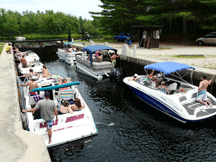 A bill submitted by Rep. Paul Waterhouse, R-Bridgton, sought to indefinitely close Songo Lock, shown here last summer. Invasive milfoil is spreading quickly in areas below the Songo Lock, and while Waterhouse’s bill died Tuesday night, business owners and environmentalists continue to debate how to fight the spread of milfoil. (File photo)
Comments are no longer available on this story