
WESTBROOK – The words of Westbrook police Chief Bill Baker’s mother rang in his head as he took cover behind a tree in the woods off Methodist Road.
“You be careful. It’s the last two weeks of work that something bad happens,” she told him. “Don’t get yourself shot the last two weeks.”
Just weeks from retirement – he will join a special program at the FBI – Baker found himself in the middle of a foot chase through the woods after spotting a man urinating in public on the side of the road. The man fled at the sight of a uniformed officer and Baker, thinking the suspect may have had more reason to flee than just a citation for public urination, gave chase.
About 400 yards in, Baker lost sight of the suspect’s footprints. Suddenly, he realized the danger he put himself in. He knows that a cop’s death right before retirement isn’t just the stuff of movies.
He started thinking about Bobby Mortell, a police chief in a small Massachusetts town of 2,500 who was shot dead in 1994 during a pursuit of a couple of burglars through the woods.
And he remembered Mark Charbonnier, a law school buddy and former Massachusetts state trooper who was killed in 1994 during a routine traffic stop a week from being transferred to a non-uniformed desk job.
These things ran through his mind as he searched the area for his suspect. Roughly 20 yards away, he saw footprints near a creek indicating the man ran farther into the woods. He breathed a sigh of relief, knowing the man did not end up behind him.
Other responding officers helped catch the man, who was charged with resisting arrest and indecency; fortunately, he had no firearm on him. But as a police officer, Baker said, you just never know.
It is a minor story that is symbolic of what the chief will be taking on when he leaves his post Friday. Through Keane Federal Systems of McLean, Va., he is joining the FBI LEOKA (law enforcement officers killed and assaulted) program as an instructor to help reduce the number of officers killed and injured in the line of duty.
According to the Officer Down Memorial Page Inc., a nonprofit dedicated to honoring fallen law enforcement officers, 162 officers were killed in the line of duty in 2010. Seventeen have died already in 2011. They averaged 41 years of age.
Though rare, an officer being killed in the line of duty is not unheard of in Westbrook. In 1959, police Chief Pierre Harnois was mortally wounded by gunfire during a standoff in Limerick.
Baker’s new post is a full-time job, so he is not truly “retiring,” though he is stepping away from full-time law enforcement after a 36-year career.
“It’s a pretty significant change. It’s a new phase, and maybe the final phase, of my career,” he said.
Rob Casey, the section chief for the FBI’s criminal justice information services, described Baker’s job as “the most important thing we do” and something that saves lives on a daily basis.
“No question it will influence law enforcement nationally,” said fire Chief Mike Pardue, who will serve as interim police chief after Baker’s departure.
Casey said the FBI puts out a web-based publication each year based on information gathered from 15,000 police agencies across the country. Departments fill out 20-page questionnaires each time an officer dies in the line of duty, he said.
Baker would use data dating back to 1980 to help conduct classes to teach skills for survival, Casey said.
Casey said Baker brings “phenomenal insight” and “investigative acumen” to the program, and that his hire is “quite a coup for the FBI.”
Baker said he also would be interviewing imprisoned criminals who killed police officers in an effort to gain insight into what circumstances led to the officer’s death.
“By interviewing people involved in all kinds of deadly encounters, there clearly are some tactical issues and training that will come up,” he said. “By talking to people who shot police in those circumstances, it reinforces that lesson and you can share that lesson with other police officers so they are thinking more strategically.”
Baker has some theories about what puts officers at risk. He said police receive extensive training in defensive tactics and firearms training. Lessons in developing mental skill are lacking, he said.
“This is kind of brain food for officers’ survival, which is one of the reasons why it’s so appealing,” he said.
Baker also thinks the negativity surrounding police use of force has hamstrung officers who may have no other options. He said violent suspects who resist arrest sometimes leave officers with few options.
“It seems to be the vocal minority,” Baker said, who “see every use of force as an illegal use of force and a violation of people’s civil rights, which is astounding to those of us in the law enforcement community.”
Baker said some incidents, especially ones involving suspects resisting arrest, require some force, but, “a lot of the newer generation of police people are getting a little gun shy about using force and I think it’s getting a lot of them hurt or killed.”
Baker will take those ideas, along with others he gathers through interviews and research, to help police around the country and, perhaps, throughout the world.
“I think there’s some interest in trying to expand the concept into the international arena, as well,” he said.
That is something Baker would be comfortable with. He used to work for the Justice Department in Washington, D.C., which took him around the world mentoring police leadership in Haiti, Uganda and elsewhere.
He recalled an officer he worked with in Guatemala City. The man’s name was Freddy. He had been shot a half-dozen times, Baker said.
Freddy worked nights in one of the most interesting, busy and violent patrol beats Baker has seen. He carried a revolver with no spare bullets, no bulletproof vest and no flashlight. Freddy made about $50 a month, but did the job “because he cares about the country,” Baker said.
“That’s kind of what motivates me and why I think it’s important,” he added.
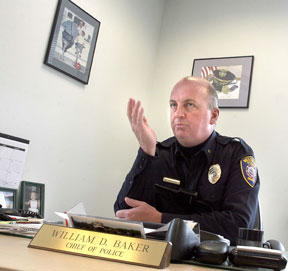 Bill Baker, former Westbrook police chief, in a file photo.
Comments are no longer available on this story