
LAKES REGION – With Black Friday and Cyber Monday come and gone, new digital technology is not only topping many Christmas gift lists, it’s also front and center in the minds of educators aiming to take advantage of the new digital revolution to further students’ grasp of everything from history to home economics.
Throughout the region, schools are utilizing laptops, netbooks and e-readers to break down the boundaries of education, further students’ breadth and depth of knowledge and maybe even put a little more fun into the process of learning key essentials of a 21st Century education.
At Bonny Eagle, the school library has recently allowed students to take home Amazon Kindle e-readers to read the classics of literature. And in Windham, the technology director has installed software on all school-issued laptops to allow students to open their devices as they would a book to read and view content.
Both efforts are a glimpse of education’s future, which state educators believe will be free of textbooks and where laptops, e-readers and tablet computers like Apple’s iPad render traditional textbooks obsolete. And that future, which just a few years ago seemed like science fiction, is coming quicker than expected with advances in technology.
Local ‘E’ Efforts
One example of how technology is starting to change the delivery of knowledge can be found at the Bonny Eagle High School library, where students are allowed to check out an Amazon Kindle just as they would a book.
Librarian Jodi Breau, a former Library Specialist of the Year in 1996 and 25-year school library veteran, started allowing students to take the devices home Oct. 1 in an effort to bridge the divide between reading screens and reading books.
“I was trying to tap into students who like computers,” said Breau. “They’re so connected with their cell phones, their iPods, their iPads, they’re on screens all the time. So, I thought, here’s a way to get those students who are on screens anyway, to get them reading.”
Breau has so far purchased five e-books ranging from classics to modern titles that might catch a teenager’s eye, including “Salem’s Lot” by Stephen King and the popular “Eragon” by Christopher Paolini.
Breau doesn’t worry about the population of kids who read. The Kindle wasn’t really meant for them, she said. It was meant for the kids who might think books are old school.
“We have a population of readers who read all the time. They’re voracious readers, always constantly have a book, but in my experience, that population of students is smaller,” Breau said. “But then we have another population who wants to be gaming, and as a school we’re trying to get them to read more and this is one way I’m trying to entice them.”
And does a digitized book offer the same experience as a traditional book? Breau thinks it does.
“I didn’t have a different literary experience either way because I was reading from a Kindle,” she said. “Whatever we do when we’re reading a story, I got the same experience from the Kindle as I did a text paper copy.”
Bonny Eagle didn’t opt into the one-laptop-per-student philosophy and instead offers 22 laptop stations around the school with 50 laptops available for circulation from the library for student use.
While laptops and netbooks rival desktop computers in terms of hard disk storage and operating speeds, e-readers have less robust operating systems and some don’t feature color screens limiting their graphics capability. Engineered for reading text primarily, e-readers are less costly, though new technological gains offer color versions and wireless connectivity. Some schools, however, are eying the use of laptops and netbooks to deliver e-content.
Windham offers the one-to-one ratio for laptops and takes advantage of the devices by recently installing iRotate, which allows the netbooks to be rotated 90 degrees to open and display text like a book. It’s as close to a digital textbook that exists in schools today.
“A Kindle is dedicated technology,” explained Windham’s technology director, Bob Hickey, who said schools would be limited in where they can obtain digital content. “A netbook with the right software, especially since we have 1,050 kids that already have them, can do so much more.”
Hickey has already found sites that offer classics online.
“We feel so strongly about this. How can you not be leveraging some of the stuff that has just recently become available out there?” Hickey said.
Going national
Maine’s efforts in modernizing the classroom were recently heralded by U.S. Secretary of Education Arne Duncan, who singled out Maine’s technology initiatives at a recent national conference held in Washington, D.C. in early November.
While announcing the release of a national education technology plan entitled “Transforming American Education: Learning Powered by Technology,” Duncan called for “applying the advanced technologies used in our daily personal and professional lives to our entire education system to improve student learning, accelerate and scale up the adoption of effective practices, and use data and information for continuous improvement.”
In his remarks, Duncan highlighted Maine as an example of how technology is being used successfully in a way that leverages the power of technology to support continuous and lifelong learning.
Jeff Mao, learning technology director at the Maine Department of Education, is vice chair of the State Educational Technology Directors Association board of directors, which hosted the November conference. Mao envisions a future where technology plays an even bigger role in the school day.
“I think the idea of digital media replacing traditional textbooks is definitely part of the future,” Mao said last week. “There’s definitely movement in that direction.”
Mao said there are times when books are better, but with the outpouring of new e-readers which realistically mimic the pages of a book and more powerful handheld devices like netbooks, Mao acknowledged a “shift” toward more fully utilizing digital devices that students already have access to through former Gov. Angus King’s laptop initiative begun in 2001. So far, laptop computers have been distributed to all seventh and eighth graders and half of Maine’s high schoolers. Specifically, Mao sees the digital textbooks as a logical next step, one that’s made more feasible by the introduction of new devices such as the Apple iPad and Amazon Kindle.
“A few years ago, maybe it wouldn’t have worked so easily, but there is new technology that makes you go, ‘wow, this can really work,'” Mao said.
An avid user of his own new iPad, on which he has already read several books, especially on long business-related flights, Mao sees that once seemed far off is possible now and that the laptop or Kindle can help deliver engaging content in a way educators have only dreamed about.
Mao uses the example of the Battle of Gettysburg to illustrate the difference between traditional and digital textbooks. A paper textbook, he says, is limited in its presentation. There may be a few pictures, a few charts, a few perspectives on the battle. But a digital device could offer that plus embedded links offering curious students an endless supply of Internet sites addressing facets of the battle. It would be the teacher’s or curriculum coordinator’s job to corral the infinite segues into a package presentable on the laptop.
“Here in Maine, we would want to have a special focus on Joshua Chamberlain’s role in the battle,” Mao said, “A textbook might give you a paragraph if you’re lucky, but online content would offer much more, perhaps a map of where Chamberlain was positioned with elevation, where the guns were, where the soldiers were arrayed, perhaps re-creations of the battle in audio, video, interactive live data, blogs. The content could be endless.”
Free content
And all that content could be free, Mao says, which in a cash-strapped budgeting environment could ease the transition for traditionalists. Textbooks, Mao explained, can cost $100 or more, and their content can quickly become outdated with new discoveries and advances, not to mention the abuse they can suffer from students. But online educational content, he said, is available sometimes for free. And even if the online content comes with a price, that cost would be primarily for access privileges to content that would grow and conform to mirror new advances, he said.
“It’s funny we’re talking about this because later today in fact, I’m involved in a conference call discussing this concept of open education resources,” Mao said referring to a nationwide group with which he is involved that for the last year and a half has been scouring the Internet for digital media. He has discovered in that process that schools such as Rice University have a repository of open educational content available mostly for free.
“Yes, you can tap into free content and Maine is the most well-positioned of all the states because of MLTI (Maine’s Learning Technology Initiative) since our students already have the devices. It’s a just a matter of tapping into it,” Mao said.
In addition to the cost savings, Mao also touted the benefits of a single laptop or e-reader that could replace a cumbersome and downright heavy pile of books. One thin laptop or e-reader could replace pounds of paper in other words, which would not only be advantageous for the environment but for students’ backs as well.
“The benefits of digital media can’t be overstated,” Mao said. “Right now, we’re buying textbooks, right, but what we are really buying is, yes, the intellectual property and the paper and the binding materials used to make that textbook.”
Digital textbooks is something the state is pursuing, not because it wants the latest gadgets like those on your Christmas gift list but because it wants Maine students to succeed, Mao said.
“We are absolutely pursuing digital delivery of content,” Mao said. “Converting to digital content is something that could not only save money but have learning benefits as well.”
Maine’s Acting Commissioner of Education Angela Faherty agrees, saying, “the reason we have drawn so much attention (from the national Department of Education) is that our focus has never been about the technology and always about what the technology can do for student learning.”
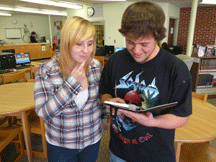 Cody Whitten, a senior at Bonny Eagle High School and fellow senior Barbie Whitten (no relation), check out the library’s Amazon Kindle, which librarian Jodi Breau has recently circulated for student use. Cody has read “Eragon” by Christopher Paolini on the Kindle, and although he enjoys traditional books, he likes the features the Kindle offers. “I like my regular books,” he said, “but I don’t mind reading on either the Kindle or a regular book. I guess it’s equal, but the Kindle is more portable.” (Staff photo by John Balentine)
Comments are no longer available on this story