
It’s nearly 11 p.m. and Gorham’s South Street is deserted when a cruiser radar reveals a speeder. Officer Ted Hatch turns his cruiser around and lights up a car with Massachusetts plates.
With eyes fixed on the car and its driver, Hatch radios the plate number to dispatch. Not knowing who is driving, he steps from the cruiser to the car.
It’s a college student hurrying home for the weekend, but he catches a break.
“He was honest and admitted he was in a rush. I gave him a warning,” Hatch said.
The Gorham stop posed no threat. But just in case, Hatch is prepared — stored in the cruiser cockpit near Hatch’s right hand are an assault rifle and a 12-gauge shotgun.
Civilians in a recent 10-week Citizens Oriented Policing School saw all that and more through an inside look at the routine of police officers, even riding up front with an on-duty officer in a cruiser.
Hoping to step up its rapport with the community, several police departments in Cumberland County sponsored the recent cops course. Officer Linda Barker of the South Portland Police Department co-facilitated the course with Bill Herbert, a faculty member of the criminal justice program at Southern Maine Community College in South Portland. Weekly three-hour sessions rotated among participating police departments.
Barker, of South Portland’s Community Response Unit, said this week the purpose of the course is to broaden understanding of the police role.
Twenty-five citizens were enrolled this year, said Herbert, who is retired from the Nassau County, N.Y., Police Department and Cumberland County Sheriff’s Office, and 21 stayed with it to receive certificates and a polo shirt bearing the COPS logo in a graduation ceremony on Nov. 17 at Southern Maine Community College.
“You’ve got the inside look at what goes on and what it takes,” South Portland police Chief Ed Googins told the class graduates.
The course covered all facets of policing including the hiring process, law, detective techniques, use of force and tactics, canines, and a tour of Cumberland County Jail.
Barry Atwood of Gorham said it was helpful in understanding how complex policing is with duty sometimes now requiring negotiating and social work skills.
“I thought it was extremely worthwhile,” Atwood said.
In a Windham ride-along, Bob Muir, a former Windham town councilor, accompanied two Windham officers including Jason Burke.
“They were in a ready state all the time,” said Muir, who rode until 2 a.m.
“They were seeing things out there that the ordinary person wouldn’t,” Muir said.
Although serving more than five years with Volunteers in Police Service, Edward Libby of Scarborough, also a graduate, cited the value of the course.
“It gave me a lot more depth and insight,” Libby said.
Cape Elizabeth resident Jeff Croft took the course for the education value. He said it presented a behind-the-scenes look that the average person won’t ever have the opportunity to see.
As an example, Croft cited the tour of the jail where guards focused on security monitors. The citizens saw the inmates — their faces, and the interior of cells with steel-framed bunk beds and steel toilets.
They learned jail security prohibits even police officers from carrying weapons inside while booking suspects.
“Being in Cumberland County Jail and walking through halls with the inmates,” Croft said, stood out as one memorable part of the course.
For Atwood, the use-of-force class taught by Lt. Mike Nugent of the Westbrook Police Department was particularly interesting. Nugent told of the variety of weapons police have available as choices to deal with different situations. Nugent said officers can’t be complacent.
“It’s a dangerous business,” Nugent said.
“They’re expected to make split-second decisions,” Atwood said about police action. “They’re the first line of defense in an emergency.”
Barker taught one session, revealing her experiences as a patrol officer. Detective Steve Webster, a supervisor with South Portland police, described details of the investigative process he employed that led to the conviction of a man who shot a police officer.
The hiring process for police, which includes a lie detector test, also impressed the students. Muir said police applicants face a “stressful” interview process. “You’ve got to have people you can trust,” Muir said.
To participate in the class, applicants were screened by their local police departments. Then, police conducted a background check on each applicant.
The checks were required because the students were in areas normally off limits to the public, like stations and the jail.
The idea for the citizens’ school came from a meeting of police chiefs. Herbert helped develop the course at the behest of the Criminal Justice Department at the college.
“We looked at various models. We cherry-picked them,” Herbert said about the curriculum. “We wanted to give it a homegrown flavor.”
The course packed extensive material into 10 weeks. It kicked off in Cape Elizabeth, where police Chief Neil Williams, who injected a bit of humor, welcomed citizens. “I don’t think anyone is going to be Tased,” he said.
The course, Muir said, afforded an insight for citizens to see what they do.
“It’s a profession. That’s their career,” Muir said. “It’s quite a grueling job.”
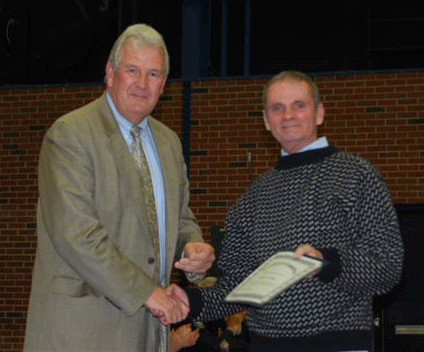 Scarborough police Chief Robert Moulton, left, presents a certificate to Edward Libby of Scarborough, who recently graduated from the Citizen Oriented Policing School sponsored by several area law enforcement departments. (Courtesy photo)
Comments are no longer available on this story