
SOUTH PORTLAND – South Portland police are expanding the use of the automated license plate recognition technology that raised privacy concerns when first implemented earlier this year.
Through a partnership with the city of Portland and the Cumberland County Sheriff’s Office, South Portland has been awarded $28,540 in funding from the 2010 Edward Byrne Memorial Justice Assistance Grant. The South Portland Police Department will use the majority of the money – $20,000 – to outfit a second patrol vehicle with the plate recognition cameras, a piece of technology the city began using earlier this year.
The introduction of the technology in January sparked a debate pitting public safety against privacy rights, and led the Legislature to pass a law that made that made it illegal to use the technology, except by law enforcement agencies, the Maine Department of Transportation or the Maine Turnpike Authority. The law also limited the amount of time an agency can store the information gleaned from the cameras.
The Maine Civil Liberties Union was first concerned at the potential for abuse with the cameras, which MCLU officials said could be used inappropriately, such as to record people at a political rally. The group was also worried about the safety of the information recorded by the cameras, and about the oversight of the system.
But police say the technology has been useful during its time in South Portland.
“This initiative was implemented last year and we have found this technology to be very useful and worth expanding,” South Portland police Chief Ed Googins wrote in a letter to City Manager Jim Gailey explaining the grant, the remainder of which will be used by the department to replace an aging digital camera and to purchase five electronic control devices, or tasers.
South Portland was the first city in the state to use the technology, which takes a picture of a license plate and converts it to readable data that is then compared to the “hot list,” a National Crime Information System list of license plates that are of interest for law enforcement agencies.
South Portland police Lt. Frank Clark said the list, which is updated daily, includes license plate numbers of stolen vehicles, or vehicles belonging to a wanted criminal, someone who is reported missing or endangered, of individuals connected to domestic abuse crimes, the violent gang or terrorist list, or who are considered habitual traffic offenders.
If a match is found, Clark said, an alarm goes off on the police cruiser’s computer. The officer, he said, then would investigate further to see why the alarm went off, since the system cannot determine anything about the driver, the vehicle owner, or even the license plate itself.
“Even if the alarm goes off, all we know is that plate number,” Clark said. “We know nothing about who the driver is, who the owner of the vehicle is. We have to investigate further and run more queries to find that out.”
He said police cannot stop a vehicle solely on a hit, but can take action based on information from further investigation into the license plate number.
Clark said the department used the system to compile a “list of what we considered dangerous drivers in the city.” This list, he said, includes 1,100 residents of South Portland who have suspended or revoked licenses for being habitual traffic offenders. The department is now using the system to expand the dangerous driver list to include Portland, Westbrook, Cape Elizabeth and Scarborough.
South Portland police Lt. Todd Bernard said since the system was first introduced to the department in late January, the system has resulted in hundreds of hits, including 31 hits where action was taken. Most of those, he said, were for operating a motor vehicle after suspension.
In one case, however, Bernard said police recovered drugs, and in another a handgun was found in the vehicle.
“I think almost without exception, these stops would not have been made had it not been for the ALPR system,” he said.
“It has definitely made our law enforcement more efficient and more effective than it previously could have been,” Clark said.
One of the issues with the system, Bernard said, is that it cannot recognize license plates types, meaning a license plate number on an out-of-state license plate that is on the hot list would come up as a hit when the same license plate number on a Maine license plate is read.
Clark said the South Portland Police Department has implemented a policy to regulate how the department uses the technology. The policy, he said, was made following a meeting with the MCLU. Per the policy, the data provided by the ALPR system is retained by the police department for 21 days before it is overwritten. The only exception is if the license plate is part of an ongoing investigation.
Googins said the Maine Department of Transportation uses it for traffic counting purposes to see where a vehicle originates from and where it is going. The Maine Turnpike Authority uses it through its EZ pass system.
“I think the hardest part for the Legislature was how much does [this system] know about an individual driver,” Googins said. “It does not know anything about you, unless we run further queries. All it does is read numbers on the plate.”
“While I understand the privacy concerns,” Googins said, “through the Legislature and policy, I think those concerns can be managed.”
The MCLU said the group continues to monitor the issue.
“We certainly continue to have concerns about any increase in the use of this sort of technology for law enforcement purposes, particularly when it is used to survey people that aren’t suspected of doing anything wrong,” said Alysia Melnick, public policy counsel for the Maine Civil Liberties Union.”However, we were pleased to see the limitations in place that are reflected by the bill and the operation policy of the South Portland Police Department. We are pleased there are at least some measures to protect individuals’ privacy and confidentiality. We are encouraged, but we still continue to be concerned by the use and expansion of this type of surveillance.”
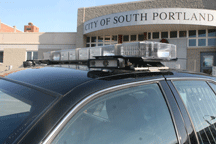 The South Portland Police Department in January acquired three cameras that when placed on the top of a cruiser create an automated license plate recognition system. The cameras photograph license plates as the cruiser moves down the street and run the numbers through a national database, alerting police if the car is connected to a crime. On Monday, the City Council approved a grant that will allow police to add a second camera system. (File photo)
Comments are no longer available on this story