
WESTBROOK – Westbrook students are finding technology is a way for bullies to harass their peers outside the sight of adults.
Bullying happens at Westbrook High School “way more than it should,” said Liz Torrey, 15, a sophomore and one of the student representatives to the City Council. With cell phones and Facebook, the popular online social networking site,“it’s easier for people to say things they wouldn’t say in person.”
“This is definitely a touchy subject that should be dealt with carefully and in a timely manner,” said Glenn Emery, 18, one of the student representatives to the School Committee.
Their comments about bullying come at a time when the Westbrook School Committee is debating the implementation of administrative procedures to deal with bullying incidents.
Emery recalled an incident two years ago when students were using Skype, a free Internet video calling program, to pressure other students to send sexually explicit images of themselves. Skype has since been blocked at the school.
He has also heard the stories nationwide about students who have committed suicide because of the constant harassment of a bully.
“We want to avoid it here,” he said. “There is a little bit of tension between groups of people. I’d like to see that go away.”
Still, the students indicated bullying is fairly mild in Westbrook. There are initiatives ongoing to preach tolerance. This week is Ally Week, and a table is set up in the cafeteria to provide students with information on affording all students a safe school environment regardless of sexual orientation, gender identity or expression.
“I think the direction we’re taking is the right one … to break that tension,” added Torrey.
The district already has a policy in place that defines and prohibits bullying. But School Committee members disagree on how best to craft procedure administrators should follow when bullying occurs.
The Westbrook School Department’s bullying administrative procedure was up for a first approval at the School Committee’s meeting on Oct. 13. The board ultimately tabled a vote on the matter following a passionate debate.
Committee member Alexander Stone had previously stated the procedure was “not worth the paper it’s written on,” and reiterated his concerns it is not specific enough.
“What happens when a teacher ignores bullying? I haven’t seen that information. I’ve asked for it, but I haven’t seen it,” he said. “Can this policy be better? Yes. Let’s make it the best policy we can make.”
Committee member James Violette raised his own concerns about a line in the procedure that states first offense consequences may include suspension, expulsion and reporting to law enforcement.
“I’ve got a problem with a first offense, and you’re calling the police,” Violette said. “There’s really no consistency or direction.”
Violette also wanted to send the procedure to attorneys for review before adopting it.
Others on the committee approved of the procedure and expressed frustration at belaboring the matter.
“It’s frustrating. It’s totally absurd to me. How many times are we going to go back to the administrators and say, ‘They don’t like it, come up with something better?’” said committee member Suzanne Bearor.
Superintendent Dr. Reza Namin said the procedure “gives discretion to administrators.”
Namin said bullying was a focus of his shortly after his arrival in the district in 2009. He said a study of culture and climate in the schools revealed a significant number of students felt bullied at the middle and high school levels.
“That data, to me, was alarming,” he said. “It showed that we need to address this.”
He said it can be difficult for school staff to know how deeply bullying can affect a student, but noted it is cited as a factor when some students opt to drop out.
“There is no such thing as a small bullying incident, because it has a long-term emotional impact,” he said.
According to Steve Wessler, executive director of The Center for Preventing Hate, the bullying situation is strikingly similar in schools all over. Bullying’s impact can be catastrophic, he said, and may cause students to drop out, turn to drugs and alcohol or become suicidal.
“Kids lose their health over this. They lose their education,” he said.
Wessler said strong bullying policies and procedures are important, adding that he would not call the various punishment options outlined in Westbrook’s procedure “vague.”
“You’ve got to allow administrators discretion,” he said.
He said having a sound procedure and staff training are crucial, but a major piece of the puzzle is working with students on strategies for low-key interventions among themselves.
“The vast majority of (bullying) happens outside the eyes and ears of an adult,” he said.
The Center for Preventing Hate works with organizations in Maine and the rest of the country, as well as Northern Ireland, to prevent and respond to bias, harassment and violence. The center has recently worked on sexual harassment issues with the Westbrook Fire Department.
In other area school districts, bullying policies are already in place. The Windham-Raymond School District has a policy defining harassment, sexual harassment, hazing and bullying. Its language regarding punishment is similar to Westbrook’s proposed procedure, stating disciplinary measures for bullying could include suspension and expulsion.
Windham Raymond Superintendent Sandy Prince called it a “no tolerance” policy. It was adopted in June 2009 in response to bullying issues, he said.
“We like to think that it doesn’t happen but it does happen, and that’s why we’ve taken a proactive, preventive approach,” he said.
The Bonny Eagle School District, serving Buxton, Standish, Hollis, Limington and Frye Island, also has a bullying policy. It outlines both prevention and intervention programs and similarly states punishment for bullying may range from positive behavioral interventions, suspension, expulsion and reporting to law enforcement.
At Westbrook High School, Principal Marc Gousse said he appreciates the School Committee’s approach to the procedure, but at the same time he cannot wait for it to be approved before responding to bullying incidents.
He said he thinks the district’s administrators are fairly consistent with handling bullying now, noting principals often call their colleagues at other schools before deciding on an appropriate punishment.
Gousse’s major concern is handling how bullies abuse technology to harass their peers.
“There are a lot of people who get very brave behind a keyboard,” he said, adding that outright banning of cell phones and other devices is not the answer.
“(Technology) is here to stay. We have to recognize it and educate our students in its appropriate use,” he said.
The School Committee will hold a workshop on the bullying procedures on Thursday, Oct. 28, at 6 p.m. at the high school.
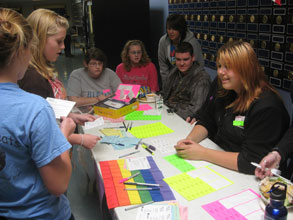 Westbrook High School students receive information about tolerance at an Ally Week table set up in the cafeteria. Pictured, clockwise from left, are Angela Beattie, Delaney Baither, Tayler Baker, Bethany McCallister, Amanda Rubino, Dylan LaPlante and Sarah Prince.Staff photo by Joey Cresta
Comments are no longer available on this story