
WINDHAM – Last year, state Sen. Bill Diamond, D-Cumberland, received overwhelming support from fellow legislators – and generated much public discussion – on a distracted driving law aimed to turn motorists’ attention back onto the roadway.
This year, with text messaging trends rising quickly, the Windham resident and former secretary of state is lead-sponsoring a bill to ban texting while driving.
“It’s pretty straightforward,” Diamond said of his bill, which he has already submitted and expects to be considered by the Maine Legislature sometime in January or February, “It’s the same piece of legislation that has been passed in 30 other states, including New Hampshire and Vermont.”
Diamond, who last year hesitated to seek a ban on texting to instead focus on the broader “distracted driving” law, says he is “always cautious about chasing technology with legislation.” However, texting has become a major concern around the country and requires a more direct response, he said.
“It’s becoming more prevalent. It’s not just kids; it’s adults too,” Diamond said. He cites a recent study that indicates texting while driving is the impairment equivalent of driving with a .13 blood alcohol content, or nearly twice the legal limit of .08. Diamond also cites a new law banning federal employees from texting while driving and is urging the Baldacci administration to immediately adopt a similar rule for state employees.
According to AAA of Northern New England, which is based in Portland, texting while driving has become almost as popular as making a cell phone call in the car. The association’s director of public affairs, Pat Moody, said this week that it fully supports Diamond’s bill and has been pushing for a nationwide ban.
“Our policy has been pretty consistent over the years regarding texting while driving. We’ve surveyed our members and found there is strong public support for banning the practice,” Moody said.
Moody quotes a December 2008 member survey of Maine AAA members, which found 94 percent welcomed a ban. Regionally, Massachusetts’s texting ban takes effect in October; New Hampshire’s ban took effect in January and Vermont’s took effect June 1. In all, 30 state legislatures plus the District of Columbia have approved texting bans. And as technology improves, especially with the advent of user-friendly smart phones, texting will get more popular, Moody said, making a texting ban while driving even more necessary.
According to industry data, “in 2000, there were virtually no text messages sent. In 2005, there were 81 billion text messages sent. In 2009, there were 1.56 trillion. That’s 4.2 billion text messages per day. Texting will eventually eclipse talking (on a cell phone),” Moody said.
Moody’s organization doesn’t advocate for the banning of cell phones however, only texting.
“Texting is a unique distraction,” Moody said. “Visually, it takes your eyes off the road. Manually or physically, it takes your hand off the wheel, and cognitively, it takes your mind off your task.”
Diamond is up for re-election this November, running against Republican Ann-Marie Grenier of Windham. Grenier “commends” Diamond for “taking interest in the issue” and agrees it’s a serious issue.
“My husband is a commercial truck driver, so trust me, I get it,” she said. But while she feels the goal is a noble one, Grenier also said Diamond’s original bill dealing with distracted driving was deficient.
“By getting back to the texting question, perhaps Mr. Diamond is right, his original bill was poorly crafted,” she said. “It’s a redundancy to the distracted driving law perhaps?”
In the broader scope, Grenier also says texting while driving isn’t what people are concerned about this election cycle.
“Texting is not what voters are talking about these days. What comes up most often on the campaign trail is jobs, turning the economy around and how to fix the state budget,” she said.
Diamond says the one deficiency in the bill is enforcement.
“The other side of the story here is whether it is enforceable or not,” Diamond said. “But my motivation is not to get people arrested. I believe people will obey the new law, because the majority of people will not knowingly break the law.”
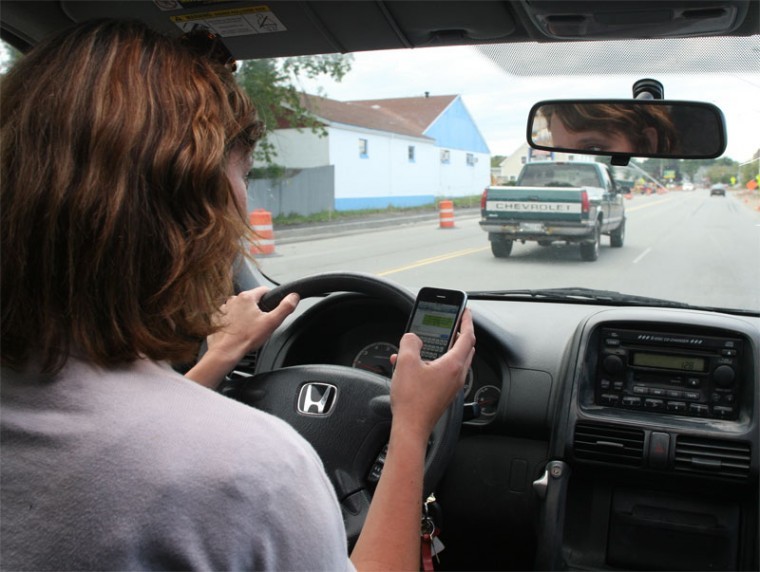 Texting while driving has been compared by some lawmakers to driving under the influence of alcohol and some lawmakers in Maine want it banned.
Comments are no longer available on this story