
Two road races, the TD Bank Beach to Beacon 10K, the largest such race in the state, and Tri for a Cure, Maine Cancer Foundation’s annual triathlon, are set for next month, and they bring thousands of racers and onlookers to Cape Elizabeth and South Portland.
Maine has become well known for its oceanside clam shacks, blueberry picking, inviting sand and surf, and in recent years, road races.
Two road races, the TD Bank Beach to Beacon 10K, the largest such race in the state, and Tri for a Cure, Maine Cancer Foundation’s annual triathlon, are set for next month, and they bring thousands of racers and onlookers to Cape Elizabeth and South Portland.
In order to pull off these popular races, it takes the help of local police and public works departments, as well as other municipal services. The large crowds and blocked off roads can also aggravate neighbors on race day as well.
But the influx of people is also a boon to local businesses, and organizers from both races have worked hard to minimize the races’ impact on both the host communities and the environment.
Leading up
The Beach to Beacon, which began in Cape Elizabeth in 1998, has grown from 3,000 runners in its inaugural year to more than 6,000 runners representing 43 states and 16 countries last year.
“Leading up to it, in terms of municipal services, there is very little impact,” Town Manager Mike McGovern said. “There may be more traffic with people going to see the race. It has turned out to be a big reunion weekend for the town of Cape Elizabeth.”
This year, 7,000 racers have registered for the Aug. 7 event, making it the largest the town has ever seen. Another 8,000 to 10,000 spectators are expected to watch the race – a number dependent on the weather. Counting the hundreds of volunteers as well as the participants and spectators, as many as 18,000 people are expected to come into town for the event.
Luckily, said race director David Weatherbie, race officials have nothing but support from the town of Cape Elizabeth and its surrounding communities.
“We utilize all of the town’s municipal services,” said Weatherbie, who has served as race director since the first year. “We utilize local police departments, fire departments, EMS, public works, community service, janitorial services.”
The staff heads of those departments, Weatherbie said, are part of the 63-member race organization committee.
“It is a partnership,” Weatherbie said. “Those department heads volunteer their time to come to our meetings and a good chunk, if not all, of their staff is used on race day.”
Weatherbie said Beach to Beacon race officials strive to make the event as “budget neutral” as possible for Cape Elizabeth by reimbursing departments for all municipal services and costs.
When race founder Joan Benoit Samuelson, a native of Cape Elizabeth and a gold medal winner in the 1984 Olympic marathon, started the race in 1998, Weatherbie said they weren’t sure if it was going to be supported by the town. It didn’t take long, however, to learn town leaders were wholeheartedly behind the race, he said.
“When Joanie asked me to be race director 14 years ago, we built the organization from the ground up. We knew the town was either going to embrace the race or not,” Weatherbie said. “Fortunately the town has embraced the event and has been a huge supporter of it. We truly have a great partnership where we work together to put forth the best race we can. I have nothing but good things to say about working with the town.”
Tri for a Cure organizers make a concerted effort to let both city officials and homeowners along the race route know the race’s needs well in advance of race day.
“We close four roads, make reverse 911 calls to neighborhoods, go door to door in neighborhoods telling them about the race and get signatures to close the roads,” race director Julie Marchese said.
Despite the advanced working together of race and municipal officials, the Cape Elizabeth and South Portland do feel a municipal impact from the race, South Portland police Chief Edward Googins said.
“It does create an impact on the towns, but they are good events,” he said. “We do all we can to make sure they are policed correctly and done safely.”
Even though there are eight police officers along the race course to manage traffic control and guide the athletes to safety, Marchese said, the race still sees problems from anxious motorists who have to stop to let the racers through.
“The people on the roads are very difficult to deal with. The police are harassed quite a bit because they stop traffic for long periods of time,” Marchese said. “The police understand what this does for the community and work with us willingly, but it is a difficult job.”
Googins said there were considerable traffic conflicts during the first Tri for a Cure. The conflicts, which were addressed the next year through a modified race, created a “bottleneck” when participants were going both ways on Highland Avenue during the triathlon’s bike loop.
Picking up
Not only have Beach to Beacon officials vowed to make the race as budget neutral for the town as possible, Weatherbie said, they have also made a pledge to leave the race course cleaner after the race than it was prior to it.
“We pride ourselves on the fact that if you passed by the race course at, say, 1 p.m. on that Saturday, you wouldn’t know a race had been going on,” he said. “Everything is picked up.”
That, he said, has only happened through a years-long effort.
This year Fairchild Semiconductor has signed on as the event’s green sponsor.
In a pledge to be environmentally friendly, all the trash from the event is collected and removed by volunteers who trail behind the runners picking up trash and sweeping the course along the way.
The race’s green team aims at diverting as much waste from landfills as possible by encouraging the recycling of all plastic, cardboard, paper, glass and the composting of food items and wax-coated paper cups used on the 10K course. Last year 46 percent of all waste produced was recycled or composted. A higher number is expected this year.
The race also recycles shoes through Nike’s Reuse a Shoe program, which encourages runners to bring their used running shoes to the Cape Elizabeth High School gymnasium prior to registration so the shoes, which take hundreds of years to break down in a landfill, can be reused in recreation facilities such as playgrounds, basketball courts and athletic tracks. It also offers eco-friendly portable toilets and encourages runners, spectators, and volunteers to carpool to the event.
“Running is a pure sport – runners are in tune with environmental changes of their daily runs and running experiences,” Benoit said. “It only makes sense for a race that receives great acclaim and visibility to do its part to reduce the runner’s footprint throughout the event – from before they start the race until well after they cross the finish line.”
Organizers and participants of South Portland’s Tri for a Cure, taking place at 2 p.m. on Aug. 15, also share this obligation to environmental awareness.
Like the Beach to Beacon, Tri for a Cure has trash runners – this year a 30-member force from Atayne, a Brunswick-based company that makes athletic clothing from recycled materials – trail the participants, at least on the running portion of the triathlon, and recycling containers and marked waste bins throughout the race areas.
The registration process for the triathlon, which includes a triangular one-third-mile swim near Spring Point Ledge Lighthouse, a 15-mile bike race loop through the streets of South Portland and Cape Elizabeth and a three-mile run for 950 registered participants, is also paperless.
“We work really hard to try not to leave a footprint,” said Marchese. “We have a very extensive recycling plan. We sort trash, we take the compost to farmers, we recycle bottles, glass and plastic. When we leave the SMCC campus each year, you would never know we have been there all weekend.”
Helping out
Marchese co-founded the Tri for a Cure in 2008 with her friend Abby Bliss as an alternative to Maine Cancer Foundation’s annual golf tournament. Marchese, a breast cancer survivor, and Bliss got the idea after they participated in a triathlon in 2006. The two, both active volunteers for the Maine Cancer Foundation, decided to combine their dedication to the foundation with their new-found love of triathlons in order to promote healthy lifestyles while raising funds for cancer research.
The 2009 Tri for a Cure, the largest all-women race in the state, attracted athletes from 13 states, with 89 percent from Maine, and raised $425,000 for Maine Cancer Foundation.
This year, Marchese said, they hope to raise $600,000.
While both of the events raise funds for area nonprofit organizations, with Tri for a Cure funds going to the Maine Cancer Foundation and Beach to Beacon benefiting Junior Achievement of Maine this year, local businesses also benefit from the races.
Kettle Cove Take Out and Dairy Bar on Bowery Road, not too far from the beginning of the Beach to Beacon and the southernmost point of the Tri for a Cure bike loop, is one of these businesses.
“As far as business goes, it is a wonderful weekend,” said owner Mark Pendarvis.
“I love it,” he said of the Beach to Beacon passing his store. “I go out in the morning with a cup of coffee and watch all of the runners go by. I think it is a great event for the neighborhood and the town.”
Every year Pendarvis, a high school Spanish teacher, particularly looks for his fellow Cape Elizabeth High School staff members or sport teams that are running the 10k race.
As the Beach to Beacon has grown over the years, Pendarvis said he has seen fewer Cape Elizabeth runners in the race and more accomplished international and out-of-state runners. Nevertheless, he said, many of the race’s participants see the ice cream stand while they are running the Beach to Beacon course or biking the Tri for a Cure course and come back with their friends and families after their races. Many times, he said, the international Beach to Beacon runners will visit later in the weekend with their host families.
It is the international flavor of the event that provides the biggest boon to local businesses, said Barbara Whitten, president and CEO of the Greater Portland Casco Bay Convention and Visitors Bureau. The financial impact of the runners, she said, depends on how far they came for the race.
Using rough guidelines, she said a local person makes a minimal impact of between $50 and $100, largely due to registration fee and expenses for the race.
“When somebody comes and stays overnight and spends a couple nights here, that’s where the real economic impact comes in,” she said. “They have some off time. They go to some of our attractions. They eat in some of our restaurants and stay in the local hotels.”
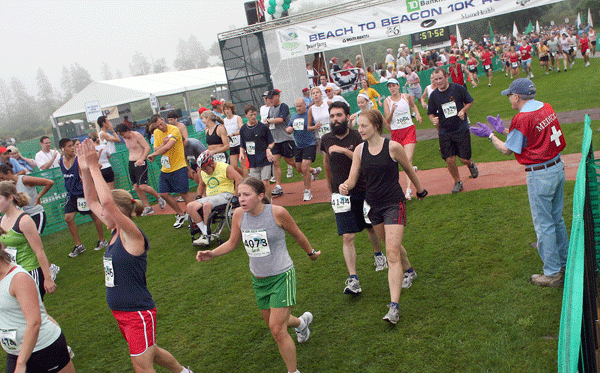 The Beach to Beacon 10K road race, held every year in Cape Elizabeth, has grown to become the largest race of its kind in the state, with 7,000 racers registered for the Aug. 7 event. Race organizers and town officials work together to minimize the impact of the race on residents and the town budget. (File photo)
Comments are no longer available on this story