
WINDHAM – Donations are down, and expenses up, at Maine State Society for the Protection of Animals in Windham.
WINDHAM – With the economy in a downturn, local non-profits are feeling the pinch. The Maine State Society for the Protection of Animals, located on River Road, is one such organization struggling with higher expenses and lower revenues.
To combat the negative trend, the society, which was formed in 1872 to care for the retired and unwanted horses who pulled fire engines and street cars in Portland, is getting more aggressive with reaching out to the local community, reminding people of the Society’s mission and importance, all in hopes of carrying on to continue to care for horses and other large animals.
The Lakes Region Weekly recently sat down with the society’s president, Marilyn Goodreau, and vice president, Meris Bickford, at the 149-acre farm in South Windham.
Q: How did the society get started in Windham?
Goodreau: In the early 1970s we were able to acquire land from the state that was originally part of the Maine Correctional Center. I personally sent out – under the direction of the then-president Lawrence James Keddy, who was president of the society for 25 years – a questionnaire to anyone who had anything to do with caring for animals, selling feed, transport, breeding, any kind of riding stables, municipal offices, and said, OK, we have the ability to acquire this (Windham) property, what would you like us to do? And overwhelmingly, the response was please do something for the large animals, because there was no place to bring large animals and if a veterinarian was to go someplace and see a large animal severely malnourished and down, it was just put to sleep.
And it was the cooperation of Lawrence Keddy, Gov. Brennan, and Preti Flaherty and Harrison Richardson (the late Portland lawyer). So, we reinvigorated the society. And Mr. Keddy, in his generosity and kindness, rebuilt the small barn, and we had the original six stalls put in.
Q: Do you remember the first animal rescued?
Goodreau: We started out with two ponies rescued from mid-Maine. I was here, I’ve got pictures of them.
Q: And it just grew from there?
Goodreau: The people used to say, we won’t get any horses, and we won’t be able to fulfill our mission. But that wasn’t a true statement. Right off the bat, we were taking in animals from law enforcement. At that time it was more from animal control officers and police officers because the animal welfare program as it is now, was really non-existent. And then as time went on one case I had involved 14 ponies. So we went up to get them and had to add 12 more stalls on the other side of the small barn. Then, in 1988 and 1989, Mr. Keddy built the big barn which has 24 stalls in it, and we have never gone a day without having all the stalls filled.
Q: How many stalls total?
Goodreau: Fifty-two in all.
Q: And there’s never been a day that’s gone by when they haven’t all been filled? That’s amazing.
Goodreau: There is always a full house here because there are always horses to fill the stalls when they become empty. Unfortunately.
Q: I guess that shows how much need there is.
Goodreau: We’ve had cases where we’ve had 12 horses in one case. So it’s not just one horse here and one horse there.
Q. What’s the success rate here? Are some horses too far gone when they come in?
Goodreau: We’ve never lost a horse. But that means you stay with them 24/7. We’ve had them brought in totally unconscious. One little horse was in a tarp on the back of my trailer and we propped him up with hay, and the next morning we put him in a sling, but you have to stay with an animal that’s in a sling because it can twist, and sometimes they panic. It was in the middle of February – freezing, freezing cold. I made a bed out of some bales of hay, and I slept with him in his stall for two months.
Q: Two months?
Goodreau: Yes, two months, every night. I had a baby (horse) that was two days old when we got her and she had to be fed every 20 minutes. I’d lay down and she’d lay down and put her head in my arms and when she was hungry she’d just touch me with her nose, and I’d get up and syringe her.
Q: What motivates you to stay two months every night with a horse? I don’t think some people would do that even for another person.
Goodreau: It’s a passion I guess. I don’t know. I just feel so empathetic because they suffer so much and they’re such beautiful, beautiful animals and they just deserve so much better. It’s a love affair I guess.
Q. So, how is the society faring financially?
Goodreau: We depend on No. 1: public donations. No. 2: bequests from wills. And No. 3: grants. We’re a non-profit charitable organization. We receive no money from the state or the federal government, or the town of Windham. Not a scintilla. And we spend $1.3 million yearly taking care of these animals. Now, anyone who’s in the non-profit business, we’re all hurting. No matter what anybody says, the economy’s down. And people have to take care of their own family first. That’s a given.
Plus everything has increased. Grain, hay, veterinarian fees; they’ve all increased. So, what we do now is clear and simple: total maintenance. If the plumbing is broke, we fix it, we don’t replace it.
Q: How is fundraising?
Bickford: It’s easy to promote the society. What Marilyn does here, what the staff does here, what’s done for the animals here really sells itself. It’s not a question of me going out and strong-arming the people to recognize how wonderful this place is. When people become aware of it, it’s self-evident what’s happening here. But I will say when I first came in 2007, I don’t think the organization was putting its energies into external connections or communications. It really was, appropriately, spending most of its energy on program delivery, taking care of the animals.
Goodreau: No questions about that.
Bickford: In a perfect world, that’s all it would take, but unfortunately, this is not a perfect world, and we have a number of requirements that are imposed on us by the tax code and one of them is that we make a public support test each year, which means 30 percent of our operating budget has to be raised from the public. So, that’s where I come in. And with respect to this community, I will say, because it’s a busy road (River Road), over the last three years I’ve met thousands of people who have driven by this farm for five years, 10 years, 20 years, and never realized that it was a public charity, that it needed public support. But the reality is, since we’ve begun to raise our profile in the community, the response had been overwhelming. This community is so excited about helping this institution. And it grows every year. And we need that, without the community’s support it would be hard for us to continue in this location.
Q. What kind of animals do you take in?
Goodreau: The animals that are received here are the result of neglect, abuse and malnourishment that are seized by law enforcement. I do try to do a lot for cats, because cats are disposable animals, so I will take in a sufficient amount.
We also have a federal and state wildlife rehab permit including various types of birds, woodchucks, foxes. We have two pigs. We have a mule, two donkeys. We had a cow, who’s gone to heaven now.
Q: Are all these animals up for adoption?
Goodreau: Part of our mission is we’re a sanctuary meaning we protect and keep animals forever if they’re not able to be placed. If a suitable place can be located, yes, they are placed out into the community. That’s part of the way we make capacity for others.
Q: Is it getting more expensive to run the society?
Goodreau: Years ago, I never had to think about how much it cost because hay was 75 cents a bale, grain was $1.25 for 50 pounds of oats, but now you’re talking $6 for a bale of hay, $12 for 50 pounds of grain. You have to figure on at least 300 bales of hay a year. Plus they have to vaccinations in spring and fall; they have to have their hooves trimmed, their teeth coated.
Q. Why should someone give their money to this organization?
Bickford: It is about humane treatment of animals. We offer a lot of humane education. We go into the schools by invitation of course. It is also an economic engine in this community. If you’re spending $1.3 million locally – and that’s we where spend it. We buy our feed locally, our staff is local, we buy our services locally – we’re part of what makes Windham a prosperous community. So, we think that’s another reason why people who may not be horse lovers ought to maybe give us a second look when they’re thinking about donating time or in-kind services or making a bequest to an organization that does something important.
I can also tell you quite candidly, that when we look at where we were last year, our revenues are down and our budget is up. So the combination of those two budget factors gives us a pretty significant budget gap, and certainly we’re looking for ways to close that. We can’t control what grant makers will do. But when it comes to individuals, that’s something that is our responsibility to get the word out to the public not only that we exist but that the work we’re doing is valuable and without us the work wouldn’t get done and that we can’t do it without their support.
Goodreau: Clearly, neglect will never go away, and we want to be here forever. Someone once asked me if I had one wish what would it be? And I said, that we weren’t here. And that everyone could afford, had the knowledge and interest and passion and the love to take on the responsibility of that animal that they took. Remember, that animal, no matter what it is, is totally dependent on you, totally. That animal didn’t ask to be put on the earth, it didn’t ask to be put in your home, but you owe that animal that responsibility. If you can’t fulfill that, then somebody has to fill it for you. That’s never going to go away.
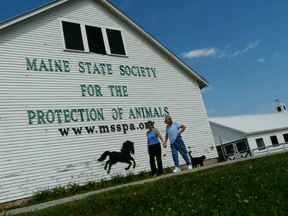 Marilyn Goodreau, right, and Meris Bickford, president and vice president of the Maine State Society for the Protection of Animals, stride by the main barn just off River Road in Windham. The society has no ties to the state, despite the name, and runs on private donations and grants. (Staff photo by John Balentine)
Comments are no longer available on this story