
Jeannine Lauber, a former newscaster for Channel 8 and a Casco resident, has recently written a book on the Shaker religion and its remaining adherents living at Sabbathday Lake Shaker Village in New Gloucester. Lauber will be at the Alfred Shaker Museum, 118 Shaker Hill Road in Alfred, on Sunday, June 6, from 2-4 p.m., to speak and sign copies of her book.
Jeannine Lauber, a former newscaster for Channel 8 and a Casco resident, has recently written a book on the Shaker religion and its remaining adherents living at Sabbathday Lake Shaker Village in New Gloucester.
Published by Down East Books, which is affiliated with Down East magazine, “Chosen Faith, Chosen Land: the Untold Story of America’s 21st Century Shakers,” documents the history and current state of the Shaker faith and is already grabbing national attention and awards. Lauber will be at the Alfred Shaker Museum, 118 Shaker Hill Road in Alfred, on Sunday, June 6, from 2-4 p.m., to speak and sign copies of her book.
During a period of 15 years, Lauber gained access to the Shaker community in New Gloucester – something few journalists have been allowed to do – and has received acclaim for her resulting work. She has already won a Maine Literary Award from the Maine Writers and Publishers Association and a bronze medal in the 2010 Independent Publisher Book Awards.
She recently answered some questions about the Shakers and her new book.
Q: Shakers are mysterious to most of us. Can you tell us what Shakers believe? And do they “shake” during worship?
A: What I found most interesting about today’s Shaker faith is that it is very progressive. I originally approached the book with the notion that Shakerism was an “old and dying” belief system, but quickly learned I was wrong. This discovery, that our country’s oldest distinctly American religion looks a lot like its newest Christian movement (the Postmodern Christian Church), is what truly energized me. I vetted this theory before a number of prominent and well-respected scholars of American history and the history of religion in America, and they agreed.
Briefly, Shakers believe in an expanded notion of the nature and image of God. They believe, and have for centuries, in a Father/Mother God. This concept is especially “new age,” and was at the core of a lot of the violence and persecution the Shakers suffered in Colonial America. Shakers believe in “Progressive Revelation.” That means they are allowed, in fact, they are encouraged to continue interpreting Holy Scripture. Their doctrine is not “fixed” in time or place. Shakers have always believed in the Bible, for example, but as individuals they are not bound to interpret it literally. They believe God reveals spiritual information to man as man is ready to receive it.
Shakers are spiritually tolerant. They worship with people of all faiths. They were “ecumenical” long before the ecumenical movement. Shakers have always believed in non-traditional concepts of the family. They are “communal,” for example. They also believe men and women hold equal power as members of the family, as well as members of the church. From a modern perspective, they would support gay marriage and full clerical gender equality.
They are celibate because they believe Jesus Christ was celibate, and they believe spiritual salvation comes through emulating his life. They do not, however, condemn marriage. They believe marriage is a sacrament. blessed by God.
Shakers have always been pacifists and socially active reformers, not unlike a lot of progressive contemporary Christian movements.
No, Shakers do not “shake” anymore. It slowed down in the late 19th century, and disappeared altogether in the 1930s. When worship extends to physical manifestation it is called “ecstatic” worship – which is not unique at all to Shakerism. I like to explain it this way: think of Shaker worship in the late 18th and early 19th centuries like a full-bodied modern Pentecostal “tent-revival’ of today.
The last known ecstatic Shaker experience occurred at Sabbathday Lake Shaker Village in New Gloucester in 1938. It was breathtaking for those who were there. Several pages of my book are devoted to an eyewitness account of what occurred.
Q: How many Shakers were there at its peak? How many Shakers are there now, and how did New Gloucester come to be their home?
A: There were around 5,000 Shakers living in nearly two dozen communities at its zenith between 1840 and 1860. There are three Shakers today, and they live in community in New Gloucester. Shaker missionaries traveled to Maine from New York in 1782. By the following year there were two Shaker “centers of union” in Maine; one in Alfred and one at Thompson’s Pond Plantation (later known as New Gloucester.)
Q: Explain the title of your book, “Chosen Faith, Chosen Land,” especially what you mean by the subhead, “The untold story…”
A: All Shaker communities were given secret spiritual names during the 1850s. The community at New Gloucester became known among members as “Chosen Land.” Since Shakers are celibate, you can’t be born into the faith, therefore it is a “Chosen Faith.” I say it is an “untold story” because my book is the first book written for public consumption that goes straight to the Shakers for the story. And the story they tell, including the progressive nature of their belief system and the viability of their faith in a modern world, is very different from what you will read anywhere else.
Q: When most people think of America’s Shakers, the first thing that usually comes to mind is that they’re all dead, mostly because they are celibate. Why is celibacy important to them, and is that tenet leading to the group’s demise? If so, why would such an illogical rule be made part of the religion?
A: They are celibate because they believe Jesus, as the embodiment of the Christ Spirit, was celibate. They believe the path to heaven begins by living the “Christ life” based on what the Gospel tells us about the life of Jesus. A lot of people have a difficult time understanding how celibacy can play such a large role in an individual’s spiritual life, but think of Catholicism. The clergy, priests and nuns are also celibate. Think of monks. Scholars will tell us that celibacy plays a role, either temporary or permanent, in some form or another, in most world religions. It’s not that strange if you think of it in perspective, in my opinion.
The reason most people leave the Shaker life after having tried it during a “novitiate” period is not because of celibacy. It’s because living in community proved too difficult.
Q: The next thing people think of is their material culture: Shaker furniture, art, music and architecture. What is the foundational philosophy behind all of it?
A: America’s Shakers have unquestionably left an indelible mark on our material culture. How and why it happened has been subject of many, many fine books. My book, however, is about the details of the faith. There is, however, a section in my book where I ask the Shakers for their impression of America’s obsession with the collecting of their items of material culture. They hold unique and fascinating perspectives on this. People are usually surprised at what they read.
Q: One of the reasons you wrote “Chosen Faith, Chosen Land,” was to shatter a widespread myth about the Shakers. What is the myth?
A: It is actually a “trinity of myths” that has persisted for two to three generations, due in large part to modern mainstream media reports eager to pronounce the end of Shakerism in America. The myths are that the faith is dead; that there are no more Shakers; and that the doors of the church are closed. The truth is that the faith is alive and well and thriving, through what is known as the Postmodern (Emerging) Christian church. There are three living Shakers. They are still accepting members. It is still a problem for the Shakers, but hopefully this book, over time, will help to set the record straight.
Q: If they’re so cloistered, how did you get the Shakers to trust you enough to let you into their lives for so long, when, as you say in your book, they have been so badly burned by members of the mainstream media in the past?
A: They trusted me because they knew I was interested in their faith, not their furniture. They trusted me because they knew of my work as a journalist. They knew I was honest, a stickler for detail, and aware of the myths. It was the Shakers who eventually asked me to help them set the record straight, not the other way around. I agreed because I knew the time was right.
Q: “Chosen Faith, Chosen Land” also chronicles your personal spiritual journey. What has that been and how did writing the book affect your spiritual development?
A: The most important personal spiritual transformation I experienced was the ability to think of God in an expanded way. An awareness of Shakerism encouraged me to push the limits of my own notion of the image and nature of God. I no longer think of God in human form. It has empowered me more than anything I have ever experienced. I don’t think what I learned at “Chosen Land” can’t be found in other places, but I do believe it was where I was supposed to find it, and I did. It was a lot of hard work, but well worth the journey.
Q: One of the Shakers, Brother Wayne, left the faith while you were working on the story. He had been a Shaker for more than 20 years. That must have been quite shocking. What did the Shakers have to say about this?
A: It was indeed shocking and unexpected, although I know now that the Shakers knew it was coming a few months before the rest of us did. They said it was like experiencing a sudden death in the family. Their range of emotions was normal, I suppose, under the circumstances: shock and disbelief, then anger and confusion, and finally acceptance and hope for the future.
Q: What can we learn from America’s Shakers?
A: That we shouldn’t hurt people in the name of God because someday we may understand that their God is not all that different from ours.
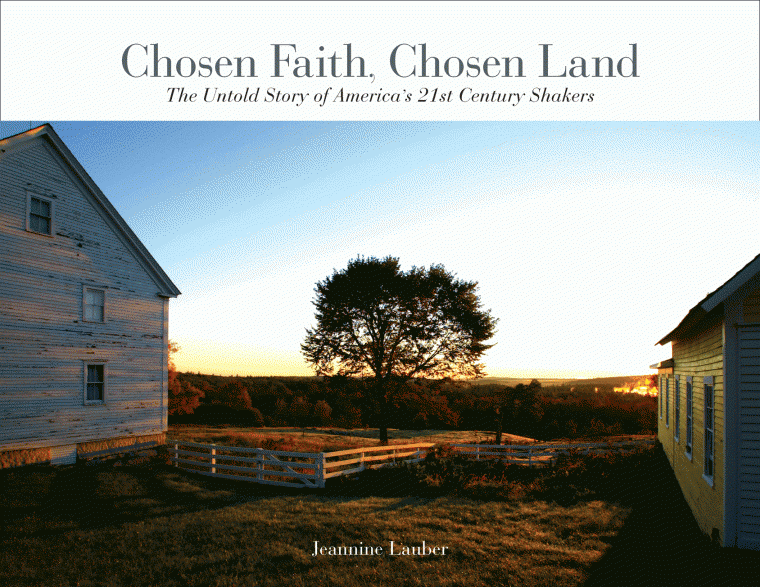 Jeannine Lauber, a former newscaster for Channel 8 and a Casco resident, has recently written a book on the Shaker religion and its remaining adherents living at Sabbathday Lake Shaker Village in New Gloucester. (Courtesy image)
Comments are no longer available on this story