
If you’ve ever had surgery in a hospital or dentist’s office, or undergone a procedure like a colonoscopy, chances are a nurse anesthetist put you to sleep so you wouldn’t feel any pain.
And you probably don’t remember a thing about it.
“There are a lot of people that don’t know what we do because we make them amnesiac,” said Catherine Hagerman, a Scarborough resident and interim director of the University of New England’s School of Nurse Anesthesia. “We give them medicine that makes them forget all about us.”
That’s why National Nurse Anesthetists Week exists.
The week was observed this year from Jan. 24 to Jan. 30, and Maine joined in celebrating it by official order of Gov. John Baldacci. The time period is set aside to recognize a profession that is a vital part of the healthcare system, but of which many people are unaware.
“It’s oftentimes referred to as the best kept secret in health care,” said Vance Wormwood, a Scarborough resident who is president of the Maine Association of Nurse Anesthetists.
Yet the proclamation that Baldacci signed regarding Nurse Anesthetists Week outlines how important nurse anesthetists are to Maine and the nation.
“Certified Registered Nurse Anesthetists … are essential to America’s healthcare system, providing high-quality, cost-effective anesthesia care,” the proclamation reads.
It notes that nurse anesthetists not only work in hospital operating rooms and delivery rooms, but in a host of other settings. They deliver care in places as varied as the offices of dentists, podiatrists, ophthalmologists, and plastic surgeons. And they play a vital role in public health services and in the military.
“Nurse anesthetists have been the main providers of anesthesia care to U.S. military men and women on the front lines since World War II, including the current conflicts in the Middle East,” according to the American Association of Nurse Anesthetists.
And they have been at it a long time, nearly 150 years. According to the association, nurses first provided anesthesia to wounded soldiers during the Civil War.
Nurse anesthetists today safely administer 32 million anesthetics to patients each year, the association says. And they are particularly important in rural states like Maine. In many of the state’s rural communities, nurse anesthetists provide the only anesthesia care available, the governor’s proclamation says.
Also, Wormwood pointed out that as the nation currently debates the high cost of health care, the use of nurse anesthetists can save money. “Managed care plans recognize nurse anesthetists as providing high quality anesthesia care with reduced expense to the patient and insurance companies,” he said.
There are about 250 nurse anesthetists in Maine, said Wormwood, who works at Mercy Hospital and Maine Medical Center.
Many people may be familiar with anesthesiologists. Those medical doctors give anesthesia too. However, according to the American Nurse Anesthetists Association, “regardless of whether their educational background is in nursing or medicine, all anesthesia professionals give anesthesia the same way.”
While nurse anesthetists often work independently in small, rural hospitals, they frequently work on teams with anesthesiologists in large, urban hospitals. In Portland, Mercy Hospital and Maine Medical Center have such teams, according to the nurse anesthetists.
Hagerman said that patients may remember anesthesiologists because the doctors’ typical role is to meet with the patient up front and discuss the procedure, and have them to sign permission forms.
Anesthesiologists also give advice to their team members, Hagerman said. However, she said, it is the nurse anesthetist that actually delivers the anesthetic.
Training is rigorous, Hagerman said. The University of New England, which has campuses in Biddeford and Portland, is the only place in Maine that trains nurse anesthetists. It was one of 109 nurse anesthesia programs nationwide in 2009.
The University of New England’s Master of Science in Nurse Anesthesia program this fall will graduate its 25th class from the 27-month program. Hagerman said the profession by 2018 will mandate that nurse anesthetists obtain a clinical doctorate. The university hopes to start offering a doctoral program in the field as early as next January, she said.
To get into a nurse anesthesia program, students must have a bachelor’s degree in nursing and at least one year of experience working as a registered nurse in acute care. When they graduate, they have to pass a national certification exam. Also, once they begin working, Wormwood said, they have to continue learning, taking courses and attending seminars and conferences, in order to update their certification every two years.
Despite all the hard work, nurses are eager to become nurse anesthetists, Hagerman said. She said the university’s program “is very difficult to get into. It’s very competitive.”
And they enjoy their work, she said. “Every nurse anesthetist will tell you they love their profession,” she said.
One reason is that the profession is a way to advance in nursing to a higher-paying job with more responsibility without going into management, she said. “It’s a way of staying in medicine and nursing and advancing, but you’re not leaving the bedside,” Hagerman said.
Heidi Alpern of Cape Elizabeth is a nurse anesthetist at Maine Medical Center, and has been in the profession for 26 years. “I love what I do,” she said. “And I’ve been doing it a long time.”
“I’m providing a service that people not only need but, if it’s done well, makes them have a better surgical experience,” Alpern said. “I’ve been a patient many times and I’ve had surgery before. It’s a scary place to be, rendering yourself unconscious and giving yourself over to people you’ve never met before that day. It feels good to help people have less anxiety.”
She said she particularly enjoys working with children. She said she sometimes tells them a story as they go off to sleep, creating an atmosphere that is reassuring for them and their parents.
And the recovery room is where Alpern sees the results of her work. “The greatest satisfaction I get is having a patient wake up from their procedure and be comfortable and pain free and not feeling sick to their stomach and nauseous and vomiting, and feeling the best they can after their surgery,” she said.
Alpern said she doesn’t need a recognition week for herself. “The patients who thank me for taking care of them, that’s all the recognition I really need,” she said.
But she agrees that Nurse Anesthetists Week – which was first established in 2000 – is good for the profession.
“I would like the public to know more,” Alpern said. “We do anesthesia all over the United States and the world, and nobody knows what we do.”
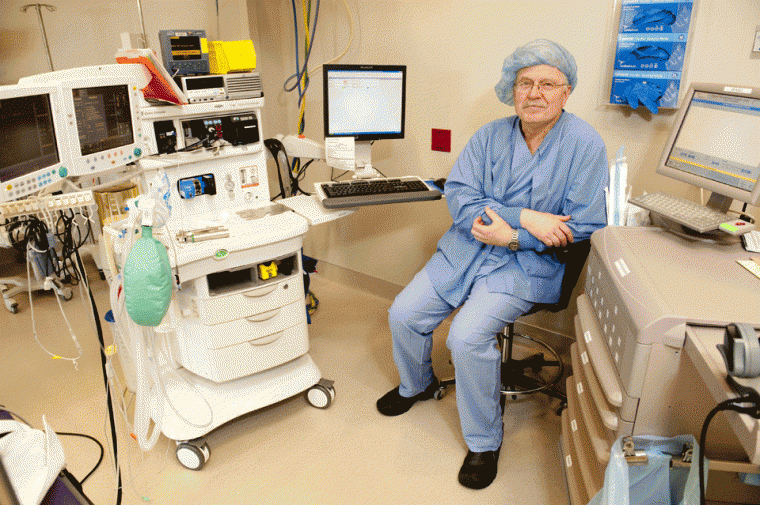 Vance Wormwood of Scarborough, in an operating room at Mercy Hospital in Portland, is the president of the Maine Association of Nurse Anesthetists. Maine recently took part in National Nurse Anesthetists Week, shining a light on a profession that Wormwood said is often referred to as “the best kept secret in health care.” (Staff photo by Brandon McKenney)
Comments are no longer available on this story