
Casella Waste Systems, which operates Biddeford’s Maine Energy Recovery Co., plans to build a trash processing facility on County Road in Westbrook. But first, the company will have to quell all fears that Westbrook could once again be a city that stinks.
Tons of trash now headed for a controversial incinerator in Biddeford may instead be trucked to Westbrook.
Casella Waste Systems, which operates Biddeford’s Maine Energy Recovery Co., plans to build a trash processing facility on County Road. But first, the company will have to quell all fears that Westbrook could once again be a city that stinks.
“We’ve spent years trying to rid ourselves of being a smelly town,” Mayor-elect Colleen Hilton said Monday. “I’m not going back to being a smelly town.”
Casella’s plan to build a new trash processing facility is part of a proposal to mitigate the negative effects of its Biddeford incinerator. At the new Westbrook facility, trash would be sorted and compressed into pellets, which would then be trucked to Biddeford, where the pellets would be burned and turned into energy.
The main benefit for Biddeford would be the reduction of truck traffic into its downtown, where the incinerator is located, because fewer trucks would be needed to transport the compressed trash. Instead, those 19,000 trucks that pass through Biddeford per year carrying 280,000 tons of trash – numbers estimated by Biddeford Mayor Joanne Twomey – would be coming to Westbrook.
Casella’s operations in Biddeford have been a source of contention in the city since the incinerator opened in the 1980s. But Westbrook won’t be willing to take on that battle, especially considering its own history.
Stigmatized for decades as a city reeking of a rotten-egg smell, Westbrook has been working hard to rebuild its reputation ever since pulp-making operations at the Sappi paper mill – the source of the stench – were shut down in 1999.
“We don’t want to have removed ourselves from the fire of the pulp-making process just to go back into the fire of the pellet-making process,” City Councilor John O’Hara said Monday. “The community has a new image now.”
Several perks for Westbrook are built into Casella’s proposal, including a reduction in energy bills for residents and businesses in the city and a program to weatherize area homes, said Hilton. Casella would also have to renegotiate its host community agreement – the same one that brought free automated trash and recycling to the city in October.
Though representatives of Casella have said neither the pellets nor the facility would emit an odor, Hilton is concerned about the smell of the trucks carrying trash coming into the facility.
“It’s presented like it’s almost too good to be true,” Hilton said. “The question is: Will it smell?”
SETTING ITS SITES
Casella first made public its plans to build a trash processing facility beyond Biddeford’s borders at a press conference in October, held by the Maine Energy Recovery Co. task force.
The task force, whose members included state and local officials as well as representatives of Vermont-based Casella, had been meeting since May to explore a way for the public to purchase the incinerator and close it.
Instead, the task force developed initiatives to address concerns about odors and traffic at the plant. The construction of the pellet-making facility was a key component of that proposal. Casella wouldn’t say where the facility would be at the time, only that it would be in the middle of a large, open site and would not be in Biddeford.
With plans already in the works to build a construction and demolition facility on County Road, Westbrook was a prime candidate for the new trash processing plant. In a memo to city councilors earlier this month, City Administrator Jerre Bryant wrote that Casella wanted to add the trash processing operations to its site behind 600 County Road.
According to Bryant, Casella has its permits from the Department of Environmental Protection to operate the facility it originally planned, but would also need a municipal solid waste processing license from the state agency in order to move forward with its new proposal. Casella might also need the Planning Board’s approval to amend its site plan, if the company needs to construct an additional building for processing trash there.
At the time of the task force announcement, James Bohlig, Casella’s chief development officer and a task force member, said the trash processing facility would take two to four years to come online.
In a brief interview Tuesday morning, Bohlig said the facility would cost $15 million to construct and the trash processing operations would replace the construction and demolition use previously proposed. He said there would be fewer trucks coming through Westbrook due to the change in use, but he wouldn’t estimate how many.
Bohlig said the configuration of the site won’t change, but the company would likely go back to the Planning Board as a matter of policy.
“There really won’t be any changes,” he said about the difference in operations at the facility previously planned and the one now proposed. “It’s going a different mix of materials than it was before.”
CHANGING PLANS
Casella’s original plan for the County Road site was to build an office and maintenance garage – a project approved by the city in 2001. However, that plan changed shape due to delays in the state permitting process, and instead, last year, the company came forward with a plan to build a $9 million, 27,000-square-foot construction and demolition processing facility and recycling drop off station.
At a meeting in September 2008, as the City Council was considering approval of the host community agreement with Casella, neighbors came forward with concerns about noise, traffic and the possibility of a trash incinerator eventually being built on the site.
“It seems like there’s potential for this to keep expanding and growing. I’m very sensitive about this,” County Road resident David Darling said at the time.
Representatives of Casella addressed the neighbors’ concerns and pointed to a state ban on building commercial disposal facilities, saying the company couldn’t build an incinerator if it wanted to.
But the plans did grow. Earlier this year, Casella went back to the Planning Board for an expansion of the facility from 27,000 to 48,000 square feet. When asked the reason for the expansion at the time, Dan Emerson, general manager of the processing facility, said only that the company decided it would need more space for its equipment and operations, but that the use of the facility would not change.
After the Planning Board approved the expansion, Casella upgraded its host community agreement, offering a whole new curbside automated trash and recycling program, worth nearly $1 million, at no cost to the city. Originally, the company was going to provide free curbside recycling, which would have cost about $540,000.
Emerson said of the upgrade at the time, “there is no catch.”
Now, the city is again presented with a new, expanded plan for the site. Hilton said she’d like to look at adding stipulations to the zoning in order to ensure that Casella doesn’t come back later with another proposal – to bring an incinerator to Westbrook.
But O’Hara has another concern about moving a trash processing facility into an undeveloped area of the city – how it might deter other businesses from coming there in the future. Still, he said, it’s hard to turn down an offer like Casella’s in this economic climate, in the hopes that something better might come along later.
With benefits that include the creation of new relationships with nearby communities and the renegotiated host community agreement – for which, he said, “everything is on the table” – O’Hara sees the facility as a great opportunity for Westbrook. He also sees the potential for it to go awry.
“Will we be helping ourselves in one way and shooting ourselves in the foot in another?” O’Hara posed.
“I don’t have an answer,” he said.
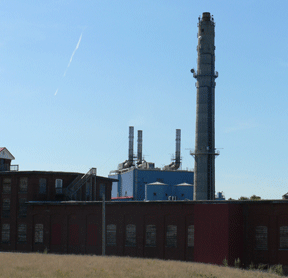 Maine Energy Recovery Co. in Biddeford has for decades been a source of controversy in Biddeford, where officials have decried the odor and traffic coming from the trash incinerator. (File photo)
Comments are no longer available on this story