
Take some favorite recipes, add a good dollop of family stories, and mix with a heaping helping of history.
That’s what it took to create a new cookbook featuring the foods that Cape Elizabeth residents have enjoyed for centuries.
“A Culinary History of Cape Elizabeth,” compiled by the Cape Elizabeth Historical Preservation Society, is a cookbook served with a strong historical flavor.
The book, for which a launch party will be held Oct. 26 at 7 p.m. at the Thomas Memorial Library, starts with recipes and stories from the 1600s, when the promontory that is now the town was named in honor of an English princess and European settlers first arrived. The book ends with similar items from the present day as it describes the town’s history from a culinary perspective.
For example, the book describes not only what the first European settlers in Cape Elizabeth ate in the 1600s, but also what the Native Americans who also lived there typically consumed. Recipes like “samp and fruit” (a kind of mush or porridge made with cornmeal and blueberries) or the pease porridge (pea soup) – typical foods that Cape Elizabeth residents ate back then – are found in the cookbook.
When it comes to more modern times, such as the 19th and 20th centuries, the recipes also feature lots of family lore.
Along with one of the recipes, for “Mama’s sour milk chocolate cake,” town resident Nancy Murray Johnson provides readers with scenes from her childhood.
She still lives in the house that her father, William B. Murray, built with the aid of his six brothers in the late 1940s. It’s where Johnson and her brother and sisters grew up on the good cooking of “Mama,” Barbara Murray.
“When I was a young girl, our milk arrived at the door by milk truck,” Johnson wrote for the new cookbook. “The milk was in a glass bottle and heavy cream topped the milk; it was a treat on our cereal, but if it had a chance to sour, Mom made this chocolate cake, Daddy’s favorite.”
To her tale, Johnson adds advice for the modern cook: Because milk and cream today don’t usually sour, substitute commercial sour cream.
Not all of the recipes in the culinary history are for the modern palate, said Jane Beckwith, the historical society’s corresponding secretary and editor of the book.
“A few of them people wouldn’t want to even try,” she said.
A sea moss pudding recipe – or blanc mange – is one such recipe. The gelatinous white custard dessert used to be made in Cape Elizabeth with a kind of seaweed called sea moss or Irish moss. The book says the frilly, white seaweed with purple-tipped edges still can be found on Crescent Beach after a storm or high tide.
However, the book cautions the recipe is included for “historic interest only.” Because of pollution today, it may not be safe to eat sea moss anymore.
The culinary history – which Beckwith said is on sale for $20 at such locations as Nonesuch Books in South Portland’s Mill Creek Shopping Center and at the gift shop at Fort Williams Park, with proceeds beneifiting the historical society – has been about four years in the making. Other historical society members, such as Norman Jordan, credit Beckwith with spearheading the effort to get the group to finish the book and get it published.
“I cracked the whip,” Beckwith admits.
She said the approximately 200-page book entailed going back through history books and town records, as well as gleaning recipes and stories from town residents, including Jordan, who includes some of his own family’s history and recipes in the book.
The Jordans have been farming and fishing in Cape Elizabeth since the days of the early settlers. Norman Jordan, who runs a flower farm in the center of town, says he’s the 12th generation of Jordan farmers in town.
One of the family recipes he included in the book was one of his mother’s for “Whacky Cake,” a chocolate cake that has no eggs in it.
“I don’t know where my mother picked it up,” Jordan said last week. But he said it’s his favorite because it’s delicious and very convenient to make.
“You don’t have to do dishes or anything,” he said. “You make it in the pan you bake it in.”
The Rev. Ruth Morrison, pastor of the Cape Elizabeth United Methodist Church, is a fan of the new book, which was on sale at the church’s bean supper last week.
“I just think it’s charming,” said Morrison, who said she enjoys learning about town residents and their families along with reading the recipes. “It does kind of connect people.”
And, Morrison said, she likes the unique features of the book.
“I love the cures,” she said. I think that’s a riot. It’s not what you get in every cookbook.”
Morrison is referring to a section on “home cures” that tells about recipes town residents used to to combat common ailments and injuries. The book includes recipes for homemade cough syrup and liniment and tonic for stomach troubles, but stresses they’re for interesting reading only, not for actual use.
The book also has ethnic recipes in its “Roots” section. The Jordan family traces its roots back to England, for examplek, so there are recipes for English, Irish and Scottish dishes, including Yorkshire pudding, colcannon, and scones.
But the diversity of Cape Elizabeth is also reflected in the Italian, Polish, Danish, French-Canadian and even Belgian recipes in the book.
Other chapters include “Feeding the Servicemen,” which has recipes for the chow, such as “Army goulash,” dished up to U.S. Army personnel at Fort Williams during World War II. It also gives recipes for what lighthouse keepers ate, such as “keeper’s fish chowder.”
“The Feeding the Public” chapter includes information on the inns, hotels and restaurants and even a casino that drew visitors to Cape Elizabeth over the years, and cherished recipes from some of those places. It also gives recipes from popular eateries in town today.
Janice Reale-Hatem, a historical society volunteer and photographer who designed the cover of the book, said it is much more than a cookbook.
“When someone reads it,” she said. “They’ll really get a sense of Cape Elizabeth.”
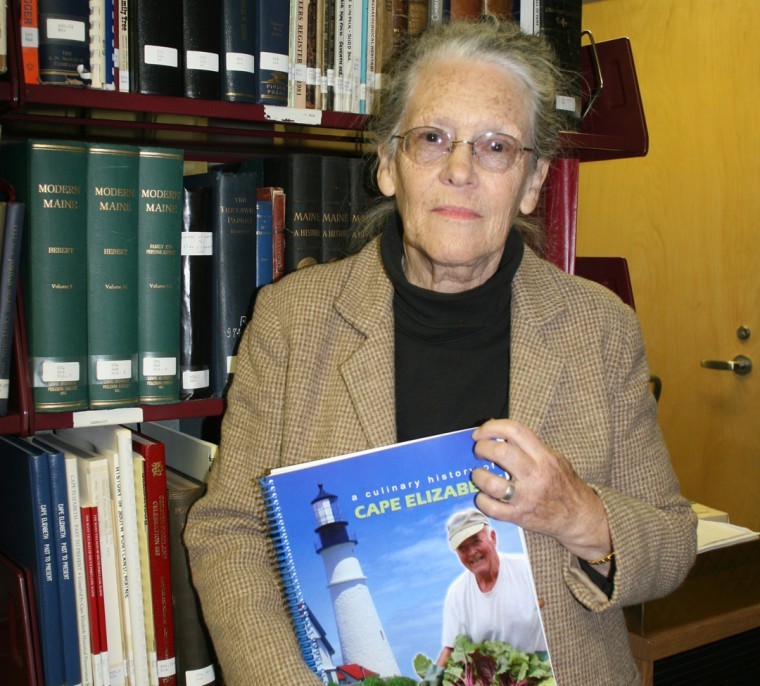 Jane Beckwith, editor of “A Culinary History of Cape Elizabeth,” shows off the new cookbook that she and others members of the Cape Elizabeth Historical Preservation Society recently compiled. (Staff photo by Tess Nacelewicz)
Comments are no longer available on this story