
After 23 years, Camp Hawthorne head is looking for another spot.
During her visits to Camp Hawthorne in Raymond, Wendy Traynor saw why her three kids enjoyed staying there so much, why they seemed to let go of their worries, why they became more confident in themselves.
Everything at Camp Hawthorne – the games, the stories, the odd names, the ever-present music – seemed to nudge the campers almost unconsciously to a certain state of mind, said Traynor, of Massachusetts. They shed a barrier, and found out more about their true selves, rather than the person with problems at home, or learning disabilities, or the usual growing pains.
“That place means more to me than any place on the planet,” said Traynor. “It is this camp of love and light and peace. It doesn’t exist anywhere else in the world.”
Next year, Traynor may have to find somewhere to send her kids besides the rustic camp, set on 120 acres on Panther Pond in Raymond. After 23 years at the spot, Ron Furst, the man behind the latest incarnation of Camp Hawthorne, is being pushed aside.
David Allen and the Allen family, of Raymond, which owns the property, are not renewing Furst’s lease, choosing instead to hand it over to a track coach from Bowdoin College, who plans a track camp on the site, Furst said. The coach offered a 20-year lease, Furst said, and the Allens told Furst that the longer lease gives the family more financial security and is better for the family.
Furst’s lease runs out May 1, 2010, so another season for Furst at Camp Hawthorne is out of the question.
“I can’t stop crying about it,” said Furst, 62, of York, when contacted about the loss of the lease. “I’ve been there for 23 years, and parents would say we’ve saved their children.”
After an initial 12-year lease, Furst and the Allens have historically operated using two-year lease agreements, working a year in advance of the end of each lease to reach a new agreement. Furst said he was assured that another lease was in the works, and he even went ahead with some construction and renovation projects.
But when he didn’t hear from the Allens, he grew concerned. After finally tracking down a member of the family, he was told someone else had come forward and offered a 20-year lease.
“I don’t know why they did it. We’ve always paid our bills in advance, our taxes in advance,” said Furst, who said he has offered to buy the parcel many times in the past.
The Allens can do whatever they want with their land, Furst said. But he feels sucker-punched. He has built up the camp, put on new roofs, added new buildings, made plans for the future.
“I’m not ungrateful,” he said. “We are all very thankful to have the opportunity to build this place. But what do I do now?”
Reached by e-mail, David Allen said his family has been committed to the children’s summer camp business for 90 years and have kept Camp Hawthorne going through four generations.
“I also think that the fact that we have only had five tenants during that time period testifies to and validates our desire for long term, stable relationships with our tenants,” wrote Allen. “We have been fortunate to have had Mr. Furst as a tenant for over 20 years and at this time last year we assumed the relationship would continue.”
Allen did not want to discuss the details of the camp business, either under Furst or the new tenant, except to say that the new tenant would continue to use the property as a children’s camp. He said he was sorry that Furst felt the way he did “given the time and effort we put into trying to prevent this from happening.”
Furst is now frantically looking for another spot for his camp. There was a perfect place in Bridgton, he said, but he did not make an offer because he thought a lease at Camp Hawthorne was in the works.
He has enlisted some of his campers’ parents to help in the search, including Jack Sarafin of Florida, who went to the camp as a boy in the 1960s, before Furst took over. The camp, established in 1919 and one of the oldest in the nation, hasn’t changed all that much since then, at least outwardly, Sarafin said.
“My kids would see my name written on some of the bungalow walls,” he said.
But Furst has built something special at Camp Hawthorne, Sarafin said. It is a culture of love and respect and friendship, and he has watched his own kids mature because of it.
“It has probably been one of the best experiences they could have in their lives,” he said.
Sarafin’s daughter, Julia, 15, and son, Jacob, 19, have now attended the camp for four years each, with Jacob working as a counselor the last two. Campers return as counselors at a high rate, Furst said, and they combine with other staffers, college-aged and above, with degrees in education and psychology, to create the right atmosphere.
Camp Hawthorne, under Furst, offers a traditional summer camp three weeks a year, with tuition for a 20-day session at $2,395 and 13-day session at $1,795, according to the camp’s Web site. There are also film, arts and sailing camps at the same rates. The camps are coed and include overnight stays. Furst offers scholarships as well.
In some ways, the camp is like many others. The campers sing songs, perform plays, play music, and take advantage of the water and woods around Camp Hawthorne.
But there are also poetry readings set up in the style of a coffeehouse inside the camp’s biggest building, a one-story, open structure. There are also tea parties, a chance for the kids to quiet down, reflect and talk, getting to know one another.
“Kids come back to camp because of the feeling they get when they are here, and the feeling is how they are experiencing themselves,” said Furst, who has a bachelor’s degree in business, a master’s in counseling psychology, and even spent a semester in theology school.
Furst welcomes kids from all financial and religious backgrounds, from out of state or right around the corner. He offers scholarships to families that cannot afford the camp, and has run special day programs at a loss.
He also brings in campers with difficulties like Asperger’s syndrome, a form of autism that presents problems in social interaction. People with Asperger’s are generally awkward around others and unable to recognize another person’s feelings. They may have repetitive tendencies and have difficulty moving away from a routine.
Placing those campers with Asperger’s alongside the rest of the population helps draw them out, he said. Everyone contributes to the camp, he added.
“You need 90 percent of the community so you can help the other kids,” said Furst, remembering one camper, a 16-year-old boy, who would not let anyone touch him.
“At the end, he’s touching everybody,” he said.
“There are no phonies, no roles, everyone feels emotionally safe,” said Furst. “Then, they can be themselves. They feel grounded, they feel loved, they feel comfortable just with who they are.”
Now, faced with a challenge, Furst hopes to find some land to put his camp. Taking a year off would kill it, he said. So the only option is to “take the spirit of here, and take it somewhere else.”
Wendy Traynor hopes so. Her kids have gotten so much already out of Ron Furst and Camp Hawthorne. But they could use a little more.
“They need the love and support of being with those people for another two years,” she said.
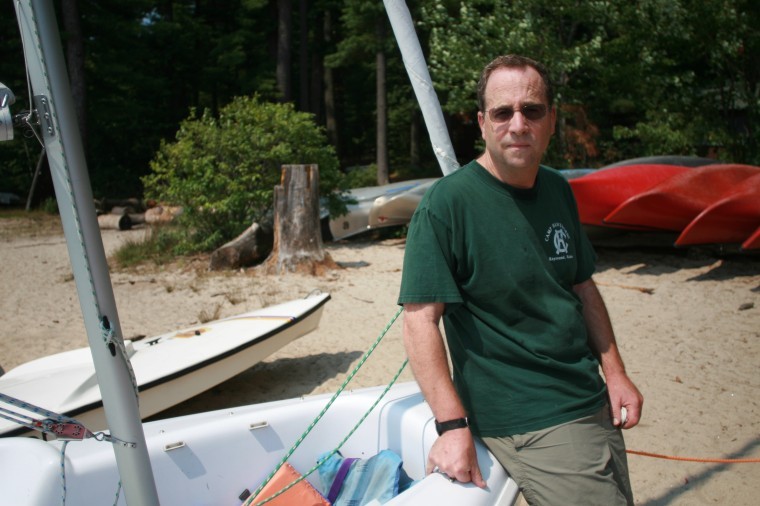 After 23 years running Camp Hawthorne in Raymond, Ron Furst has lost his lease. With camp activities both traditional and creative, parents said Furst helped kids of all backgrounds to develop maturity and self-confidence. (Staff photo by Ben Bragdon)
Comments are no longer available on this story